EKIP– Expert Club for Economics and Politics A Different Opinion

As the winter season approaches, the economic prospects are becoming increasingly bleak, both for Bulgaria and for the whole of Europe. Data show that gas storage facilities in the European Union are filled to relatively satisfactory levels and natural gas prices have started to decline. Recession, however, seems inevitable in a number of key European economies, led by Germany. Although the gross domestic product (GDP) recorded relatively good growth in the first two quarters of this year (4-5% on an annual basis), the economic prospects in Bulgaria are not at all bright. On the eve of a global economic crisis, it is of particular importance to clearly realize what the weaknesses of the Bulgarian economy are.
Long-term investments are collapsing, consumption is slowing down
The most worrying data is on fixed capital investment. This indicator is particularly important because it shows the level of new long-term investments – those that lead to increased productivity of the economy in the future. NSI data show that gross fixed capital formation fell by 7.7% on an annual basis in the second quarter, deepening the 5.7% decline recorded in the first. In addition, the contribution of this component to GDP fell to 16.2% in the second quarter of this year. This is the lowest level since 2001.
Meanwhile, short-term investments are rising sharply. The level of change in inventories, calculated as the difference between the level of gross capital formation and gross capital formation of fixed capital, rose by over 300% in the second quarter, after growing at an even more colossal rate of 774% on an annual basis in the first. The very values of the change in inventories in the first and second quarters of this year are at historically record levels (the NSI GDP data go back to 1995). All this shows that Bulgarian enterprises have begun to accumulate very large short-term inventories, at the expense of long-term investments. The most obvious reasons for this are economic uncertainty and galloping inflation, which hits producers harder than consumers, especially when it comes to the prices of some types of raw materials.
Chart: GDP growth and gross fixed capital formation over the last 3 years

Source: NSI
Galloping inflation is also starting to choke consumption. The GDP breakdown shows that household consumption grew by 4.5% in the second quarter, slowing from 5.8% in the first. This is the lowest growth in household consumption since the last quarter of 2020 – the period of the strictest lockdown during the pandemic. Retail sales data from the beginning of the year show a very clear downward trend.
The outlook for the near future is even more negative.
The outlook for the coming quarters is not better. Investment in fixed capital is likely to remain very low and will even fall further in the coming quarters, due to the overall worsening of the economic climate. Inflation remains very high and the energy crisis is likely to worsen in the winter months. At the same time, the European Central Bank is raising interest rates, which will lead to a tightening of lending by banks. Economic growth across the European Union is expected to slow down significantly, and the Eurozone itself is expected to enter a recession. The German economy minister said that he expects Germany itself, the engine of the German economy, to enter a recession by the end of this year.
This will have a very bad impact on Bulgaria, because Germany is the largest market for domestic exports, with a 15% share. And the contribution of net exports is already deeply negative anyway, mainly due to the rise in the price of key imported goods such as crude oil. NSI data show that the negative contribution of net exports to GDP was 10.6% in the second quarter, slightly down from 11.3% in the first. These are the most deeply negative values of net exports since 2008 - the time of the last severe global crisis.
In such a macroeconomic context, most businesses will be particularly cautious about any new long-term investments. The negative effect of the collapse in fixed capital formation will not be isolated, but will also affect other components in the long run. It will lead to lower economic productivity, lower income growth and, accordingly, a lower level of private consumption. In other words, the state of fixed capital investment at the moment shows us what the trajectory of other components and GDP as a whole will be in the future.
The state budget is in surplus, but not for long
With investment falling, private consumption slowing, and net exports contributing more and more negatively, what will sustain GDP growth? The only remaining component is government consumption. But the reality is that the government's fiscal position is already very weak and not at all prepared for a recession.
At first glance, everything seems fine. By the end of August, the budget was still in a fairly large surplus, with a cumulative value of about 1.7 billion leva since the beginning of the year. However, the surplus will evaporate very quickly in the last quarter of the year. A number of new expenditures voted in the budget update, such as the increase in pensions and the extension of energy subsidies for businesses, will cost the budget 3.6 billion leva in the period October-December.
The Ministry of Finance itself, in its latest monthly budget execution report, writes that the execution of expenditures for the first eight months of the year is 57.1%, which is “relatively low compared to previous years.” It also expects expenditures under the consolidated fiscal program “to increase in the coming months.” In conclusion, the ministry says that “the current budget balance under the CFP is not an indicator of the size of the budget balance in annual terms.” That is, the deficit will swell in the last months of the year.
The consequences of the failure of the capital program
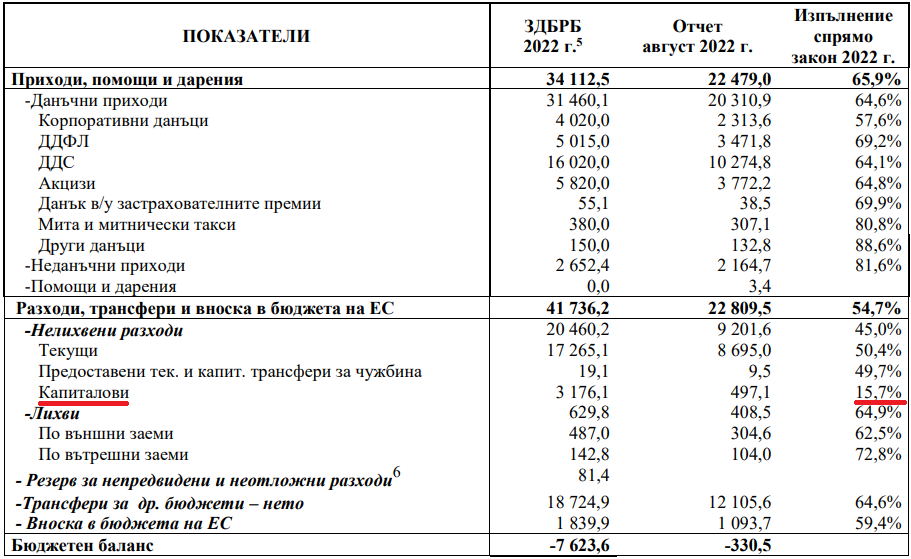
It is very important to emphasize that the main reason for the budget to be in surplus by the end of August is, above all, the extremely poor implementation of capital expenditures. The data shows that it is only 15.7%, which is an absolutely insignificant value. Again, as in each of the previous years, either there will be a huge concentration of capital expenditures at the end of the year, which is an extremely inefficient approach to the implementation of public investments, which also leads to a lack of sufficient transparency, or the failure to implement the capital program will feed a kind of fiscal “buffer”. Similar artificially generated “buffers” were often used during the years of GERB rule to feed politically convenient expenditures at the end of the year, and always in a scandalously opaque manner.
Table: Ministry of Finance data on the implementation of the state budget as of the end of August 2022.
Source: Ministry of Finance
In other words, the surplus that the budget records for the first eight months of the year is not a cause for pride. It is actually a symptom of a failure in the implementation of the capital program. Which failure in the current economic context is particularly painful because, as became clear above, of all the components of GDP, the most seriously lagging behind are fixed capital expenditures (long-term investments). The state's capital program should stimulate the generation of such investments, but how can this happen when it is practically almost not implemented? This failure directly contributes to the collapse in fixed capital investments in our country and their decline in contribution to GDP.
There is a risk of a fiscal crisis
A huge problem is emerging, as Bulgaria will face the economic crisis in Europe with a budget deficit. The low level of public debt as a percentage of GDP should not reassure us. In 2008, Romania's public debt was only 17% of GDP, but our northern neighbor is unable to finance its deep budget deficit. The debt markets simply do not want to buy Romanian debt and in early 2009 in Bucharest they are forced to ask the International Monetary Fund for help.
Today, Bulgaria is also starting to have difficulty placing government debt on the markets. On October 4, the reopening of a government bond issue with a maturity of July 27, 2026 achieved only a 0.75 coverage ratio, and that with a very serious increase in the average interest rate on the debt to over 4%. For reference - if the coverage ratio is below 1, it is considered that the debt issue has practically failed. In the next issue a week later, the coverage is better, but still very low - 1.15. The average interest rate rises further, to 4.47%. In this way, the financial markets are giving a very alarming signal that the interest in Bulgaria's government debt is already very low. The situation will most likely worsen if measures are not taken to reduce the budget deficit. And a state in which the state is unable to finance its budget deficit is called what? That's right - a fiscal crisis.