 EKIP– Expert Club for Economics and Politics A Different Opinion
 Russell Lamberti
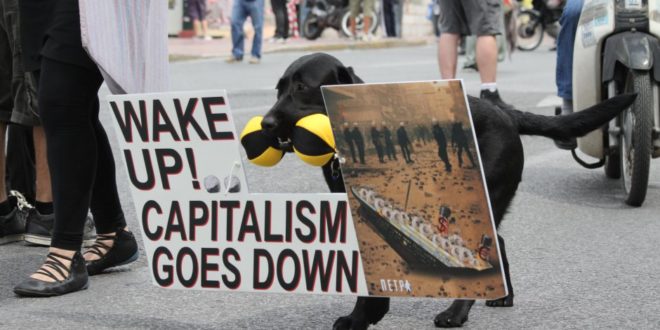
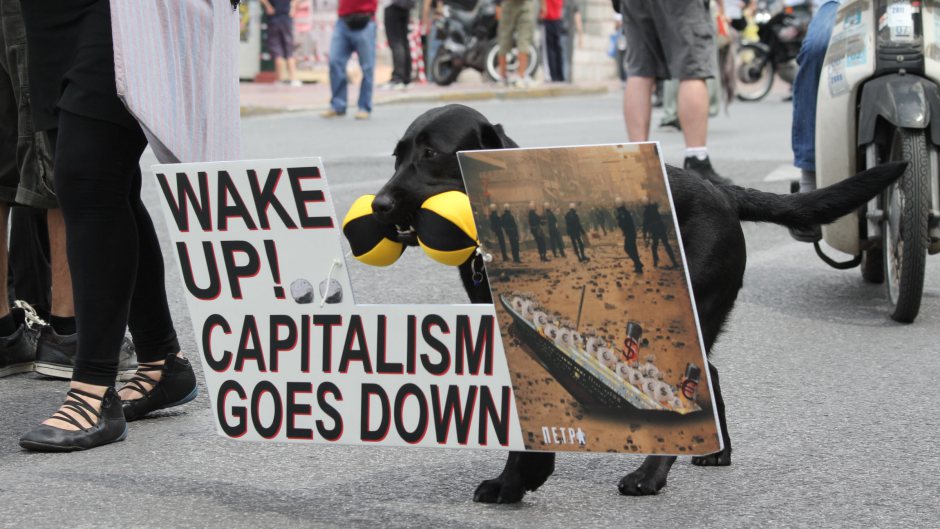
Today it is considered politically incorrect to criticize culture, but whether it uses euros or drachmas, whether it is in the European Union or not, Greece must somehow correct its cultural dysfunction. I am not talking about the customs of the people of the country, their traditions, their architecture, their music, and even less about their food. I am talking about their cultural anti-capitalism. Negotiations, treaties, counter-offers, referendums, protests, and all other actions will be almost meaningless if the Greeks as a whole do not free themselves from their statist zeitgeist and rediscover the exceptional Greek capitalism.
Argentina is a perfect example. A bankruptcy and a domestic debt crisis were supposed to propel the country in the sensible direction of pro-market reforms, as the folly of debt-addicted crony socialism was thoroughly discredited. That’s a nice theory. But thirteen years after its bankruptcy in 2002, and after years of high inflation, dollar shortages, and economic chaos, Argentines continue to elect ignorant, over-interventionist socialist overlords who are still ruining the country’s economy to this day. The reason for this is that the culture there has not changed. When the culture in a country is toxic, “up” means “down,” black and white, the collapse of socialism is presented as the failure of capitalism.
In Anticapitalist Thinking, Ludwig von Mises beautifully describes this cultural anticapitalism: “As John Doe sees it, all the new industries that provide him with goods unknown to his father were created by some mythical institution called progress. In his view, the accumulation of capital, entrepreneurship, and technological creativity have done nothing to bring about the spontaneous emergence of prosperity. Therefore, if any man is to be praised for what John Doe sees as the increase in the productivity of labor, it should be the assembly line worker. …”
The advocates of this view of capitalist industry are praised in universities as the greatest philosophers and benefactors of humanity, and their teachings are received with awe by millions of people who use radios and televisions (among other conveniences) in their homes.
The biggest risks for Greeks are not austerity or frugality [1], nor bankruptcy, the euro or the drachma. The country is certainly not most threatened by the specter of being removed from financial markets. The biggest problem facing the population remains its antagonism to free and unfettered markets and the chronic dependence on the state of large social groups.
Let’s look at another Latin American country: Venezuela. After creating destructive inflation in the 1980s and 1990s, in 1998 the electorate elected another central planner and inflationist, Hugo Chavez. They re-elected him in 2000, 2006, and 2012, and his successor, Nicolas Maduro, in 2013, even though the country was already in a deadly hyperinflationary spiral and on the path to economic collapse. Ultimately, Venezuela’s bigger problem is not [destructive] fiscal management, but an anti-capitalist culture.
The same goes for Greece. After the country secured a debt write-off and was effectively allowed to go bankrupt by rescheduling the remaining debt over the next 50 years at preferential interest rates (and after actually achieving economic growth in 2014 thanks to tax cuts and a small cut in the size of its sclerotic, bloated government), the toxic Greek culture in question took over again, and voters elected a pair of hard-line socialists who once again dragged the economy into the swamp. Of course, it doesn’t help that there is another set of central planners on the other side of the negotiating table – the EU, the IMF and the ECB. However, Greece is caught between the hammer and anvil of two different camps of central planners precisely because the country’s electorate is too busy fighting for “free” goods instead of freedom.
Most countries are in trouble, but some are better off than others
Any sovereign nation can start spending too much and get into financial trouble, and most countries have gone down that path. It wasn’t that long ago (in 1976) that Britain was forced to follow the IMF’s orders and surrender its fiscal sovereignty to that institution. By the second half of the 1970s, the country was in open chaos. America secretly defaulted on its international bonds in 1971 and suffered an inflationary crisis for the rest of the decade. But both countries recovered. As did Chile, Uruguay, and the Philippines after their fiscal and financial troubles in the 1970s and 1980s.
But other countries are not getting back on their feet, and I think that happens when the popular culture is or has become fundamentally anti-capitalist and people are en masse dependent on the state from cradle to grave. In addition to Argentina and Venezuela, politicians have led other countries into severe crises. Among them are Zimbabwe, Ghana, Bolivia, Nigeria, Russia, Turkey, and now the countries of southern Europe. The electorates in these countries do not seem to learn from their mistakes, as they seem unwilling or unable to find the lesson in the intellectual fog of their cultural zeitgeist.
But in reality the lesson is clear. An economic crisis can put a fundamentally pro-capitalist (or mostly pro-capitalist) society back on track, having lost its way. But there is no guarantee that it can recover if, at a cultural level, it has already fallen into infantile anti-capitalism, dysfunctional statism, and antagonism towards entrepreneurship and personal responsibility. For these individuals, the crisis may bring not recovery, but a longer and deeper crisis. Only a cultural change, driven by sensible ideas, can create in Greece (and in other southern countries) the fertile ground for the adoption of real solutions. The need to spread the good news of freedom and free markets is clearly extremely urgent.
Translation: Daniel Vassilev
The original text in English can be found here.
a culture shift resulting from the spread of sound ideas can make Greece (and other countries) a fertile ground to accept real solutions. The need to spread the good news of liberty and free markets is clearly as urgent as ever.
[1]“Fröksterittet” (“fraudulent austerity”) – an increase in government spending and taxes, which is intended to create the impression of a reduction in government payments, while in reality they increase – note trans.





please translate zeitgeist?
Zeitgeist means "spirit of the times." The term became popular after the release of a series of conspiracy films that are named that way.