EKIP– Expert Club for Economics and Politics A Different Opinion

For more than a year now, we have been conducting a very interesting experiment at EKIP. With the launch of the Virtual Pension Fund last year, we set ourselves the goal of illustrating what we mean when we talk about alternatives to the current pension system in Bulgaria. A system that, as you may know, we criticize extremely harshly. Because the state pension fund is practically bankrupt and if a comprehensive pension reform is not undertaken, pensions for young workers (like us) may not exist.
In this experiment, we have been monitoring the performance of three different investment strategies so far. As everyone who has signed up for the fund knows, 60% of the "virtual contributions" they make are invested in an average Universal Pension Fund from the Second Pillar of the pension system. In addition, an additional 30% is invested in an alternative investment strategy - the so-called "Permanent Portfolio" of the American investor Harry Brown - which is also a highly conservative investment, similar to pension funds. However, with the remaining 10%, we do the exact opposite - they are invested in the most speculative investment we can think of. And what better choice for such an investment these days than... Bitcoin?
In this article, we will present a report on how these three investments performed over the 13 months from May 2018 to May 2019. Those of you who have signed up for our Virtual Pension Fund receive monthly updates on the returns of these investments. This article is the annual version of that. First, let's start with a general comparison of returns.
What kind of returns do the three investment strategies bring?
The first graph below shows the dynamics of the average monthly return of Universal Pension Funds in Bulgaria from May 2018 to May 2019. In the table below the graph, you can see what return the sector achieved in each month of the period under review. The best month is January (2019), when the average return of Universal Pension Funds in the country was 1.10% compared to the previous month. On the other hand, the worst month is October (2018), when these funds lost an average of -1.64%. The average return for the entire period is 0.03%, and the median is -0.02%.

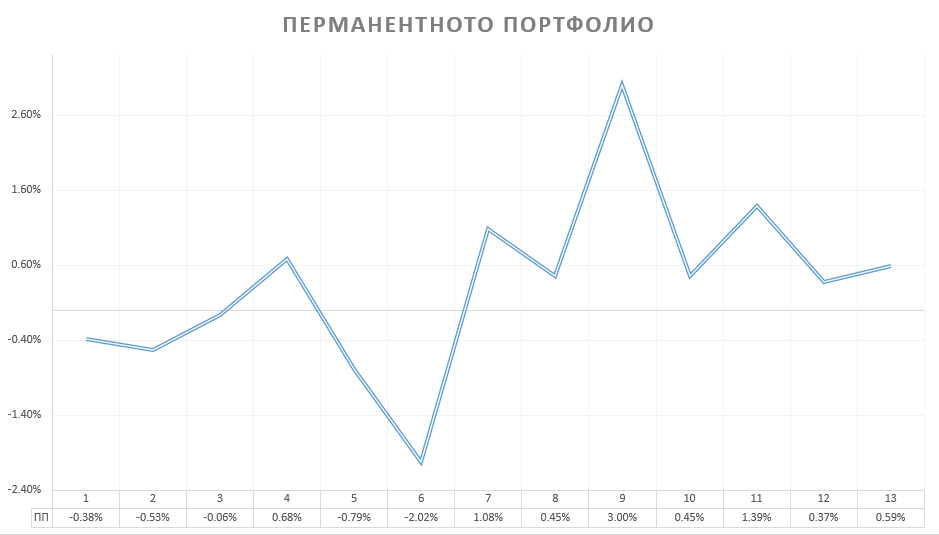
The second graph depicts the dynamics of the return of Harry Brown's Permanent Portfolio - the investment strategy that we at EKIP decided to adapt as "ours" within the framework of the Virtual Pension Fund experiment. In this strategy, the investor's money is distributed among 4 types of assets - 25% in US stocks, 25% in long-term US government securities (with 20+ years of maturity), 25% in gold, and 25% in short-term government securities (3 months of maturity, again in the US). The highest return this strategy achieved in January (2019) - 3.00%. The largest loss of -2.02% was reported in October (2018). The average return for the entire period is 0.33%, and the median is 0.45%.
And of course, the third graph depicts the dynamics of the Bitcoin price during the same period – the so-called speculative "show" investment, which we focused on due to the huge popularity of cryptocurrencies as a new alternative investment recently. As you can see, the variations here are much more significant. The most serious drop in the price was recorded in November last year (-32.57%), and the highest jump in the last month – May 2019 (53.20%). This huge volatility in the price of Bitcoin in such a relatively short period of time (about a year) emphasizes the riskier and more speculative nature of this investment compared to the investment strategies of the Universal Pension Funds and the "Permanent Portfolio". The average return on Bitcoin as an investment during the period under review is 2.36%, and the median is -5.15%.

Be careful with volatility
Comparing the dynamics of the three investment approaches, we see that the highest average monthly return is achieved by investing in Bitcoin. However, this higher average return goes hand in hand with extremely high volatility. The standard deviation (the most basic indicator of the level of volatility of an investment) of the Bitcoin price during the period under review is 0.19. For comparison, that of the average return of Universal Pension Funds is 0.007. A huge difference. The standard deviation of the return on the Permanent Portfolio is somewhere in the middle – 0.012.
In the field of investments, the pattern between higher returns and higher volatility has long been established, so there is nothing surprising in this data. Especially in the short term, if we are looking for higher returns, we will most likely have to endure higher volatility. However, data on average returns can be misleading, so we should also look at the median data. There we see that the Permanent Portfolio presents the highest median return of 0.45%. On the other hand, Bitcoin, which otherwise has the highest average return, records the lowest median return of -5.15%. This is due precisely to the extreme volatility in its price.
Bitcoin
The price of Bitcoin falls in 7 of the 13 months under review, and sometimes at quite significant rates (by over 32% in one of the months under review). That is, in most months, the investment in Bitcoin loses money. However, these losses are most of the time offset by the larger-scale profits made during the rest of the time. In this case, the last month of the period (05.2019) is actually key. Without this month, the investment in Bitcoin is losing. With it, it is profitable. For example, if you had invested 1000 BGN in Bitcoin at the beginning of 05.2018 and sold at the end of 04.2019, you would have lost 123 BGN, i.e. -12.3% But if you had sold at the end of 05.2019, you would already be making a profit of 344 BGN, i.e. 34.4%. This makes Bitcoin an extremely speculative investment – one month you can make a big profit, another a big loss.
This type of volatility can be very dangerous for people who are close to retirement age and therefore do not have the time to compensate for serious short-term losses. On the other hand, younger investors can much more easily undertake such volatile investments, because there is a much greater probability that they will be able to compensate for short-term losses (even very large ones) with profits in the long term. Simply because their long-term plan is longer than that of older investors before retirement. Some have 30-40 years of remaining investment horizon, while others no more than 10.
Universal pension funds
With Universal Pension Funds, we see the other extreme. There, as we have already mentioned, volatility is the lowest. However, the yield is also the lowest. If you invested 1000 BGN in the average [1] pension fund at the beginning of 05.2018 by the end of 05.2019 you have earned nearly 4 BGN, which is equal to 0.4%. Interestingly, this profit actually appears only in the last two months of the period under review. From 06.2018 to 03.2019, the investment in the average Universal Pension Fund is constantly at a slight loss of 2 to 20 BGN, varying according to the profit or loss realized by these funds in different months.
Don't forget that Universal Pension Funds also have entry fees on each monthly contribution, which was 4% in 2018, and this year it is 3.75%. To this we must add the annual management fee, which is 0.8% in 2018 and 0.75% in 2019. If we subtract these fees, it turns out that for the period under consideration, the average Universal Pension Fund would not have brought profit, but on the contrary – a loss. Of course, there are also some transaction costs when trading Bitcoin, but they are lower than 4 percent of each monthly investment. And even if they are as much or even higher than the costs of fees in pension funds, the final profit of 34.4% certainly manages to compensate for them.
The permanent portfolio
Ultimately, however, we find the golden mean with Harry Brown's Permanent Portfolio. It realizes noticeably lower volatility than Bitcoin, but also noticeably higher profit than pension funds. This investment portfolio realized a loss in only 5 of the 13 months we are considering. In addition, if you invested 1000 leva in this portfolio at the beginning of 05.2018, by the end of 05.2019 you have realized a profit of 42 leva, i.e. 4.2%. As you can see, significantly higher than the profit in pension funds at similarly low levels of volatility. We recall that the standard deviation of the monthly return of the Permanent Portfolio is 0.012, and in pension funds 0.007. The difference is relatively insignificant - only 0.005 points.
The biggest trick in investing is precisely the balancing between the volatility of a given investment on the one hand and its profitability on the other. Remember – usually investments with higher profitability are more volatile and vice versa. The trick is to balance the investments in our portfolio in such a way as to find the golden mean in which we achieve the highest possible profitability, with the lowest possible volatility. In the three investments we have examined here, this golden mean is achieved by the Permanent Portfolio. At the other two extremes of very low volatility, but also very low profitability, and of very high profitability, but also very high volatility, are pension funds and Bitcoin, respectively.
This achievement of the Permanent Portfolio is due to its balance of 25% stocks, 25% long-term US Treasuries, 25% short-term government securities and 25% gold. This is a very conservative investment strategy, which, however, achieves higher returns than Universal Pension Funds because it is more diversified and more adequately balanced than theirs, which focus excessively on stocks and debt instruments of European companies and countries.
Some conclusions
Don't think that the above makes the Permanent Portfolio the best possible investment strategy. There is no such thing as a "best investment strategy" that applies to absolutely everyone. Because every person is different, they are in different circumstances, have different opportunities, and accordingly their risk profile is also different. Take for example the most basic variable - age. What is a good investment for a 25-year-old is not the same as what is a good investment for a 55-year-old man, even if we assume that their circumstances are identical in every other respect.
Remember that the Virtual Pension Fund data presented here is extremely short-term. An investment strategy should never be evaluated based on short-term one-year returns alone. Never. What the intelligent investor should be interested in is the long-term potential of the strategy. So let's not overstate the importance of the above data. It gives us some comparative insight into how Universal Pension Funds perform compared to alternative investment strategies, but it is quite limited. The long-term picture is more important.
Overall, however, from the Virtual Pension Fund experiment so far we can draw two main conclusions. First of all, something that is actually clear from the very beginning – any investment is better than the state pension fund where your money just sinks, spent at the moment on the pensions of current retirees. There your loss is 100%, always. Then you just hope that when it is your turn to retire there will be enough workers to support you, as you are doing right now. In this sense, even the second pillar with the Universal Pension Funds is a better investment.
Secondly, our experiment so far shows that at first glance the Second Pillar of our pension system has splinters to deal with. This is also not a discovery. We have written and spoken in the media about the problems of private pension funds in the Second Pillar before (for example here and here ). The easiest reform in this area is to lower the levels of fees. But the most important thing is to carry out a comprehensive regulatory reform that would give pension funds more flexibility in terms of the products they offer (for example, to create a multi-fund option for clients with different risk profiles) and open the sector to more competition.
In the meantime, we will continue our experiment with the Virtual Pension Fund. If you haven't signed up for it yet, you can do so here. And of course, we will continue to fight with all our might to push through the necessary reforms in our pension system. No matter how much politicians may not like it. Because ultimately, what is at stake is our future and that of our children.
[1] Please note that the yield we present for Universal Pension Funds is an average of the yield data for all funds in the sector. That is, in practice, some funds have achieved higher yields than this, and others lower.