 EKIP– Expert Club for Economics and Politics A Different Opinion
During my meeting with Ibrahim Al Muhana, the chief advisor to the Saudi Arabian oil minister, I saw that the book on the desk in front of him was “The Quest” by one of the great energy analysts - Daniel Yergin. His spacious discussion on hot topics in the world energy sector often revolves around the growing popularity of the “gas revolution” and the decline of oil. I wondered if this was what Mr. Muhana was thinking about in the minutes before he told me how Saudi Arabia continues to be the world oil leader and that we can be sure of this for the foreseeable future. I was even told that if oil is really running out, then the last barrel will certainly be Saudi.
The insistence that everything was fine and that the Kingdom was stable both politically and economically betrayed a certain amount of uncertainty. Saudi Arabia still holds nearly a fifth of the world’s conventional oil reserves (265 billion barrels), surprisingly undiminished despite production of about 3.5 billion barrels per year. In 2012, the country was also the world’s largest producer of oil and natural gas liquids (NGLs), with a daily average volume of 11.53 million barrels. Exports even reached a record 7.5 million barrels, in line with the Saudi cause to replace lost Iranian and Libyan volumes. So why the unnecessary stress?
The head of the snake
The Kingdom’s fear stems from the volatile geopolitical situation in the region and the changes in international energy markets. In the quicksands of the Arab Spring, the Saudi government is gripped by paranoia. In neighboring Bahrain, protests are continuing (the media simply cannot get enough to cover the events), and the civil war in Syria threatens to spiral out of control and into a regional conflict between Shiites and Sunnis. In such a war, the Kingdom will almost certainly be drawn in, and the fear that the United States might decide to stay out makes it shiver. As it did in late October when, in a surprise move, the country withdrew from its long-sought membership of the UN Security Council in protest that the organization could not effectively deal with the Syrian crisis. The panic continued when the US and Iran suddenly began a diplomatic thaw just months after weapons were being rattled in the Gulf, and the Kingdom was rubbing its hands contentedly at the thought that America would "cut off" the head of its Shiite enemy[1].
US Secretary of State John Kerry rushed to Riyadh this week to try to calm things down. It’s not hard to guess what King Abdullah demanded during the meeting: a firm continuation of sanctions on Iran (they are lining the coffers of Saudi Arabia, which has suddenly replaced China as the main oil supplier) and the initiation of concrete actions against Assad in Syria.
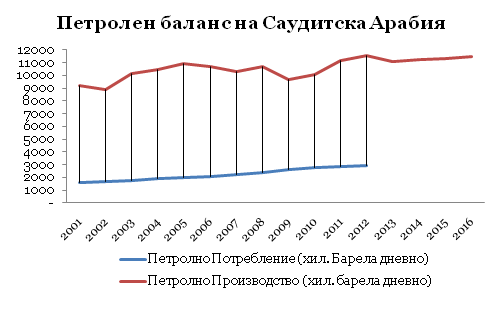
And there is a third issue that is plaguing the Saudis – the US has dramatically increased its shale oil production in the past few years, reducing the need for imports. Saudi Arabia is currently exporting between 400,000-500,000 barrels per day less to the US than at its peak in 2003 and 2004, or about 1.36 million barrels per day at the end of 2012[2]. The share of North American supplies in the Kingdom’s export portfolio has been declining and is now around 16%. Asia accounts for more than 50% of the country’s total oil exports, and this share looks set to grow. The problem is that countries like China do not want to be dependent on supplies from the Gulf, as they cannot afford the risk of a possible blockade of the US fleet in the Indian Ocean. It is no coincidence that China National Petroleum Corporation produces a quarter of Kazakhstan’s oil and has built a pipeline connecting Kazakhstan to China with a capacity of 20 million barrels per day. tons per year, which could double after the completion of the second part of the project. By taking advantage of its geographical proximity to Central Asia, China is diversifying its energy supplies and at the same time increasing its influence in Russia's traditional "backyard". Saudi Arabia will have to look for new customers, but with increasing competition from non-OPEC countries, which are playing an increasingly important role in international oil markets.
Internal uncertainty
While the external turmoil has not yet directly affected Saudi Arabia's security, the future inside the country looks bleak. King Abdullah, 89, has undergone several surgeries since ascending to the throne in 2005, the last in December last year. His successor, Prince Salman, is 76 and also not in perfect health. This calls into question the stability of the Saudi throne, given that the heir apparent is running out of time and King Abdullah's liberal reforms have not a few enemies at home. The Arab Spring in the region has heightened concerns that the discontent could also affect the Kingdom. Tensions are already being felt in some cities in the Eastern Province, which is predominantly populated by Shiites.
Far more obvious are the country’s energy problems, which could undermine overall economic stability in the long term. In 2012, Saudi Arabia consumed a quarter of the world’s oil production, or 2.94 million barrels, nearly doubling its daily consumption in just over 10 years.[3] At the same time, oil production has remained relatively constant, despite senior officials claiming that Saudi Arabia actually has an additional production capacity of 2.5 million barrels per day. Independent analysts cannot confirm that the additional capacity exists because there is no objective, external assessment of the Kingdom’s oil reserves. The development and expansion of giant fields, the world’s fifth largest, Manifa (900,000 barrels per day), and the largest offshore, Safania (1.2 million barrels per day), has brought some relief to the oil industry, as it is believed they will provide heavy crude for power generation, freeing up more light crude for export. However, this is unlikely to help the country’s overall dependence on cheap oil for subsidized transport fuel, power generation and petrochemical derivatives.
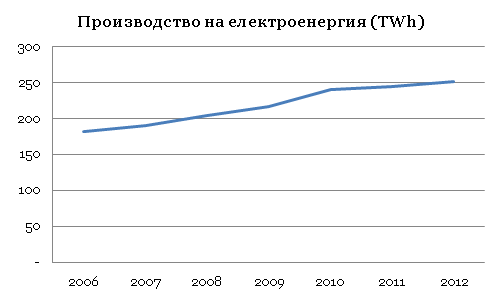
According to a Citigroup analysis last year, Saudi Arabia could become an oil importer by 2030, as it powers more than half of its electricity generation with crude oil, while electricity consumption has grown by 8% each year over the past decade.[4] This trend is unlikely to change when you consider the country’s young population, huge energy subsidies and notoriously low industry efficiency. On the other hand, the country’s rapid economic growth has naturally been matched by higher consumption, which in most years has outpaced average income growth.[5] Meanwhile, figures for the natural decline in production at some of its largest fields, including the world’s largest, Ghawar, vary dramatically. While Platts estimates the decline to be between 6-8%, the Ministry of Oil admits to a drop of no more than 2-3%, which sounds unlikely given the age of most of the country’s fields. So without giant new discoveries of new deposits, Saudi Arabia will not be able to maintain similar levels of production in the long term.
The solutions
The government is not sitting idly by and watching the country’s energy problems. The state-owned giant, Saudi Aramco, is investing billions in exploring new fields and improving the extraction of existing fields. To reduce its dependence on oil consumption, the exploration and development of the country’s gas fields is on the agenda. So far, only 15% of the Kingdom has been explored for non-associated gas (which is not extracted as a by-product of oil production), but the potential is there. Offshore , the country has launched the giant Wazeet program, which includes the two gas fields, Arabia-Hazba. Their development followed the commissioning of the giant gas field, Karan, which produces an average of 18.5 billion m 3. Great hopes, however, lie in Saudi Arabia’s unconventional gas reserves, which according to the EIA are the fifth largest in the world. Most of them are located in the northwestern part of the country and in the deep waters of the Red Sea.
The share of gas in the country's total energy consumption is already more than 40%, with the goal of natural gas catching up and surpassing oil as the main fuel in electricity generation and the chemical industry. The problem is that there is currently not enough gas for this purpose. Saudi Arabia produces exactly as much as it consumes, with gas consumption constantly increasing without predicting where the new quantities will be obtained. The quantities of associated gas depend on oil production, but with the trend of falling prices on international markets, it is more likely that Saudi Arabia will limit its production in the future to maintain levels of around $100 per barrel. From a gas perspective, this means finding new unassociated deposits and developing them quickly. At current domestic, subsidized gas prices of $0.75/MMBtu, international companies do not have the money to invest billions in exploration and development, as the investment return is minimal.
Saudi Aramco, as a state-owned company, has a social responsibility to undertake the exploration, but this requires modern technology and experience, which the company still lacks. The more serious problem, however, is the lack of political will to transform the country's energy balance, to introduce strict energy efficiency standards, and to gradually eliminate fuel and electricity subsidies, at least for households.
Conclusion
But a population accustomed to being dependent on the state and taking energy benefits for granted will find it difficult to accept a lower standard of living. In a climate of unprecedented civil discontent in the region, it is particularly risky for the royal family to begin the much-needed energy reforms. And so all eggs are put in one basket – the hope is that the price of oil will continue to be at levels above $100, and the recovery of the world economy will push consumption up again. However, both the price of oil and economic development remain quite uncertain. In such an uncertain situation, Saudi Arabia must begin to adapt to the changing environment. Geopolitically, the Kingdom can no longer count on full support from the United States, which the Kingdom simply does not need that much. The country will have to fulfill its political ambitions in the region on its own and will have to confront its enemies on its own. One thing is certain, however, that the global energy balance continues to depend on the stability of Saudi Arabia. Without an adequate solution to the Kingdom's foreign policy uncertainties and a rethinking of domestic economic priorities, Saudi Arabia can hardly remain an island of calm amidst the Middle Eastern storm that has been raging for more than 2 years.
*The article is provided by the Information Bulletin published by the Center for Studies of the Balkan and Black Sea Region.



"In neighboring Bahrain, protests are continuing (the media simply cannot get around to covering the events), and the civil war in Syria threatens to spiral out of control and into a regional conflict between Shiites and Sunnis. In such a war, the Kingdom would almost certainly be drawn in, and the fear that the US might decide to stay out of the picture makes it shiver."
Unfortunately, any attempt to buy new equipment for the Bulgarian Army will be met with a knife by the right. If tomorrow it is said "let's buy a set of Patriot air defense systems for $200 million," they will immediately start spitting that we don't need an army.