 EKIP– Expert Club for Economics and Politics A Different Opinion
In the months since the annexation of the Crimean peninsula, Russia's policy has shifted significantly. The country has been visibly trying to reduce its dependence on Western markets and cushion the economic damage inflicted by mounting sanctions against key Russian companies and individuals, including the Volga Group companies close to Vladimir Putin's regime, the energy companies Stroytransgaz and Chernomornafotgaz, the banks Bank Rossiya and SMP Bank, and individuals such as businessmen Arkady and Boris Rotenberg, energy tycoon Gennady Timchenko, and many members of the administration.
What has happened so far?
One of the key events symptomatic of Russia’s attempts to distance itself from Western markets in recent months was the signing of a deal to supply natural gas to China over the next 30 years, worth a total of $400 billion, up to a full volume of 38 billion cubic meters per year. Although East Asia is not in a position to provide a complete alternative to European markets and absorb all of Russia’s fossil fuel production, the deal is a clear sign of the Putin administration’s intention to seek rapprochement with the BRICS countries and other “emerging” economies.
A similar function is served by the agreement signed a few days ago with Iran, according to which Russia will buy Iranian oil and possibly food for the next five years. This agreement may prove to be key in the context of Russia's recent ban on the import of agricultural products from countries that have imposed economic sanctions on it, but it is certainly a sign of the country's intentions to seek rapprochement with its eastern and southern neighbors.
In May, one of the key goals of Russia’s Eurasian doctrine was achieved – the Eurasian Economic Union was created, which is designed to integrate the countries of the post-Soviet space on a model similar to that of the European Union. At this stage, only Russia, Belarus and Kazakhstan are members of the union, and the signed treaty only implies free trade and some regulatory unification, but not the creation of a single political authority. Despite the relatively modest scope of the agreement so far, according to Russian authorities, Armenia and Kyrgyzstan are also close to joining the union, and it is a matter of time before more significant political integration begins to be discussed, which would turn the Eurasian Union into a real “alternative” to the EU.
The other tool that Russia has signaled it intends to use in its growing confrontation with the West is the BRICS club of “developing” countries. A significant step in this direction was the agreement to create a BRICS investment bank that would duplicate the functions of the World Bank and the International Monetary Fund in the developing world. Although the bank has a relatively small initial capital of US$50 billion compared to that of other global financial institutions, the BRICS intend to increase it significantly in the years following its creation, and its ultimate goal is to reduce Western influence, exerted through the IMF and the World Bank, and replace it with influence and policies proposed and imposed by the BRICS.
Symptomatic of Russia's future political course are the repeatedly repeated intentions of many large Russian companies and banks to increasingly limit the use of dollars in their international transactions, and instead operate in rubles and yuan. The goal of this move is once again to maximally limit the influence of the United States on the Russian economy, and for the ruble/yuan (or a future common currency of the BRICS?) to become a new reserve currency.
The last significant sign is the significant rearmament and modernization of the Russian army in recent years; its capabilities were witnessed in the lightning annexation of the Crimean peninsula and the subsequent hostilities in Eastern Ukraine [1]
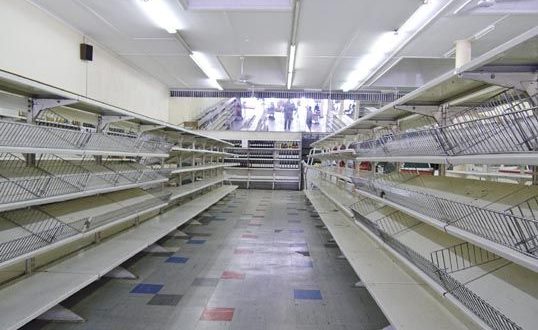
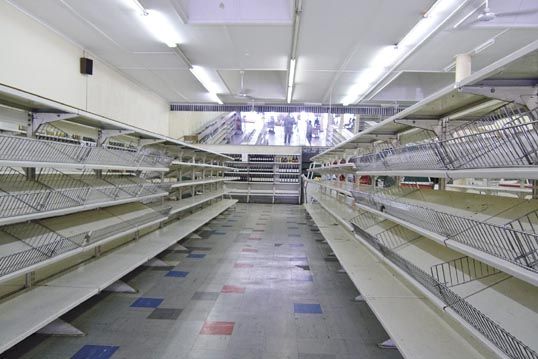
Empty stands
The latest move by the Russian government in response to the West’s tightening sanctions was to impose a reciprocal embargo on a number of food products and ingredients. This is the clearest and most unequivocal economic confrontation since the beginning of the Ukrainian crisis, which comes after a number of Western European companies have already reported significant losses as a result of the sanctions imposed on Russia.
But many joke—and rightly so—that Putin’s administration has successfully imposed sanctions on its own people this time. Days after the measure was introduced, journalists published lists of many foods that had disappeared from the Russian market and would not reappear until the embargo was lifted.
Russia is the world's fifth-largest food importer, after the EU as a whole, the US, China and Japan. In 2012, Russia imported $39 billion worth of food, much of it from the West. It is difficult to assess at this stage how much the embargo will restrict access to food in Russia, especially since most imported goods are considered "luxury" on the Russian market, and the authorities swear that boosting domestic production and increasing imports from South America and Asia can fill the gaps left by the blockade of Western imports.
For this reason, the food embargo is starting another game of nerves. It is not known whether the governments of the EU (which even promised to compensate companies suffering from the blockade) and the US will be the first to succumb to the pressure of their disgruntled producers, or whether the cup of patience of the Russian people will overflow this time when a number of goods disappear from stores.
Judging by public opinion polls in Russia, the second option is unlikely. The introduction of the embargo has even raised President Putin's already cosmic approval rating to a record 87%, and carefully cultivated patriotic fanaticism would most likely make Russians support the administration even if only black bread and potatoes were left on the shelves. The legislation introduced over the past few years, in turn, allows the regime to easily and effectively deal with any civil opposition and maintain its starchy high approval ratings.
Conversely, in the EU and the US, disapproval of sanctions is growing more and more, and it is quite likely that when considering the next round of restrictions, manufacturers will wage open war against Western governments.
Now where to?
We can safely say that the situation in the events that many define as the “Second Cold War” is hopeless. Through trial and error, the West has found that economic sanctions, used as a universal tool for pressure in international relations in recent decades, in the case of Russia do not lead to the desired results. On the contrary, it turns out that they cause significant damage to the economies of the countries that impose the sanctions and attract significant disapproval.
A ray of light could come from the fact that Vladimir Putin is unable to fully rely on his allies. At this stage, the BRICS countries are not committed to firm support or opposition to the new Russian political course, and if they decide to oppose the Putin regime, it will find itself in almost complete isolation. Thus, the country's economy will gradually return to its state from the first years after the collapse of the USSR. Already in the first months after the annexation of Crimea, forecasts for the growth of the Russian economy were recalculated to 0.2% for 2014. At the same time, foreign investment in the country is progressively decreasing - forecasts are that direct investment will decrease to 50% of its 2013 levels by the end of the year. Moreover, the mechanical replacement of one importer of certain products with another almost never leads to the preservation of the previous price/quality balance - i.e. Even if politically convenient sources of embargoed foods are found, they are unlikely to be able to fill specific market niches completely.
It is far from certain whether, in the conditions of an increasingly slowing and lagging economy, the state leadership will be able to maintain the enormous approval it enjoys today in the long term. If Russia manages to win the support of the other members of the club of developing countries and gradually finds new markets for its fossil fuels, there are no visible political obstacles to continuing the sharp confrontation with the West.
The EU, for its part, must make a decision, as the continuation of the confrontation with Russia will sooner or later require a reorientation towards alternative sources of natural gas. As long as there is currently significant political will to diversify supplies, this is far from impossible, but it will take considerable time and effort at a time when European economies are barely shaking off the effects of the economic crisis.
In the event of this "worst case scenario" developing, the international system will once again be reduced to a state close to a cold war, with all the imaginable and unimaginable consequences of this.
[1] I will not dwell in detail on the capabilities of the new Russian army here. More details at https://ekipbg.com/tryabva-li-da-se-strahuvame-ot-rusia/


Dear author.
Ridiculous analysis. Not backed up by elementary economic data/facts.
I stopped reading after the "incredibly intelligent" conclusion that the deal with China was a reorientation...it's unlikely to be super profitable.
Let's just think about whether Germany would refuse such a deal:
1. Price - $350.00 (below the price for the last 5-6 years in Europe by about 20%). 2. Construction of extraction and transit infrastructure, but with German companies. 4. Price guarantee (although, as people have said, contracts with Russia are not even worth the price of production and..........
Regarding the inaccuracies below, it seems to me that you used "Google Translate", etc....for example, compare the GDP of Europe and Russia, and the trade turnover between the two as a whole for Europe.
The article is so poorly crafted that I would be ashamed to post it on a blog like this.
NIKI
p.s. op, so as not to confuse you, also look at the Gazprom report (it is there, but not in Bulgarian), but use "google translate" ... and you will see something interesting, such as that over a third of gas and oil production is through fracking technologies. You remember where they got these technologies from and what embargo Uncle Sam imposed on them