 EKIP– Expert Club for Economics and Politics A Different Opinion
The international system has changed significantly in the past two months. The reason for this was the Russian Federation's bid to regain the status of regional hegemon in Eastern Europe that it lost two decades ago. The method chosen for this is reminiscent of the redistribution of the Old Continent around the two world wars and the creation of the USSR - a military attack supported by "internal forces" being prepared in Russia itself, which would serve as a justification and casus belli.
As a result, surrounding countries significantly changed their policies towards their large and once again aggressive neighbor. While the Baltic states and Poland called for a stronger NATO presence in the region to deter possible future violence from Russia, others – the autonomous Moldovan region of Transnistria, for example – welcomed the new Russian expansion.
Having lost the Cold War arms race, until recently everyone considered the Russian army weak and incapable. It is clear that today the Russian government is much more confident in the capabilities of its army than it was a decade ago. And rightly so – in recent years the Russian state has invested significant funds in the modernization and improvement of its armed forces, and these investments are starting to pay off.

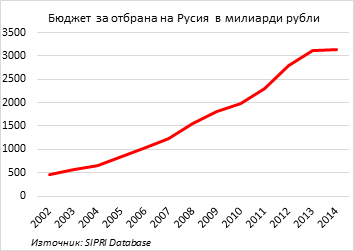
According to data from the Swedish Stockholm International Peace Research Institute, over the past ten years the country's military spending has been steadily increasing, with the total jump for the period being approximately 6 times – from under 500 billion rubles in 2002 to over 3 trillion in 2014. Forecasts indicate that this trend will continue in the coming years. At first glance, it seems as if the Russian state has been intensively preparing for the events of the past few months.
This assumption is partly true. While the country's defense spending has been increasing in absolute terms, considering it as a percentage of the country's gross domestic product paints a much different picture. The country has been experiencing quite rapid growth over the period under review, and in this sense, the increase in military spending is not an anomaly compared to other government spending; on the contrary, from the beginning of Vladimir Putin's rule until 2008, the share of defense spending has been decreasing significantly.
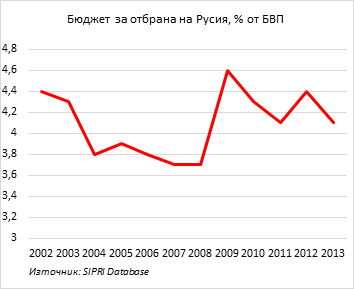 The change in doctrine came after the 2008 war between Georgia and Russia, in which, despite its victory, the Russian army suffered significant losses, caused mainly by outdated equipment and insufficient training of soldiers. It was only after this conflict that the Russian government began to invest significantly more in defense, which in turn led to the significantly improved capabilities of the Russian army that we witness today.
The increase in spending is being translated into investments in military equipment and personnel not seen since the end of the Soviet War. According to estimates by the Russian Ministry of Defense, by 2020 the country’s standing army will have reached 1,000,000 soldiers, most of them with new, modern equipment. The army will also be augmented by 2,300 new tanks, 1,200 aircraft and helicopters, 50 new ships and 28 submarines, including 10 Borei-class nuclear submarines armed with intercontinental ballistic missiles.
It is not known what the future of the armaments program will be. The goals set by the Russian government are calculated on an annual economic growth of at least 3.5-4% per year. However, to the extent that the crisis in Ukraine served as a demonstration of the new “powerful” Russian foreign policy, the annexation of the Crimean peninsula has isolated the country and in the future the West will most likely continue to impose increasingly severe economic sanctions. A few days ago, Economy Minister Anton Siluanov announced that the growth forecast for 2014 had been recalculated to 0.5%, and in an “optimistic set of circumstances” i.e. it is quite realistic to expect something close to a recession
If in the future Russia decides to repeat the Crimean scenario in any of the other territories inhabited by Russians, its isolation will deepen, which will inevitably affect the economy's ability to support the country's army. Paradoxically, maintaining an aggressive and expansionist foreign policy will most likely deprive Russia of the tools necessary to conduct it.
However, the question “should we be afraid of Russia?” has no clear answer. No one expected Vladimir Putin to react so sharply to the political crisis in Ukraine and to come to the aid of the “threatened” Russians in the country, and it is possible that his future moves will be just as unpredictable. The only visible obstacle to the continued projection of Russian interests into Eastern Europe by force of arms is the ability of the Russian economy to withstand isolation from the West. If Russia’s economy proves to be more resilient than it seems today, there are no visible limits to the Kremlin, supported by an increasingly well-armed and trained army.




One comment
Pingback: Quo vadis, Russia? – EKIP – expert club for economics and politics