 EKIP– Expert Club for Economics and Politics A Different Opinion

The short answer to the question in the title is "nothing", or at least none of the goals that European central bankers declare to the public. But before that, let's take a look at the details of the decisions. At its last meeting on September 4, 2014, the board of the European Central Bank (ECB) took several measures that many analysts later described as a surprise to the markets - the latter can be confirmed by the decline in the euro that followed the announcement of Mario Draghi's press conference. Here is a brief summary of what the ECB decided one day after "Super Mario's" birthday:
- A reduction in the three main ECB interest rates by 10 basis points each. So, currently the main ECB interest rate is 0.05%, the interest rate on deposits that commercial banks can "park" in the central bank's vaults fell to -0.20%, and the interest rate for extraordinary liquidity operations of the central bank decreased to 0.30%. Draghi said at the press conference that these interest rates will not be lowered any more, but we have heard this lie from him before;
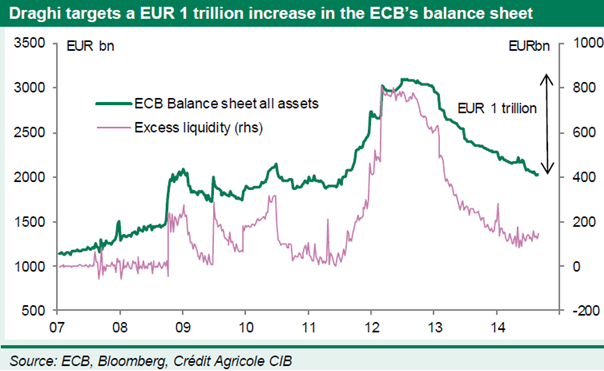
- Launching a program for the purchase of financial instruments backed by a specific asset (Asset backed securities or ABS and Covered Bonds for short). The first operation will start in October, but the size of the program is not yet known. In addition, legislative changes are expected in the field of this type of financial instruments. During the press conference, Draghi said that he wants the ECB's balance sheet (assets) to reach the peaks of 2012, which is about 1 billion euros more than at present (see Chart 1). In early June, the ECB announced that the new program for providing liquidity to the banking sector in the euro area, Targeted Long-term Refinancing Operations (TLTRO), will start in September, which will replace the already outdated and soon maturing LTRO, in order to stimulate lending. The increase in the ECB's balance sheet will be carried out through TLTRO and purchases of ABS and Covered Bonds, with the first expected to be at least 500 billion euros. euros, which means that the new program will have a maximum size of 500 billion euros as well, although some analysts predict the size to be more around 200 billion euros.
Graphics 1
- Through the measures taken and the comments during the press conference, Draghi "managed" to lower the price of the euro against the dollar to an over one-year low, which is good news for politicians in the euro club countries with a socialist mentality such as France and Italy;
- The decisions taken by the ECB board members were not unanimous, with some bankers wanting to do more (QE perhaps?), while others opposed the measures taken (most likely the "hawks" on the board in the face of the countries in Northern Europe). But since the ECB remains the only major central bank that does not publish minutes of its meetings, we will have to be content with the information provided during the press conference;
- The ECB has revised down its forecasts for eurozone growth (how unexpected) and consumer inflation. The slowdown in economic growth in the eurozone is already evident, with quarterly growth in the second quarter at 0%, and major economies such as Germany and Italy even registering a decline. Regarding inflation, Draghi said he is not worried about deflation, but not because deflation is not a bad thing, but because he does not expect consumer prices in the eurozone to enter negative territory;
- It is also worth noting the dose of reason in Draghi's words, who said that the monetary measures adopted by themselves will not lead to a significant result if the countries in the eurozone do not continue (and when did they start?) to make structural reforms. Alas, it is unlikely that any politician will catch anything from these words against the backdrop of the bazooka of monetary stimuli provided by the ECB.
The aim of the measures taken by the ECB is to stimulate lending in the eurozone, which will set the wheels of growth in motion. It is interesting how exactly lending seeks to solve the problem created in the years before the Great Recession precisely by excessive lending, but let's leave this issue aside and see what the measures taken by the ECB will lead to:
- The reduction of the three interest rates is marginal and is unlikely to have a significant effect. In addition, this mechanism for conducting monetary policy in the eurozone has not had a significant impact on financial markets for a long time, although there may be slight decreases in bond interest rates. Increasing the “penalty” for banks through a negative deposit interest rate will not make financial institutions start withdrawing their money from the ECB (which is already a negligible amount) and lending, since lending itself depends on many factors. When there is high corporate debt, banks with very bad loans on their balance sheets (the real amount of which is much higher than what appears in the reports), the opportunity to make easy money by taking out cheap loans from the ECB and investing this money in government bonds, and businesses that do not want to take out loans because there are not enough good projects in which to invest them, then lending will naturally not occur. This is also the case in the eurozone;
- There are still many question marks about the ABS and Covered bonds buyback program. Regarding ABS, the market in Europe is relatively small at the moment and the legislation is yet to be changed. In addition, it is not clear what asset bombs the banks will hide under these well-equipped financial instruments. Doesn't this sound familiar?
- A cheap euro may help some exporters, but what will happen to consumption once households have to pay more for imported goods? What if an exporter imports most of its raw materials from markets outside the eurozone? Overall, the only sure result of a cheaper euro is poorer Europeans;
- Regarding economic "growth" in the eurozone - another recession in the currency bloc is most likely coming, which will be marked as something completely unexpected by European politicians when it occurs. After all, the latter have recently once again started claiming that everything bad is already behind us;
In conclusion, it is doubtful whether the ECB's measures will have a significant effect on lending and economic recovery in the eurozone. There will be a visible effect on financial markets, where bubbles in stock and bond prices will continue to inflate thanks to the easy money provided to banks, which subsequently invest it in these assets for the purpose of quick and low-risk profit. As we have mentioned before, fiscal and structural problems cannot be cured by monetary policy measures, the latter only delaying the collapse.
It could also be said that the ECB has already used its full range of monetary policy tools, assuming of course that the asset purchase program announced on September 4th can be classified as quantitative easing. The latter can be argued, but by the time the ECB is legally allowed to undertake QE in all its glory, the euro will most likely not exist in its current form.
Sources:






The ECB does not have a decisive influence on saving from a crisis, since the cause of the crisis is not within its direct competence.