 EKIP– Expert Club for Economics and Politics A Different Opinion
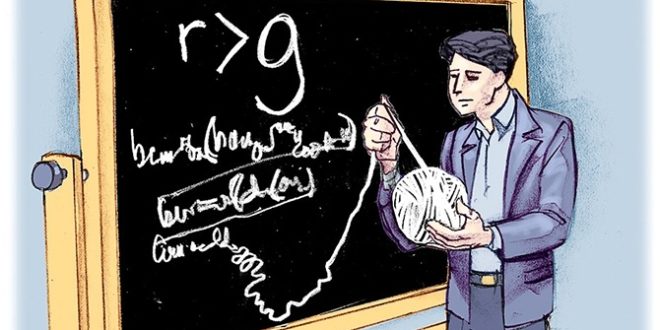
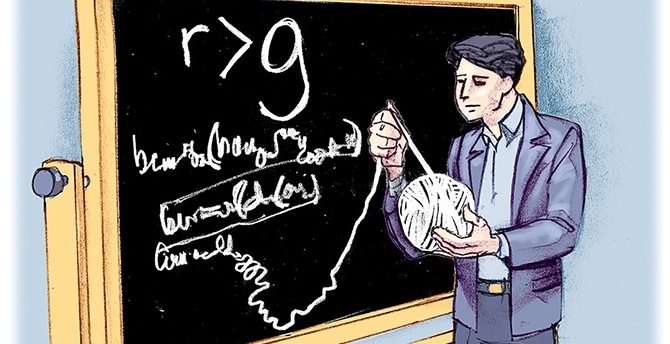
When the French economist Thomas Piketty published his voluminous text arguing that the steady rise in economic inequality is inevitable under capitalism, his thesis and its supposed and empirical basis quickly gained support among leftists, who echoed Piketty's call for greater redistributive taxation.
Other economists have spent a lot of time studying the data and found significant problems, and now Piketty himself is making efforts to add new explanations and additions to his own thesis, financier and economist Robert Rosenkranz reports in an article for the Wall Street Journal.
picketty-stands-off-against-inequality
Rosenkranz, who is also a member of the national board of the American Enterprise Institute, explains that central to Piketty’s book is his r > g equation, which argues that “over time, the rate of return on capital (r) outpaces the rate of growth of the economy (g), leading inexorably to the dominance of inherited wealth. Left-wing intellectuals like Princeton University economist Paul Krugman use Mr. Piketty’s thesis to justify policies they have long advocated — namely, very high taxes on the rich.”
However, in a forthcoming publication for the American Economic Review, Piketty argues that his thesis has been taken to extremes by its ideological supporters.
“For example, I do not see r > g as the sole or even the primary tool for explaining changes in income and wealth in the twentieth century, or the path of inequality in the twenty-first century,” Piketty writes. “Institutional changes and political upheavals—which can largely be seen as intrinsic to inequality and to the development process itself—have played an important role in the past, and will likely continue to do so in the future.”
Piketty continues: “Furthermore, I certainly do not believe that r > g is a useful tool for discussing growing inequality of labor income: other mechanisms and policies are much more appropriate here, for example, the demand and supply of skills and education.”
In his Wall Street Journal article, Rosenkranz explains why Piketty's thesis has never seemed convincing to him or to many economists who object to the simplistic and imprecise formulations in the book, and calls for humility on the part of left-wing intellectuals who use Piketty's work as an ideological basis for their own political defense.
“Mr. Piketty is ready to stand up and say that the material in his book does not support all the possibilities attributed to it, and that Capital in the Twenty-First Century is primarily a historical work,” Rosenkranz writes. “That is certainly worthy. Now is the time for those who declare that we are headed for a new era of vast inequality to follow his lead.”
Read Robert Rosenkranz's full article " Piketty Corrects the Inequality Crowd " in the Wall Street Journal.
Read “ Challenging Piketty's inequality empirics.”
Прочетете “Challenging the Empirical Contribution of Thomas Piketty's Capital in the 21st Century,” на Phil Magness and Robert Murphy.
Read “ Defeating Piketty's Charge — A working paper,” by Brad Lips.
Прочетете “5 remaining problems for Thomas Piketty in the wake of the FT controversy,” на Phil Magness.
Read “ Join the Inequality Debate,” by Brad Lips.
Read “ What Piketty Misses,” by Herbert Grubel.






''In the summer of 2012, doctoral student Thomas Herndon received an assignment from his professor to empirically test some famous and complex research. The young scientist decided to repeat the calculations of Harvard economists Professors Kenneth Rogoff and Carmen Rinehart from their latest scientific paper'' - http://solidbul.eu/?p=3421
Under the article I commented about offshore companies and my idea is to avoid the three planetary catastrophes
The basic truth is that regressive taxation and inflation reduce final demand, and there are two ways to stimulate it:
- from the banksters, but with 320% total world debt to global GDP, it can't happen, that is, it can happen if the interest rate is up to 0.01%, maybe even 200% of the national debt
- the second way I propose is a ban on offshore companies, etc. regulations and a luxury tax with the aim of 6% budget surpluses through the state bank and public procurement being invested in precisely defined things IN ORDER TO AVOID THE THREE PLANETARY CATASTROPHES
Keynes' multiplier - when some money is given for pensions and salaries of civil servants or in another non-productive sphere, the result is that 1 lev creates 0.3 - 0.8 levs of GDP growth, while when this lev is invested in new production or infrastructure, i.e. as a government order, then 1 lev can create between 2.5 - 3 levs of GDP growth.
The big question is what to invest in - renewable energy and energy efficiency because oil is running out and for the sake of ecology
SUSTAINABLE DEVELOPMENT AND SYSTEMIC APPROACH - RESOURCE-BASED AND PLANNED ECOLOGICAL ECONOMY
In 2012, the income gap between the average top manager and his average worker in the US grew more than ninefold – from 30 times in the late 1970s to 277 times today. Average hourly wages from 1975 to 2010 grew 10 times less than productivity – meaning they have to earn 10 times more or work 10 times less (1 hour per day).
277 times the difference is a lot.
WHO determines the difference in salaries and in general the basic policies of the state??? - SOVEREIGN (citizens) with a referendum as BEFORE THIS IT SHOULD BE EXPLAINED IN A SIMPLER WAY
In Switzerland, there was a referendum on a salary cap, meaning if the average salary in our country is 1,000 BGN, anyone who earns over 10,000 BGN is subject to 100% tax, even if it is over 30,000 BGN.
With a ceiling on wages and profits for companies, especially banks, things are regulated - 23 trillion cannot be given to save the banks and they continue to take millions.
I have described almost everything in comment #1 and especially #8 - http://darikfinance.bg/novini/112887?&order=asc#comments
I have been researching everything for years and I was provoked and intrigued by the article "Where Economists Failed" by Rex Weyler, co-founder of Greenpeace International.
, and I have described everything here - https://www.facebook.com/atanas.shalapatov/posts/1574304312847797
''In 2011, an interesting book by Richard Heinberg was published, The End of Growth: Adapting to Our New Economic Reality. The author makes a startling diagnosis: humanity has reached a fundamental turning point in its economic history. The trajectory of the expansion of industrial civilization is facing indisputable natural limits. Further growth will be blocked by three factors: resource depletion, environmental constraints, and the crushing volume of debt. These interacting constraints, Heinberg writes, will force us to reassess cherished economic theories and rethink money and trade. If we set goals that enhance human and environmental well-being, we must learn to save, rather than continue to pursue the impossible - endless growth in GDP.'' - I have reached these conclusions by other means
In the ocean of information, I sift and analyze what is more important and write everywhere with the goal of informing more people and they in turn inform more people in a geometric progression so that there is a strong civil society so that we can take measures and monitor, and pressure government authorities to act correctly to avoid the 3 planetary catastrophes because if measures are not taken, things will get scary.