EKIP– Expert Club for Economics and Politics A Different Opinion
The April 1876 uprising is a landmark event in Bulgarian history. The motives for it lie in the dissatisfaction of some of the then Bulgarians with the Ottoman state power. The history of the uprising is often misused, but there are two neglected and important aspects in it. First of all: it covered settlements with a relatively wealthy population, whose main activity was market-oriented. Second: those who participated in the suppression and the subsequent looting were driven exclusively by their envy of the market successes of the Bulgarians in the rebellious regions. It is to these specifics that we will pay attention in this text.
In the interest of the synthesized exposition, we will concentrate on the manifestations of these two aspects only in the Fourth Revolutionary District, which covers the regions of Plovdiv and Pazardzhik. There the uprising was massively best prepared. It was brutally crushed with the participation of a small number of regular troops and mainly irregular reserve soldiers (bashibozuk), various volunteers mainly from the Muslim population: Turks, Pomaks, Gypsies and Circassians. All those who participated in the massacres and robberies were encouraged by the state authorities.
Economic characteristics of the rebel settlements
There are several main economic characteristics of the Bulgarian lands in the last decades before the April Uprising. The predominant sector is subsistence or semi-subsistence agriculture, in which the production is consumed by the producer and a very small part of it reaches the market. There is no modern industry, the urban economy is concentrated in the hands of small craftsmen, there is no modern credit system and solid savings. However, the broad strokes hide some important trends. Dynamic market-oriented centers of economic activity are gradually taking shape. In them, the Bulgarians successfully take advantage of their competitive advantages, the growing ties of the Ottoman Empire with world markets and the large internal markets of the empire itself. Market-oriented activity is not limited to the relatively large urban centers such as Edirne, Plovdiv, Varna, Ruse, etc. It includes settlements that, by administrative status until the time of the April Uprising, and some long after, were villages.
The center of the insurgent preparation in the Fourth Revolutionary District was Panagyurishte. The natural and geographical conditions of Panagyurishte and its immediate surroundings did not suggest the development of a closed agriculture. The arable land was small and infertile. With the gradual penetration of market relations in the empire, the population focused its efforts on production and trade, which turned the disadvantages into advantages. The main economic activities of the Panagyurishte people were concentrated in large-scale commercial cattle breeding - mainly the breeding and sale of sheep - and in the processing of raw materials from it - mainly abadjiystvo, i.e. the production of woolen fabrics and clothes from them. Before the uprising, the Panagyurishte people were owners of a total of over 30,000 heads of sheep, which were sold in the large urban centers of the empire. The Panagyurishte abadjis produced and sold woolen fabrics and clothing for the domestic imperial market, but also for the markets of Serbia and Greece. It is estimated that the abadjis' annual profit was between 40 and 50% of the invested capital.
The economic structure of the settlement, where the first gunshot during the April Uprising was fired on April 20, 1876 – Koprivshtitsa – is similar. It is believed that the years between 1830 and 1876 were a “golden age” for Koprivshtitsa. Before the uprising, about 1,500 Koprivshtitsa residents were engaged in abadji production. As contemporaries noted, the “commercial spirit” possessed Koprivshtitsa residents, who scattered throughout Constantinople, Asia Minor, the Turkish Mediterranean islands, Egypt and Abyssinia (the old name for Ethiopia). Koprivshtitsa residents diversified their economic entrepreneurship by also focusing on growing oil-producing roses, the product of which was also entirely intended for the market. The prosperity of two other important centers of the April Uprising in the Srednogorsk region – Klisura and Strelcha – is also due to the oil-producing rose and abadji production.
The main settlements in the Rhodope Mountains that joined the uprising were Batak, Bratsigovo and Perushtitsa. The residents of Perushtitsa focused on the market production of wine and brandy. They satisfied the needs of the nearby relatively large cities such as Plovdiv and Pazardzhik, but they also sold their goods in other places. A wealthy Perushtitsa merchant was Spas Ginov, who is one of the most tragic figures in the history of the uprising. In order not to surrender, he killed his wife, his five children and finally committed suicide. The population of Bratsigovo specialized in construction, logging and the production of rose oil. Batach residents specialized in commercial logging and wood processing.
A common characteristic of the population of all of the mentioned settlements is that they skillfully took advantage of the expanding economic freedom in the empire. They showed enterprise, thrift, hard work and honesty: all traits that allowed the process of getting rich to begin. It is visible in the improved clothing and housing, in the opening of schools, the construction of churches, etc. Researchers point out that in the years before the uprising in Batak, for example, there was no real poverty. Significant differences in income can be found, but it is really important to emphasize that thanks to the market, real poverty disappears.
Envy
In authentic documents from the period of the April Uprising, in early memories and in some of the first studies of the uprising, information can be found that the market successes of the Bulgarians from the settlements listed above aroused envy among the local Turks and Pomaks.
The Russian diplomat (Bulgarian by origin) Naiden Gerov notes that the progress of the Bulgarians caused envy on the part of the Turks, who believed that it was dangerous and should be stopped. The participant in the Uprising, Petar Karapetrov, also mentioned the envy of the local Turks towards the Panagyurtsy. Shortly after the brutal suppression of the uprising, the Englishman Robert Jasper More visited the affected villages. He wrote that from the Turkish village of Yeni Mahle "they always looked with a certain envy at their more hardworking and wealthy neighbors" in Batak. It was the people from the same village who committed one of the most terrible massacres in Batak. Another witness to the atrocities during the suppression of the uprising, Eugene Skyler, notes the envy against the inhabitants of Perushtitsa because they were rich. The researcher of the Perushtitsa uprising, Ivan Kepov, also writes about envy towards the inhabitants of Perushtitsa. The envious were Turks and Pomaks from the neighboring village of Ustina. They were the ones who participated in the massacres and the subsequent looting of property from Perushtitsa. Another local researcher - Hristo Gyulemetov - notes that the shops full of goods and the large houses of the people of Bratsigov attracted the envious glances of their neighbors.
In a special publication dedicated to the economic situation of Panagyurishte before and after the uprising, M. Vlaykov is categorical that the irregular army that crushed the local rebels “had little interest in the importance of the uprising for the future fate of the Ottoman state.” The surrounding Turks were aware of the economic prosperity of the settlement and participated in the suppression of the uprising solely for the purpose of plunder.
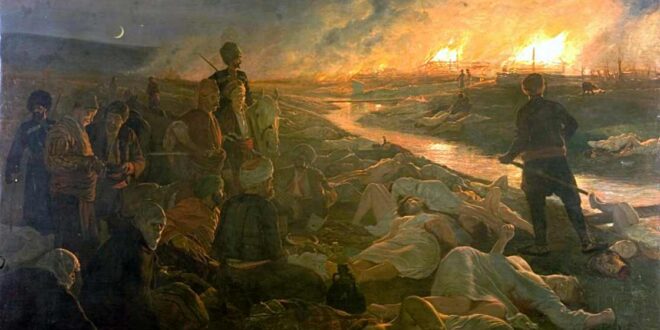
The documents reveal a characteristic feature of the bashibazouk and the other volunteers who suppressed the uprising. In his diary, the Koprivshtitsa teacher Hristo Pulekov wrote that Koprivshtitsa was plundered by bashibazouks "sluts". One of the Batak surviving rebels also described the looters from the village of Yeni Mahle as "sluts". In Perushtitsa, according to Ivan Kepov, the Pomaks were crazy about loot. For a long time after the uprising, they went around looking for hidden treasures from the local Bulgarians. The leaders of the bashibazouk were indeed not poor. It can be argued, however, that the mass perpetrators of crimes were Turks and Pomaks, whose poverty testifies that they were not successful in a market environment. Even in areas far from the uprising, poor Muslims were preparing to subject the richer Bulgarians to robberies and murders. Their poverty fuels envy, is garnished with religious fanaticism, which is in turn encouraged by the state and the results are murderous in the most direct sense of the word. In Batak alone, over 1,700 people were killed: men, women, children and the elderly. The scenes when the conquerors entered the village are shocking. Not quite as cruel, but similar is the fate of Perushtitsa, Klisura, Panagyurishte and many other villages, some of which did not even participate in the uprising.
Instead of a conclusion. The April Uprising – ways of (mis)use
The propaganda abuse of the April Uprising can be sought in at least three directions: by lovers of the strong state, by anti-Turkish nationalists and by advocates of social justice. The Bulgarian Spring of 1876 is indicative of what the state power – in this case the Ottoman – can do to a minority – in this case the Bulgarian – when the minority questions its legitimacy. After the Liberation, the Bulgarian statehood failed to create conditions for the restoration of the market vitality characteristic of the main centers of the uprising before 1876. For this reason, the April Uprising should not be among the important historical events for lovers of the strong state. The history of the uprising and its crushing abounds with betrayals, in which Bulgarians betray Bulgarians, and in some of the robberies Bulgarians (Bulgaro-Mohammedans, but also a few Bulgarian Christians) participate. There are also known cases in which Turks helped to save Bulgarians. Thus, the anti-Turkish nationalist ecstasy that often provoked April 1876 becomes irrelevant. A meaningful story about the April Uprising is difficult to fit into the ideologemes of the self-proclaimed fighters for social justice. Because their spontaneous and unconscious predecessor is not the rebellious Bulgarians and the innocent victims, but rather the bashibazouks and other bloodthirsty criminals who are dissatisfied with the inequality caused by the market.
The neglected aspects of the uprising revealed that envy of market success kills. Therefore, based on historical experience, it can be concluded that limiting envy is a prerequisite for social welfare based on a market economy.