 EKIP– Expert Club for Economics and Politics A Different Opinion
Argentina is definitely a country with a number of cautionary tales in its history, reminiscent of the well-known expression "don't try this at home". Its economic past hides a whole series of harmful and destructive policies - state regulations and price controls, nationalization, accumulating budget deficits and the country's external debt defaulting twice in just 13 years...
Enough upheaval for a comprehensive assessment and bold reforms, right?! But are the citizens of Argentina ready to fight for their freedom? To learn to take responsibility for their own ups and downs and not allow the state to interfere in their affairs?
The recent election victory of center-right conservative Mauricio Macri was read by many analysts as a call and a desire by society for a change in the governance model. And although the election of a new “state savior” is far from a sufficient condition for the dreamed-of change, we cannot ignore the dethronement of the 12-year-old left-wing populism of the Kirchner family as a positive sign for the future development of the South American country.
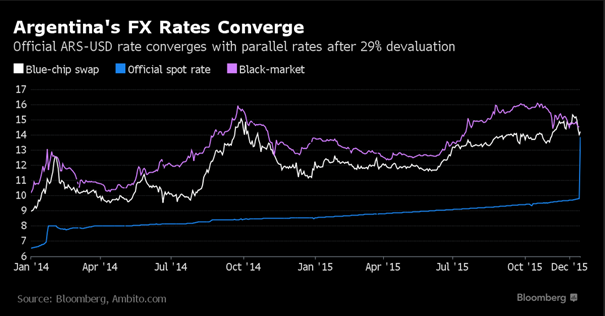
Dozens of challenges await the new government of Argentina. A few days after coming to power, the president began to fulfill his election promises aimed at promoting exports and stimulating economic growth. The removal of capital controls marked the beginning of the new government's rule. For reference, at the end of 2011, Argentina introduced strict currency controls on the purchase of dollars. Only those Argentines traveling abroad were allowed to buy foreign currency, and that with prior permission from the tax authorities. With the removal of restrictions on currency trading, the Argentine peso erased almost 30% of its value. The devaluation of the local currency brought the official peso exchange rate closer to the levels at which it is traded on the so-called "black" foreign exchange market (an alternative option for supplying foreign currency in case Argentines do not receive permission to buy dollars up to a limited amount from the tax authorities). Looking at the bigger picture, the lifting of exchange controls is a useful move in the long term and a necessary condition for restoring investor confidence in the country.
Chart 1. Convergence of the official and unofficial peso exchange rates after a 29% devaluation of the currency
What are the main risks in the economy after the abolition of exchange controls?
On the one hand, the government is faced with the need to secure enough foreign exchange reserves to meet the demand for foreign currency. On the other hand, Argentines will have to pay the high price of government spending and insane restrictions through a hidden tax called inflation. But what the outcome will be on the political and economic stage remains to be seen.
To increase its foreign exchange reserves, the Argentine central bank has taken a series of measures. Some of them include converting yuan into dollars under a swap agreement with China, stimulating exports and agricultural production by eliminating taxes and restrictions on the amount of wheat, corn and soybeans that producers can export, starting negotiations to conclude an agreement with several foreign banks to grant a credit line worth over $5 billion, etc.
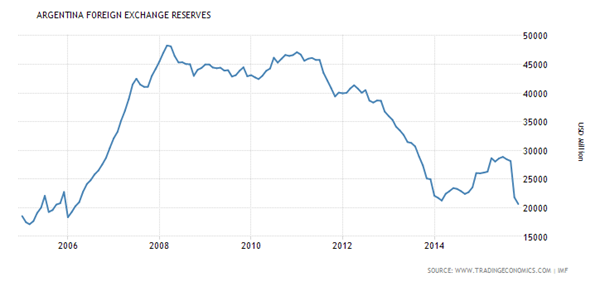
According to the country's new president, the sharp depreciation of the peso will have a positive impact on exports, which are often seen as the engine of economic growth. In order to stimulate exports, in addition to lifting the ban on the free movement of dollars, the government has also relied on other measures. Taxes on the export of cereals, including corn and wheat, were canceled, and the tariff for issuing a permit for the export of soybeans was reduced by 5 percentage points. These reliefs are also aimed at increasing Argentina's international reserves, which in October reached a nine-year low.
Chart 2. Argentina's international foreign exchange reserves
In comparison, the previous government imposed taxes on grain exports in order to fill the state treasury, further fueling the dissatisfaction of agricultural producers after the failed attempt to increase the tax on soybean exports from 35 to 45%.
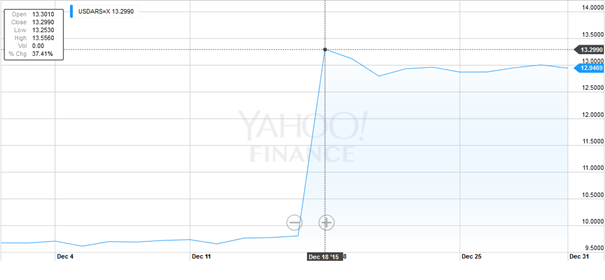
After the removal of tax barriers, the expected adjustments in the foreign exchange market were not long in coming - the Argentine peso regained its position against the dollar thanks to the greenbacks that entered the country as a result of the sales of stocks by some agricultural producers, waiting for a better exchange rate for their produce. The facilitation of trade is a positive move, but in order to benefit consumers, its beginning should not be seen as the end, when those in power achieve the desired results.
Chart 3. Change in USD/ARS as of December 31, before and after the devaluation of the Argentine peso
The results are not long in coming.
With the removal of capital controls, the risk of rising inflation, which is already “unprecedentedly digging into the pockets” of Argentine citizens, has also increased. Moreover, for some time now, Argentina has been seen as a country where inaccurate statistics are prepared. Due to accusations of manipulating inflation data, the country’s former president Cristina Kirchner introduced a new model for calculating the consumer price index a year ago. However, many analysts still share the opinion that the reported inflation levels deviate significantly from their estimates.
The latest official data show that annual inflation in October reached 14.3%, and according to unofficial sources its level amounted to 25%. A few weeks ago, the new director of the statistical agency announced a delay in the publication of inflation data for November, citing a lack of qualified staff and efficient work. But, as we can guess, this is hardly the only reason.
It is no coincidence that the consumer price index, although widely used, cannot be called the most accurate economic indicator for measuring the inflation rate. In fact, the main problem does not even lie in the use of one or another calculation methodology, but in the fundamental question - how do we define inflation? What do we interpret as the cause of its occurrence and what as its subsequent effect? Different economic schools defend different theses and define this monetary phenomenon in different ways. Unlike "mainstream" economists, who are blindly guided by such indicators and accept inflation as a general increase in the price level, "Austrian" economists oppose the entire idea of accurately measuring the inflation rate and the existence of an imaginary price level. They explain inflation as an increase in the money supply. [1] In this sense, since the additional amount of money reaches the real economy unevenly, the prices of goods and services (as a subsequent effect) do not change to the same extent, direction and time. And it is not the statistical models and formulas that are actually the most important thing, but the fact that inflation is a hidden tax to rob the population, which sneaks in quietly, benefiting the first to whom the new money reaches (the government and central banks) and harming all free people, but especially the last, to whom only the salty bill actually reaches - the poor, pensioners and able-bodied people with fixed incomes.
The Argentines' sobering up after an entire era of harmful interventionist policies has begun, but whether common sense will prevail or old habits will take over is a matter of choice and desire for real change. Because, in fact, the greatest fault lies not with the state, but with those who have given it power, exchanging their own freedom for the beautiful, but still lie, promising false security and "fair rules."
[1] Виж Henry Hazlitt, What you should know about inflation, Second Edition 1964





Inflation is theft because some people stole the money through various "methods" and everyone pays.
, and I have collected facts about ''methods'' used to steal - https://www.facebook.com/atanas.shalapatov/posts/1442612112683685
EKIP published a very good article on 20.09.2014 - ''10 things that inflation is to blame for''
There is another article from 02/19/2014 - ''How central banks cause income inequality''
in which there is one fact about the USA - ''during the period between 1979 and 2007, the incomes of the middle 60% rose by less than 40% while inflation was 186%.''
that is, inflation is theft, a legalized crime like offshore companies which are unfair competition like the shadow economy, etc. about these ''methods'' it was said around 1900 by an American ''if you want business, pass laws'' and so they made a private coin bank (FED) in 1913, etc. an encyclopedia can be written, that is, it should be written how with ''loopholes'' in the laws, etc. ''methods'' people were robbed and are being robbed.
In his article from 4/01/2016 Joseph Stiglitz writes: ''The only cure for the malaise of the world economy is an increase in aggregate demand... and a deep reform of the financial system... The private sector created the inequality and environmental degradation that we must now deal with. Markets cannot solve these and other critical problems they have created, or restore prosperity on their own. Active government policies are needed'' -“Why The Great Malaise of the World Economy Continues in 2016”. ProjectSyndicate
That's exactly why I'm writing about a ban on offshore, etc. regulations aimed at 6% budget surpluses being invested in - https://www.facebook.com/atanas.shalapatov/posts/1436573383287558
to avoid the oil catastrophe and global warming, and to have growth -