EKIP– Expert Club for Economics and Politics A Different Opinion

Today, the BSP accused the government of manipulating the official statistical data on the state's current account, and hence - on the gross domestic product (GDP). The BSP's claim is that in practice one of the main components of GDP - net exports - was overstated in the 2019 data, because, according to them, imports of at least 2 billion euros, mostly oil products, were deliberately not reported. Since the accusations are very specific and serious, I took the trouble to personally check the data of the Bulgarian National Bank and the National Statistical Institute. So, is there anything true in the opposition's accusations?
Is the record trade surplus real?
BNB data on Bulgaria’s current account shows that in 2019 we reported a record surplus in trade in goods and services worth 3.88 billion euros. Bulgaria has never had such a large surplus on this indicator. We have data up to 1998 and since then there has not been a single year in which we have had a trade surplus that even comes close to this value. The closest year is 2016, but even then the surplus, although quite high, was 38% lower than the one reported for the previous year.
Of course, an unusually high trade surplus in itself is not something that strange. After all, economic activity in Bulgaria has been on the rise for the past few years, we were in a period of economic "boom", so isn't it normal for the surplus to grow, even at an unusually high rate? Yes, but the abnormalities do not end with the trade surplus. If we pay attention to the values of imports and exports, we notice something quite interesting. It turns out that the record surplus in 2019 is due to an unusually high drop in imports, and not so much to a very large growth in exports. In 2019, imports fell by 975 million euros, while exports rose by 1.21 billion euros - i.e. we observe a rather unusual phenomenon in which exports grow while imports decrease.
In the graph below you can see the dynamics of net trade in goods and services - since 1998 there have been only 2 years, apart from 2019, in which the nominal value of imports fell. The first is 2009, when the Great Recession broke out worldwide and imports and exports fell together - i.e. it has nothing to do with what happened last year. The second is 2016, in which imports fell by 50 million euros, while exports rose by 1.9 billion. Here we see the same unusual dynamics as in 2019, but the decline in exports is still insignificant - only 50 million. In 2019 we are talking about a decline of almost 1 billion euros, which is equivalent to about 2% of GDP. In 2016 imports fell by 0.17% while exports grew by 6.6%, and in 2019 imports fell by 2.77% while exports grew by 3.27%.

Source: BNB
What is the reason for the record decline in imports?
There is a certain parallel between the two years – 2016 and 2019. The difference between the growth of exports and imports in 2016 and 2019 amounts to a very similar level of about 6-6.6%. Therefore, we need to delve even deeper into the statistics for these two years. Here we turn to the data of the National Statistical Institute (NSI) on foreign trade. Looking at all import categories according to the Standard International Trade Classification (SITC), we see that in both years the largest decline was recorded in the category "Mineral fuels, oils and similar products". In 2016, imports in this category fell by 1.66 billion euros, and in 2019 by about 3.0 billion euros.
But while in 2016 this decline was due to lower imports in 3 of the subcategories (coal, oil and gas), in 2019 the decline was almost entirely due to only 1 category – oil and all refined petroleum products. Their value fell from 6.52 billion euros in 2018 to 3.50 billion euros in 2019, i.e. by a little more than 3.0 billion euros (as much as the entire decline in the large category). For comparison, in 2016 the decline in this subcategory was about 962 million. In percentage terms, this equates to a 46% year-on-year decline in 2019 compared to 16.7% in 2016. This is another record - no other year has recorded a comparable decline in imports of oil and petroleum products.
The decline in the value of oil imports in 2016 can be safely attributed to the dynamics of the price of oil on global markets in the same year. The average price of oil in 2016 was 17.3% lower than the average in 2015, which almost completely corresponds to the decline in the value of imports reported by the National Statistical Institute. However, things are not the same in 2019. Last year, the average price of oil was nearly 12% lower than the average for 2018. However, this value is many times lower than the reported 46% decline in the value of oil imports.
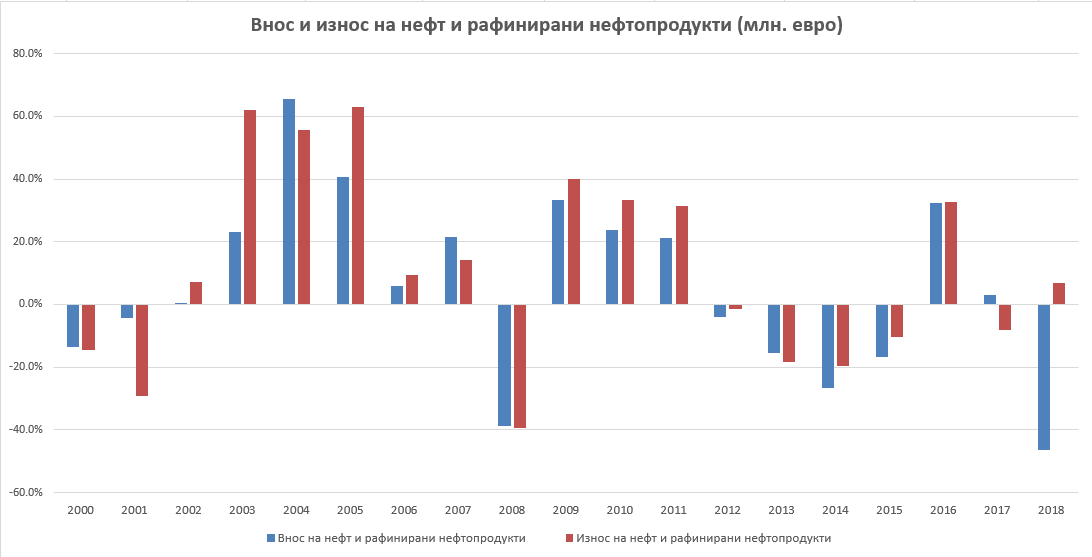
Source: NSI
It turns out that the oddities in the 2019 data become greater the more we delve into them. As we can see, last year really emerged as unprecedented in terms of the decline in imports, and of a very specific type of commodity – petroleum products. So far, alas, it turns out that the BSP has not lied – there is definitely something quite unusual in the import data specifically regarding petroleum products.
The more we look, the more unusual the data becomes.
Here we should ask ourselves - if the dynamics of oil prices cannot explain the huge drop in imports of petroleum products, then what can? In 2019, the consumption of petroleum products in the country did not fall so dramatically. Economic activity is supposedly growing, the labor market is operating at full speed, unemployment is at a record low, wages are growing at a very high rate. Yes, there is a weakening of activity in the industrial sector, but no large enterprises have been closed. If the sector had fallen into a severe crisis that would have caused a similar collapse in imports of petroleum products, this would have also affected exports. But the data does not show anything like that.
The BSP expresses doubt that the data are reliable at all and points to the category of "net errors and omissions" in the current balance published by the Bulgarian National Bank (BNB). This category shows the difference between the financial balance on the one hand and the total current and capital balance on the other. It exists to sum up the overall balance to 0 and is an indicator of whether there are any discrepancies in the data. In 2019, the value of "net errors and omissions" amounted to (minus) -3.34 billion euros. This is indeed a very high value, equivalent to 5.5% of GDP. The value of net errors and omissions has never been so high. The closest was reported in 2008, when it was -2.88 billion, but then there was no such dynamics in exports and imports. In 2016, which year I examined in detail above, errors and omissions were at plus 1.88 billion.
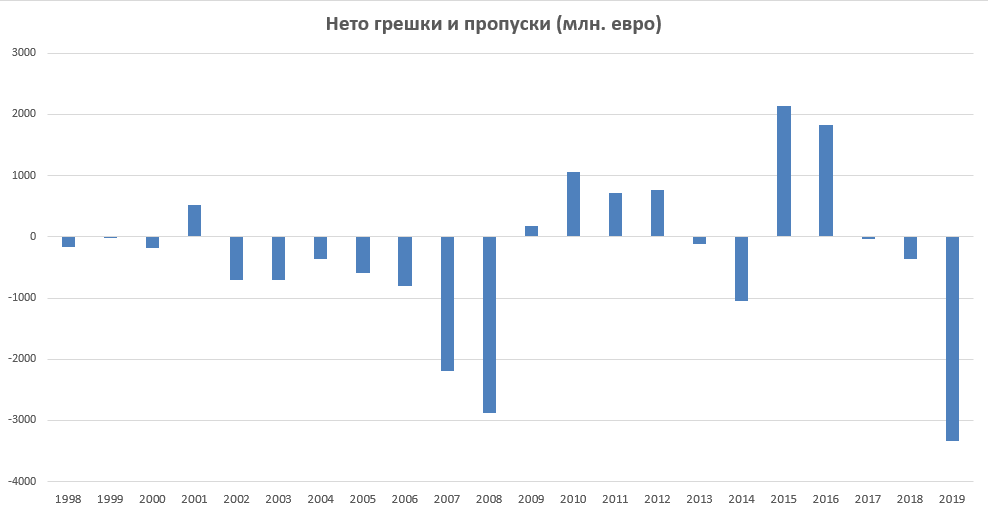
Source: BNB
Too many unusual coincidences are starting to pile up. Trade in goods and services is in a record surplus. Imports are falling by a record level of around 1 billion while exports are growing by over 1 billion. Imports of one specific type of product (oil) are falling by a record 46%, which cannot be explained by movements in market prices, and the category of "net errors and omissions" in the current account is also at record levels. Does this mean that the data is manipulated? Not necessarily. But given how unusual they are, I personally find it hard to believe that there is not at least some error. If everything is in order, then I would like someone from the NSI, the BNB or the Ministry of Finance to explain to me what economic processes are responsible for the strange data in the current account. Because for now I cannot explain them myself.
Manipulation, statistical error or...?
The opposition claims that there is manipulation of the data. Given that I have not yet seen evidence, I will refrain from such strong accusations. Such an accusation, if proven, would really be a reason for major resignations. If not of the government, then at least of the Minister of Finance. In fact, it is right to have resignations even if it turns out that it is simply a statistical error, and not intentional manipulation. In both cases, whether it is a matter of simple incompetence or intentional manipulation, such things should not be allowed when it comes to data that directly affects GDP growth.
Because if the BSP is right that about 2 billion euros in imports of petroleum products were not reported, this would mean that real GDP growth in 2019 was far from 3.3%, as the government boasts. Net exports are one of the main components of GDP along with consumption, investment and government spending. The opposition claims that real GDP growth was even below 1% on an annual basis. I have not bothered to calculate whether this is so, because we still do not have final GDP data for the last quarter of 2019, only express estimates.
I personally doubt that GDP growth was EVEN that low last year. But in any case, if there is an error or manipulation in the data that has underestimated imports, then the real growth is certainly not over 3%. Maybe it is around 2% or a little below that, which would already put us in the category of countries with rather medium to low growth levels in the European Union. But here I am just speculating. At this stage, the institutions must first explain what happened to the data, whether imports are really underestimated and why, and if not, explain what macroeconomic developments are due to the unusual data. Only then can we talk about revising the GDP data.