 EKIP– Expert Club for Economics and Politics A Different Opinion
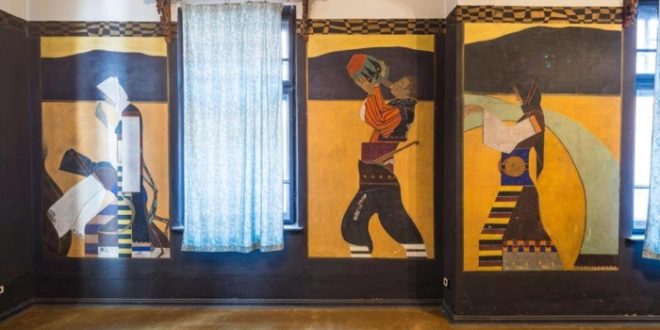
"Countdown to the house with the murals of Ivan Milev", "Petition to save the house with the murals of Ivan Milev", etc. If you were not interested in the topic of this building - a cultural asset, probably reading these headlines from the last few days you will be left with the impression that the cultural monument is in poor condition with a leaking roof, or someone is planning its demolition or something like that, really threatening the future of the house.
In fact, the previous private owner has simply decided that he wants to sell the building to another owner. And the average person would probably wonder why there is any concern. No one is going to demolish anything. The building will simply change owners. Things, however, are not that simple.
Let's start with a little history. The Stein family in Kazanlak is legendary. Without going into details - several branches of the Kazanlak family developed businesses from the second half of the 19th century, with which they accumulated great wealth - which, of course, did not only affect them, but also the entire city. Their successful management, for example, made Kazanlak one of the first cities supplied with electricity, through the construction of the private Enina hydroelectric power station in the years around the First World War. All of this, of course, was nationalized in the years after September 9, 1944.
The house, which is today commented on in the public space, was built in 1907 for Stoyan P. Staynov. His successor Manyu Staynov invited the artist Ivan Milev – also from Kazanlak – to decorate the building with the famous frescoes. Milev himself, unfortunately known to most people mainly from the 5 leva banknote, was an extremely interesting artist who developed his career in a short period in the 1920s. Alas, he died too young, but he left behind a unique artistic and cultural heritage that influenced the entire generation of artists of his time. His paintings are strongly influenced by the Bulgarian tradition, and accordingly - far from Western academic painting and naturalistic rendering of images. Therefore, after September 9, 1944, in the first 15 years or so, he was completely ostracized as a “formalist” and his work remained hidden for many years. Later, he was rehabilitated.
The house itself also did not have a very good fate. After September 9, almost all the original furniture, also designed by Milev himself, was taken out. None of this furniture has been found again, says one of the heirs, Mikhail Staynov, in an interview. Various Russian officers and city offices passed through the house, the house was renovated and surrounded by telephone cables, in general - excellent state care.
However, in 1994, the Steins managed to get their house back.
In fact, there are other Staynov houses throughout the neighborhood. For example, next door, again privately owned and with excellent care, is the Petko Staynov house-museum. There, everyone can experience the time and legacy of one of the greatest Bulgarian composers.
So. Today, selling the house with the frescoes is problematic. But why?
Against the backdrop of a number of destructions of culturally valuable buildings across the country, it is somewhat normal for artists or those who are concerned about cultural heritage to be more sensitive and concerned. It is entirely expected that petitions, letters, and signatures will be made.
But are the municipality and the state the ones to whom this energy should be directed? Are they the best stewards?
Just weeks ago we saw how the prosecutor's office treated Vasil Bozhkov's private collection, stuffing priceless cultural values into sacks like potatoes (the issue of whether this heritage was acquired legally or not is a separate one, the question is in the attitude towards it). Almost at the same time, another priceless cultural heritage - a Roman tomb near Plovdiv near the village of Manole collapsed due to poor care by the state institutions there.
There are, of course, many examples and there is no point in listing them here. Especially if we go back to the time before November 10, when the state had full authority to preserve cultural heritage, it is impossible to list what was destroyed – the very old center of Kazanlak was destroyed for the construction of boulevards, a representative hotel and a square, following a similar model to the centers of Plovdiv, Burgas, Yambol, Gabrovo and dozens of other cities.
Of course, times were different, people will say. What is happening today? The example of the tomb near Manole is far from unique. A number of medieval fortresses were ruined by pseudo-restorations, and today they are already deserted, due to a lack of visitors after the end of the “program periods”. The National Art Gallery – Square 500 recently caused a scandal with problems with the air conditioning installation, but the entire process of arranging the collection also caused a lot of scandals. The renovation of the Palace itself was unpleasant for anyone who is interested in cultural and historical heritage with examples such as placing square PVC windows in a round niche, etc. similar.
The expectations that the state will be a good steward in today's political, personnel, and cultural atmosphere really seem strange to me.
But what can the cultural community do? Let's actually act as a society. Instead of trying to shift responsibility onto the state or municipality (and then once again writing pointless petitions asking why they don't care), let's actually create a society of people who have an interest, expertise, and willingness to care in the appropriate direction.
The normal and expected reaction, I suppose, is: “Yes, there are probably people who will take care of it, but this object is expensive, there are no smart rich people to take care of it”. Here comes the moment with the crowding-out effect. For decades, society, educated and brought up under socialism, has expected the state to take care of it. “Who will give us money”. And when every time “the state takes care of it” (often with detrimental effects for the cultural heritage), the result is that if there was a person or business who had the opportunity to help, then he was pushed out, lost, “crowded-out”.
And in reality, there are businesses. What the state can do is leave them alone to donate and help with culture – with tax breaks or some other kind of incentives. This will create both a society that maintains an object with its own efforts, and people who care, have an attitude and a connection with the object they protect or care for.
People, by the way, are also there. There are modern and adequate cultural centers throughout the country - and they are, in fact, some of the best such places: "Hamalogika" in Burgas, "TAM" in Veliko Tarnovo, "The Architect's House" in Stara Zagora are the most interesting places in the respective cities, which also have sufficient independence and freedom to be critical in the right moments. And if you don't have the freedom to be critical of the authorities, the culture you create is meaningless.
So what the state should do regarding the house with the murals of Ivan Milev is to leave society alone and find an incentive for it to develop in the same way that the equally private house-museum of the Petko Staynov Foundation next door is developing. The fact that it is private has not destroyed it, right? The state and the municipality of Kazanlak have their own concerns – Thracian tombs, an excellent municipal gallery, a museum and more. Let's not go back in history, when the state took care of everything.
And society must understand that the "state" is the people, not the institutions. Some 500, 1,000 or 10,000 people who can sign up, we can also create a Patreon, in which we can donate 10 leva per month for the maintenance of the house and the team that will work there. This is not science fiction. This is how a number of other cultural centers function here, today, in Bulgaria.





If we ignore the fact that the author and the commentators have their reasons for concern and look pragmatically at the situation created around the house with the murals of Ivan Milev, which I have liked very much since childhood, I believe that it is most appropriate at the moment to create a mixed form of ownership between the state and the citizens. I know that this is difficult to achieve nowadays, but it is not impossible. I have signed this petition, but I do not think that the state would take the appropriate care if it were the sole owner and if it wanted to become one. I am currently in Kazanlak for a longer period of time and I note with pain that the city has lost its own appearance and has become like a poor suburb of a large Latin American city. Bad and tasteless new architecture, different styles, more precisely styleless, the buildings do not connect with each other, especially in the area of this house, and these inscriptions everywhere in English make me feel like I've landed in some seaport in the Middle East, and not in a picturesque sub-Balkan town that has given so much culture, and why not science, to the world.
So it would not be a bad idea to consider a partnership between the Municipality (the state) and a newly established Ivan Milev Foundation, which partnership would be agreed upon in such a way that it would not allow either party to abuse and change the goals of the entire event. Anything is possible, as long as there is a desire.