EKIP– Expert Club for Economics and Politics A Different Opinion
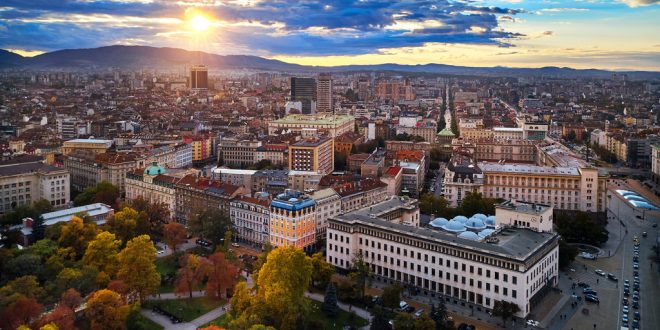
In recent years, the problems of urban planning in Sofia have become a particularly topical and politically heated topic in the public sphere. Our new report aims to present our vision of the reforms that urban planning policy in Sofia needs in order to improve its quality and, subsequently, the quality of life of the city's residents. But before we talk about the reforms themselves, let's first outline the main problems that we seek to solve with them.
What are the problems with urban planning in Sofia?
- Tension between businesses and residents fueled by the municipality's inadequate urban planning
- Daily traffic jams, difficult movement in the city due to excessively dense traffic
- Failed public projects to attract investments (Sofia Tech Park)
- Dissatisfaction with the quality of green spaces in the city
- Conflicts between “public” and private interests regarding cultural values
What should be the general theoretical framework of urban planning?
State and municipal institutions suffer from a tendency towards excessive centralization, and in the field of urban planning, sustainable solutions often require the opposite approach. In order to minimize the negative effects of this trend, it is necessary for state and municipal institutions to be decentralized to the greatest extent possible, so that in their functioning they mimic the decentralized structure of the market to the greatest extent possible. The more responsibility is left in the hands of those structures that are closest to the local population and, accordingly, have the most detailed and up-to-date information about its needs.
The role of the municipality should be limited to 1) solving coordination problems and 2) eliminating negative "externalities". From there, the municipality, if it retains its control over the relevant territory and is therefore responsible for its management, is responsible for performing this function in the most optimal way possible. What is important to note is that for the performance of this function, local municipalities by districts and neighborhoods are actually quite sufficient in most cases, and even in a better position than the municipality of the entire city. Precisely because they have much more accurate information about the specific needs of the region they administer.
What are the solutions we offer by sector?
In the field of building construction
Regulations on the height and density of building construction should be minimized. This will limit the negative effect that such regulations have on the property market and, in particular, the accessibility of residential and non-residential properties. Also, through higher and denser construction, traffic congestion in the capital can be alleviated, as well as prevent excessive growth of the city on a horizontal level, which destroys the surrounding nature of Sofia.
In the field of transport
The introduction of a congestion charge, at least temporarily, on those arterial roads of the city that suffer from the highest daily vehicle load would alleviate the burden of urban traffic. The shortage of parking spaces should be addressed by expanding paid parking zones - the quality of their management can be improved through concessions, as the example of a number of American cities such as Chicago shows.
As additional measures, it is advisable to invest the revenues from the introduction of a congestion charge in improving the public transport network and alternative forms of transport (taxi services and shared travel) should be deregulated. Deregulation of taxi services and shared travel would lead to their cheaper prices and encourage citizens to use them more.
In the field of economics
Decentralization and privatization of territory management works better than state management. The success of the private Sofia Business Park compared to the state Sofia Tech Park clearly demonstrates this. Where possible, the management and management of a given territory, especially when its purpose is to attract investment, is strongly recommended to be left to the private sector.
The municipality itself should focus on building a favorable regulatory and tax environment by optimizing its finances and reducing the regulatory burden. It is advisable to introduce specific permanent rules that put a clear restrictive framework on the regulatory and tax burden and prevent their excessive growth.
In the field of green spaces
The Sofia Municipality should prioritize the improvement of current green spaces, instead of expanding them, and their management should be decentralized to the level of neighborhoods and local private communities and owners. Decentralization would improve the quality of park management in the city by reducing their management to the level of local authorities/communities/private owners, who are much more aware of local needs and specificities (as stated in the theory of Hayek and Jacobs).
In New York, there are many clear examples of successful concessioning of green spaces, from whose experience the City Council should learn. It is necessary to conduct a study on the level of use of green spaces in Sofia, which would lead to optimization of their management.
In the field of cultural values
State and municipal regulation regarding the protection of cultural property should support, not hinder, the interests of private owners. Granting a "cultural property" status to a private property may also be associated with benefits for the owner, such as leading to higher revenues from it due to the higher image that this classification gives it.
Decentralizing responsibility for the preservation of the city's cultural assets to smaller neighborhood communities would increase the quality of this preservation, especially because it is the specific local population whose interests are most directly affected by the quality of preservation of the relevant cultural assets that may be located in their area.
You can read more about our proposals in the full text of the report, written by Georgi Vuldjev and Teodor Karakolev, and edited by Stoyan Panchev.