 EKIP– Expert Club for Economics and Politics A Different Opinion
“C orruption is the abuse of entrusted power for private gain.”
Transparency International
Corruption is a problem. Although it seems quite logical, this statement raises controversy among economists, since it is difficult to determine exactly in what form corruption manifests itself and under what mechanism it affects economic activity. In Bulgaria, corruption seems to be a common practice. However, there is often no explanation as to why, what all its manifestations are, and how its spread can be prevented. So – what is corruption?
In Bulgaria, corruption is mainly associated with the ineffectiveness of the judicial system and the presence of groups closely associated with politicians (for example, the oligarchy). We cannot ignore the monopoly in the energy sector, the opacity of customs operations and the lack of independence of institutions as part of the corruption practices in the country. However, all these manifestations of corruption are inherently very different, which makes their measurement difficult, and this in turn is necessary to assess the effect on economic activity and the channels through which this effect is created.
To this end, economists simplify the understanding of corruption to a single activity – tax evasion, illegal acquisition of property, bribery of public officials, etc. We will focus specifically on bribery, as it is easy to illustrate and clearly emphasizes the negative role of corruption.
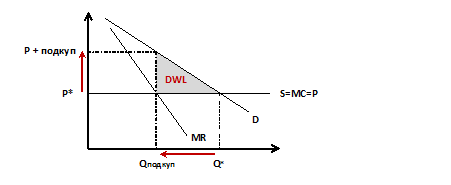
Let us imagine that we are trying to implement a project to build a building. In order to be able to start the activity at all, we need to obtain a building permit. Under normal conditions and an efficient public sector (if such a sector is possible), the price of the permit should be equal to the marginal cost of the public sector to provide the service (salary costs, consumables, etc.). In other words, the quantity of building permits issued will be equal to the quantity at which demand equals supply (Q* in Figure 1). However, in the presence of corruption, the rules of the game change dramatically.
Let's assume that the chief architect of the municipality is a supporter of the game under the table. In fact, given what is happening in the country, this is a completely realistic assumption. In our case, the architect is an absolute monopolist of the service provided – a building permit. Economic theory tells us that in the presence of an uncontrolled monopoly (almost any) the monopolist will provide such a quantity of building permits, at which the marginal costs are equal to the marginal revenues, namely Qbribe (Chart 1).
Chart 1. Economic consequences of bribery
Source: See note 1
The negative consequences of this development are several. On the one hand, the quantity of investment projects will decrease, as the return on the project is reduced by the value of the bribe. Along with the lower profitability of the projects, an element of uncertainty also arises - predicting the future price of the projects becomes much more difficult, since the level of the bribe will vary depending on the claims of the chief architect. What is of greatest importance, however, is precisely the presence of deadweight loss (DWL - the gray triangle in Figure 1), characteristic of any monopoly. The economic interpretation of this loss in this case is really simple - in the presence of corrupt practices, the quantity produced is reduced, part of the demand is not satisfied, and the economy operates below its potential. In short - resources are not used optimally.
The result is worsened if there are multiple agencies, each of which demands bribes. In fact, this fully reflects the reality, since multiple permits are required for the construction in question. This increases the price of the final product and reduces the attractiveness of the investment. [1] There are other channels through which the productivity of the economy decreases. For example, the requirement to maintain secrecy, an essential part of corrupt activity, can direct investments from productive segments such as health care and education to national defense and infrastructure [2]. Is it not entirely coincidental that we constantly hear about multimillion-dollar infrastructure projects in Bulgaria, while education and health care continue to be mired in long-term problems and inefficiency?
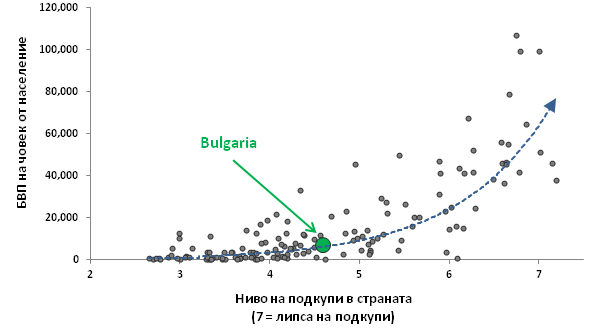
The strong negative impact of bribery on economic activity can be seen in Figure 2. High levels of bribery in the economy are associated with low levels of GDP per capita (a key measure of living standards). In other words, the more bribes a business needs to operate, the lower the standard of living in the economy. Bulgaria’s position is extremely unenviable. In the company of countries such as Kazakhstan, Namibia and China, the country lags far behind the leaders, both in terms of curbing bribery and in terms of living standards.
Chart 2. Relationship between bribes and GDP per capita
Source: Global Competitiveness Index 2013
It is difficult to provide definitive evidence as to whether reducing corruption leads to higher economic growth or whether economic development actually predetermines the reduction of corruption. It is most logical for both phenomena to occur simultaneously. However, we cannot deny that the lower the corruption, the more favorable the business environment will be. This in turn contributes to more serious activity in the business sector, increased investment and easier attraction of foreign capital. In fact, it is far from a coincidence that different assessments of corruption appear in the Global Competitiveness Index. It is indeed possible that with the development of the economy, a number of practices for reducing corruption are created. However, it is extremely necessary to take measures to prevent corrupt practices in order to improve the business environment, which is currently permanently deteriorated in Bulgaria.
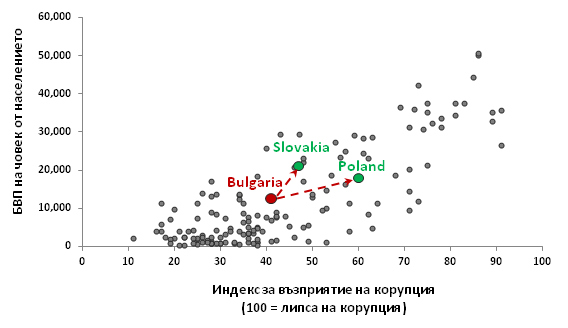
In fact, it is possible to trace the relationship between the perception of the general level of corruption (and not just bribes) in countries around the world and the level of economic development. Figure 3 clearly shows that low levels of corrupt practices are associated with high levels of economic development. Bulgaria is closer to the bottom of the ranking than to the leaders according to the Corruption Perceptions Index. We see that other countries from Central and Eastern Europe, such as Poland and Slovakia, register a much lower level of corruption, and the value of their GDP per capita is 43% and 67% higher than that of Bulgaria, respectively.
Chart 3. Relationship between corruption and GDP per capita
Source: Corruption Perception Index 2013, Penn World Table 8.0
It is difficult to say whether corruption is the only factor that determines the unsatisfactory level of development of Bulgaria. However, one thing is certain - corrupt practices around the world are certainly associated with a deterioration of the business environment, the inability to achieve potential growth and the diversion of resources to unproductive activities. It is likely that with the progress of our economy, corruption will decrease, but the prevention of unproductive practices (e.g. bribery) will certainly help to achieve the desired economic upswing.
[1]Shleifer, A. and Vishny, R. (2009). Corruption, The Quarterly Journal of Economics, Vol. 108, No. 3 (Aug 1993), pp. 599-617
[2] See note 1.





Great article, albeit with an unpleasant topic. One addition that in any case needs at least an attempt at empirical evaluation is the effect on the public level of trust between people and trust in laws. I would make a direct link to the broken window theory: http://en.wikipedia.org/wiki/Broken_windows_theory
Corruption breeds corruption, distrust of people/rules, and violation of other norms.