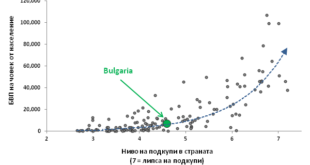
It is true that in recent years people have dared to do business, the shootouts in the center of Sofia have long been forgotten, and shady deals seem to be disappearing (or simply being more skillfully concealed). However, is corruption in Bulgaria a fading phenomenon? Although such a development has been a long-standing dream, its implementation is still …
More »Does corruption make us poorer?
“Corruption is the abuse of entrusted power for private gain.” Transparency International Corruption is a problem. Although it seems quite logical, this statement raises controversy among economists, since it is difficult to determine exactly in what form corruption manifests itself and by what mechanism it affects economic activity. …
More »Do fiscal multipliers work?
Everyone knows about the record government spending, but the result is not in reality. Over the past 5 years, the political elite has successfully recreated the dream environment described in more than one or two generations of economics textbooks by implementing record-high fiscal and monetary stimuli. However, the positive results are not just late, they remain too …
More »Is a lot of liquidity a good thing... or not? How is the banking system in Bulgaria doing?
It recently became clear that the country's economy continues to slow down its growth and even contracted by 0.2% in the second quarter on an annual basis due to still suppressed private consumption, a negative contribution from inventories and another contraction in capital formation (investment)[1]. However, how does this affect the banking sector, …
More »Is a lot of liquidity a good thing... or not? How is the banking system in Bulgaria doing?
It recently became clear that the country's economy continues to slow down its growth and even contracted by 0.2% in the second quarter on an annual basis due to still suppressed private consumption, a negative contribution from inventories and another contraction in capital formation (investment)[1]. However, how does this affect the banking sector, …
More »Five years later, the Eurozone is still dreaming of growth
With the deepening of the debt problems in the Eurozone in 2008 and the subsequent entry into recession, promises at the parliamentary level began to multiply, ambitions sharpened, and the path to growth seemed so clearly outlined that ... five years later, it is hard to believe how far we actually are from the dreamed-of recovery.
More »Where will the bubble burst?
Why European standards remain a mirage - Part 2
Last month, we looked at labor productivity in Bulgaria as one of the main problems preventing the country from reaching so-called "European standards" of living (link). It is time to also examine the reasons for the lack of sufficient growth in this area.
More »Why do European standards remain a mirage? (Part 1)
The recession in Bulgaria and the subsequent stagnation clearly highlighted the problems of the economy, which remained in the shadow of the strong growth at the beginning of the century. In the midst of political debates and promises, however, populism and social policy were the ones that reached their peak, and constructive solutions seemed to be lacking again. In this context, the catching up of …
More »How did Estonia do in 10 years what we promise in 20?
The years of transition can be characterized with many epithets, including “controversial,” “uncertain,” “disappointing,” and perhaps someone with a more optimistic view of the period would use words like “successful,” “dynamic,” or “inevitable.” However, one thing stood out as an irrefutable trend during these years, and that is precisely the long lists of …
More »
EKIP– Expert Club for Economics and Politics A Different Opinion