EKIP– Expert Club for Economics and Politics A Different Opinion
The Natural Rights of People and the Limits of Government
Patrick Barron
In The Law, Frédéric Bastiat presents the irrefutable maxim that human rights precede the formation of the state and, therefore, the collective actions of the rulers cannot conflict with these primary rights. According to Bastiat, a person can delegate to the state only those powers that he himself already possesses, and a person has no natural right to force someone else to give alms. Just as I cannot force you to participate in charity, as I see fit, so the government cannot force you to give as it pleases. Yet that is precisely the case at present. Let us say that you object to the government giving your money to a charity that you personally abhor. You will not get very far by arguing that you have the right to reduce your taxes proportionately. If you continue to refuse to pay, the government will confiscate your assets. If you try to protect your property, the government will ruin you. However, in the context of natural rights, it has no jurisdiction to force you to pay for a charity that you do not approve of and do not voluntarily fund.
True justice and the categorical imperative
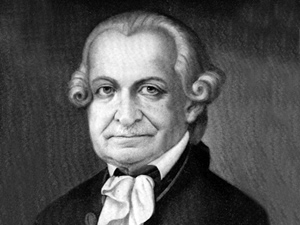
Perhaps it is more appropriate to allow the state to violate our natural rights by forcibly confiscating our property in the name of the supposedly better existence of others. For this reason, we will turn to two philosophers, Immanuel Kant and T. Patrick Burke. We will begin with Kant. Our concept of true justice finds no better expression than that given by Immanuel Kant in his explanation of the “categorical imperative.” A categorical imperative tells us what to do unconditionally, at all times, in all places, to every person. Its force derives from no other authority than pure logic. Kant distinguishes this categorical imperative from a hypothetical imperative such as “need.” While a hypothetical imperative may be valid, for example, “the poor would be better off if they received welfare,” it can never be objective. It makes sense only to those who are affected, in this case the poor. Giving aid to the poor cannot be an unconditional action applicable to all people in every place and at all times.
In his book, an introduction to Kant’s work, Roger Scruton explains that there are five types of categorical imperative. The first two are most important for our purpose here. The first variant is the Golden Rule, Matthew 7:12: “Therefore in all things, do to others as you would have them do to you, for this is the whole of the Law and the Prophets.” Abraham Lincoln expounded the Golden Rule by stating, “As I would not be a slave, neither would I be a master.” This itself contains the reason. The second variety views people as ends, not as means. A rational person is an end in himself and is never simply a means to some other end, nor a means to the ends of some people rather than others. By this law of nature, if everyone in a community except one person voted that everyone should give to charity, the categorical imperative would disprove that this was simply a way for the community to coerce that one person. The community would use him as a means, not an end, as a rational being with human dignity.
Professor T. Patrick Burge makes an important addition to the unjust nature of state coercion, in relation to the collection of donations for charitable purposes. He consistently concludes that the act of refusing to help someone in need is not unjust, since that person in need is left in the same position in which he was before. The refusal of help does not make the person in need worse off. If we were obliged by some lofty concept of justice to help everyone who comes to us in need, we would become slaves to all humanity. This would lead to the trampling of the categorical imperative, to us being used as means and ceasing to be ends.
The state's inability to perform economic calculation
In 1920, Ludwig von Mises wrote a devastating critique of the nascent socialist movement. In less than 75 pages, which include an introduction by Professor Yuri Maltsev and an afterword by Professor Joseph Salerno, “Economic Calculation in the Socialist Federation” describes how without private property, economic calculation is impossible. Mises explains how no government knows what to produce or what resources to use in production, no matter what the desired good is, because only those who actually own property can dispose of it rationally. Imagine two worlds, the world of mental preferences and the world of markets and prices. Preferences in one are ranked by the mind according to what is most necessary. They differ from person to person and are constantly changing even for the same person. These internal preferences meet the preferences of others in the market and thus determine the prices that allow us to make economic and economic decisions about what and how to produce and what to buy. Mises points out that without these market-determined prices, the “economic king” is blind to what to produce and how to do it. Market prices are determined only by people expressing their preferences for what they really own, i.e. their private property. The “economic king” does not spend his own money, nor does he put his own output on the market for sale. So how can he rationally decide what to do? Mises’ answer is that he cannot.
Since the government is composed of individuals who neither spend their own money nor market their own products, there is no way for them to make rational decisions about which charities should be supported by the government, if any at all. These individuals fall back into what can only be called corrupt practices, i.e., favoring friends, supporting organizations that would employ them in the future, buying organizations that are particularly persistent and annoying, and so on. This behavior is best described by the theory of “public choice,” which explains that the actions of individuals in government are driven by the same self-interest that drives them in all other areas of life, making a mockery of the idea that rulers have higher ethical considerations.
Conclusion
Finally, we note that the welfare state is imposed by force and has no justification other than that of sheer force. No one has a natural right to our labor or our property, no categorical imperative to help others, nor one that shames us for refusing to help others by force. And there is no chance of rational economic calculation determining which social activities should be supported by the state and to what extent.