Pencho Penchev March 02, 2022 Culture and history
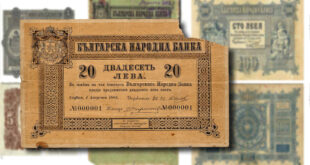
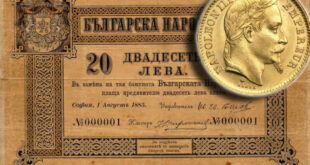
In 1928, with these words, the Bulgarian economist G. Toshev characterized paper money in conditions of inflation. His definition was the result of the experience gained during the First World War (1914-1919) and after it. This was the first clearly outlined inflationary wave in the history of post-liberation Bulgaria. The monetary system of …
More » Pencho Penchev February 07, 2022 Culture and History, Society
At first glance, monetary relations are not the most suitable environment in which honesty and trust thrive. Again, at first glance, when it comes to money, the selfishness and greed inherent in everyone are exposed. However, the intuition at first glance is not accurate. In order for money and the institutions related to it to exist, a certain …
More » Guest Author January 31, 2022 Politics
Author: Vasil Kanev The case with the Republic of North Macedonia is becoming increasingly urgent, and no solutions are being proposed, despite the changed approach of the new government. Why is the Bulgarian side not understood, what are the Bulgarian interests and what can we change to protect them and resolve the case? I define myself as a patriot, …
More » Pencho Penchev December 28, 2021 Culture and History, Society
A Bulgarian translation of the novel "In the First Circle" by Aleksandr Solzhenitsyn (1918-2008) was recently published. The story is based on his life experience and concerns one of the so-called sharashkas - secret Soviet camps where imprisoned scientists worked on intelligence or military projects. The disappointment of ...
More » Pencho Penchev December 16, 2021 Culture and History, Politics
Emotions and feelings inevitably have an impact on the overall socio-political and economic life. It is especially strong in decisive historical moments. This justifies the interest in them. The main questions that will be answered in this text are: when and under what conditions has political life in Bulgaria caused joy, delight …
More » Pencho Penchev December 05, 2021 Culture and History, Society
In the footsteps of a politically useless past The politically useless past is ugly and does not inspire national pride or enthusiasm among voters. That is why it is left to rest in peace in archives and libraries. When told meaningfully and honestly, it functions as a vaccine against social diseases such as populism, demagogy, corruption, use …
More » Pencho Penchev September 27, 2021 Culture and history
In the famous essay "What is seen and what is not seen" by the French economist Frederic Bastiat, there is a brilliant insight. It is that every action in the socio-economic sphere has visible but also invisible consequences. The invisible are events or processes that did not happen because of the undertaking of one or …
More » Pencho Penchev September 03, 2021 Culture and History, Society
The belief that various economic and social problems are solved by adopting or improving special laws, regulations, and ordinances is a persistent myth. Its existence is most easily established in the conditions of an election campaign. Then all competitors offer legislative programs that should improve the lives of voters. The myth is systematically nurtured …
More » Pencho Penchev July 29, 2021 Culture and History, Society
In a previous post, we showed some of the reasons why the political system cannot be relied on to successfully solve socio-economic problems (see here). The theory of regulatory captivity and Bulgarian economic history revealed how the interaction between management structures and interest groups ends in a conspiracy against society and the plunder of resources. …
More » Pencho Penchev July 22, 2021 Economy, Economic and fiscal policy
"Waiting for Godot" is a popular play by Samuel Beckett in which nothing happens. Two tramps wait for a certain Godot who never comes. Waiting for someone and/or something that never comes is an apt metaphor for the relationship between rulers and society. Politicians and bureaucrats are …
More »
 EKIP– Expert Club for Economics and Politics A Different Opinion