 EKIP– Expert Club for Economics and Politics A Different Opinion

This week, Berlin became the first German city to introduce a rent cap on residential properties. In this short commentary, we will look at what the city government's move could mean, as well as the functions of the price mechanism in a free economy.
The ceiling
Starting Monday, new tenants and renters in the city will not be allowed to negotiate rents that deviate more than 10% above the average rent. According to Rainer Wild, director of the Tenants' Association, "The rent cap in Berlin is very important because the difference between the price of existing and new contracts is particularly large." With this move, the institution hopes that rental apartments in the city will remain affordable for people with low incomes, and that the latter will not have to rent in neighborhoods far from the center. In real terms, prices have increased from 5.5 euros/m 2 in 2005 to just under 9 euros/m 2 in 2014, and in the period 2013-2014 alone, their value increased by more than 9%. [1]
The reason for this is very simple – in recent years, an increasing number of people have been moving to the German capital. Perhaps part of the reason for this is due to reforms in the financing model of higher education in the country, since from the current academic year, students do not pay fees for their university education. In real terms, the number of people arriving in the city is about 40,000 people per year, according to Rainer Wild. He adds that: “For this reason, the situation on the housing market is difficult.” In other words, we are witnessing an increase in demand for the commodity “apartments for rent”; a demand that the supply cannot meet, at least in the short term.
Low rents – low supply
As any first-year economics student knows, when demand for a good increases, its price also moves up; supply and demand curves are economic laws and perhaps one of the few areas where all economists agree. This movement is perfectly normal—other things being equal, more individuals compete for certain scarce goods, such as apartments. When there is no intervention in the market and prices are left to adjust freely to the prevailing conditions, they show entrepreneurs where and what is in demand; that is, in what direction resources should be directed.
Let us now consider what happens in the market when a rent ceiling is introduced. In Figure 1, it is represented by the horizontal line C, which is fixed at a price P C. Since its purpose is to lower rents, it is lower than the equilibrium price, which is formed at the intersection of the D and S curves. [2] The introduction of the administrative ceiling has two effects - one is visible to those untrained in economics, and the other is invisible. [3] The visible effect is that rents become almost fixed with little dynamics. The invisible effect is that the inability of the price to move upwards discourages individuals who would otherwise rent their homes from doing so. In other words, the introduction of a ceiling of average price + 10% will reduce the supply of apartments in relative terms below the number that would have been rented if this measure had not been introduced. In short, introducing a price cap on rents will benefit some tenants, but will harm many others who, although willing to pay a higher rent to live in Berlin, will not be able to do so because there will be no one to offer them an apartment for such a small amount.
Chart 1: Supply and demand curves
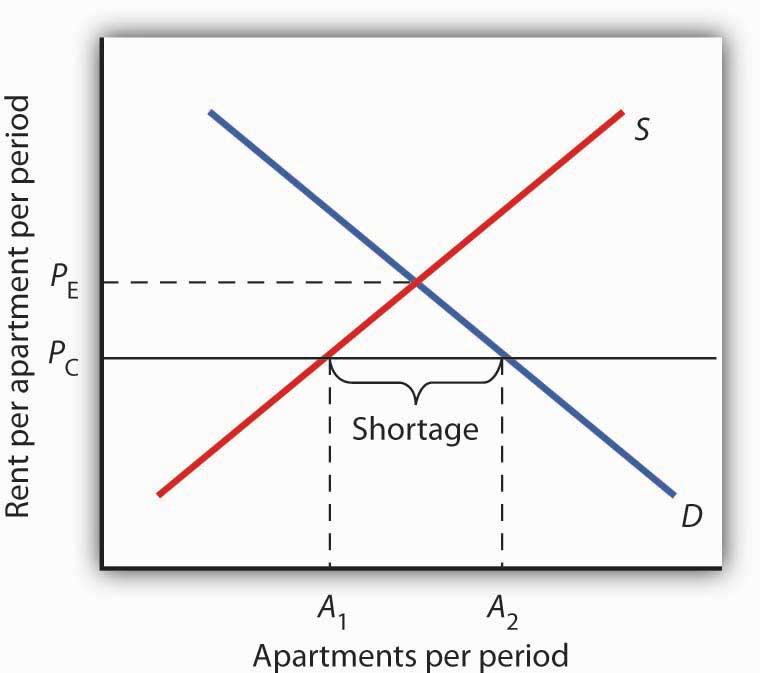
In conclusion, the Berlin city government’s move will not have the positive effects that Rainer Wild hopes for. On the contrary, cutting off the right to free negotiation between renters and their tenants will lead to a shortage of housing and, accordingly, to a smaller number of tenants and residents in the city than would otherwise exist. Thus, in real terms, the city will become relatively poorer than it would have been if prices were allowed to move upwards freely, since a certain number (which cannot be calculated categorically) of mutually beneficial contracts, benefiting both tenants and their landlords, will not take place. In other words, the rent cap is a populist measure that will benefit a few at the expense of many other potential Berliners who will not be able to find housing in the city.
[1] Data from real estate agency Jones Lang LaSalle.
[2] In reality, in the market we do not have just one D (demand) curve and one S (supply) curve, but multiple curves, but this is irrelevant to our example because the fundamental logic remains the same.
[3] For economists, both are visible.






This analysis is wrong on so many levels that I just don't know where to start...
- The ceiling is not fixed, but floating - fixed relative to the average rent.
- The price will go up and the demand will be satisfied, but the goal is to avoid sharp jumps in the city's average rent of more than 10% per measurement period (I suggest a year).
- Almost everyone in the city lives in rent. How would you feel if you lived there and your rent was, say, 800 Euros and they told you that next year it would be around 900, and then it could jump by another, say, 20%.
- Rent as a type of expense is a mandatory living expense. If the price of chocolate jumps by 20% for two years in a row, the state will not intervene, because you don't need chocolate to live. However, everyone needs a roof over their head. You can't tell people "well, if it doesn't pay for you, quit your job, university, school and go to some village".
- The rent itself in Germany is built on the basis of various types of expenses such as maintenance costs, heating (in most cases), cleaning the corridor, snow removal, water (hot and cold), proper sewage disposal, garbage disposal and a bunch of other things. If the price of rents jumps sharply just because of demand, then the new income from this increase would come mainly from the base amount before all these expenses. In other words, it would be unjustified and would go directly into the pocket of the company that owns the apartment/building in question.
- Most apartments/buildings are owned by companies, not private individuals. In other words, the fact that there will be people discouraged from renting out their homes and this "shortage" from the graph is there, but it is negligible compared to the positive aspects of this decision.
- Once again, the idea is that, for example, the price of chocolate will never jump by 20% two years in a row, because people will simply stop buying or reduce their consumption drastically. Whereas the housing market is not that flexible at all and one cannot simply leave if it does not work out in the short term. Since rent is something that almost everyone in Berlin has to pay, if its price rises drastically, the free capital of almost every resident is reduced, because people's salaries will certainly not follow such a short-term jump. That is why this floating ceiling is there - to limit growth to acceptable limits in a city full of students and foreigners, who otherwise do not have as much money as, for example, the average resident in Stuttgart, Munich, etc.
- Things in reality are never as black and white as they are in economic theory. Especially these basic supply/demand graphs take a lot of things for granted and are mainly used for first-year students to explain the economic way of thinking, but are rarely applicable in real conditions.
- There is still more to discuss on the topic, but please do not so easily jump to firm conclusions that you understand more about what is right for Berlin than its city government, which has certainly consulted more than one or two economists with at least 3 higher educations in the field and many years of experience.
Come with health.
"The price will go up and demand will be met, but the goal is to avoid sharp jumps in the city's average rent of more than 10% per measurement period (I suggest a year)."
This will limit supply.
"Almost everyone in the city lives in rent. How would you feel if you lived there and your rent was, say, 800 Euros and they told you that next year it would be around 900, and then it could jump by, say, another 20%?"
It doesn't matter at all how I would feel; market reality is not determined by "feelings." Besides, there are very easy ways to avoid rent increases - signing a long-term contract with a fixed rent for the duration of the contract.
"Rent as a type of expense is a mandatory living expense. If the price of chocolate jumps by 20% for two years in a row, the state will not intervene, because you don't need chocolate to live. However, everyone needs a roof over their head. You can't tell people, "Well, if it doesn't pay for you, quit your job, university, school and go to some village."
In economics, we don't divide expenses into "mandatory living expenses" and "other." But even if there were such a division, this is not an argument in favor of state intervention at all. Why don't you advocate that the state fix all food prices for you, just to see how many wonderful deficits that would be created? Blocking the price mechanism in any way is a colossal mistake that harms consumers. And it's not a question of "if it doesn't work for you, go to the countryside" in the free market; quite the opposite - imposing a price ceiling will implicitly convey this message to people who won't be able to find housing.
"The rent itself in Germany is built on the basis of various types of expenses such as maintenance costs, heating (in most cases), corridor cleaning, snow removal, water (hot and cold), proper sewage disposal, garbage disposal and a bunch of other things. If the price of rents jumps sharply just because of demand, then the new income from this increase would come mainly from the base amount before all these expenses. In other words, it would be unjustified and would go directly into the pocket of the company that owns the apartment/building in question."
I cannot agree that rental prices are determined only by some basic components. And the fact that higher revenues "go into the company's pocket" is only a good thing - without these higher costs, it would hardly offer the corresponding accommodation.
"Most apartments/buildings are owned by companies, not private individuals. In other words, the fact that there will be people discouraged from renting out their homes and this "shortage" from the graph is created is there, but it is negligible compared to the positive aspects of this decision."
This is an observation, not a logical argument.
"Things in reality are never as black and white as they are in economic theory. Especially these basic supply/demand graphs take a lot of things for granted and are mainly used for first-year students to explain the economic way of thinking, but are rarely applicable in real-world settings."
Venezuela is an exceptionally good example of how supply, demand, and price controls are freshman theories that are not applicable in real-world settings.
"There is still more to discuss on the topic, but please do not jump to firm conclusions so easily that you understand more about what is right for Berlin than its city government, which has certainly consulted more than one or two economists with at least 3 higher educations in the field and many years of experience."
First, the Berlin city government is struggling with economic calculation and, in fact, like any government, acts blindly most of the time - it is no coincidence that they accept populist restrictions without consulting economic theory. Second, economic laws are not something that can be circumvented simply by good will, even if we assume that the city government acted out of good will and not because of lobbying by the Tenants' Association (which is the much more likely option). Third, it does not seem to me that they consulted an economist at all - even a first-year student would have pointed out to them how insane such an idea is.
Competent people... could you tell me, since 2015, a law has been in place for fixed rents for housing, according to their condition, in neighborhoods? Can a landlord demand a larger amount than the fixed amount for a given housing? Thank you.
It's about Berlin. I apologize 🙂