 EKIP– Expert Club for Economics and Politics A Different Opinion
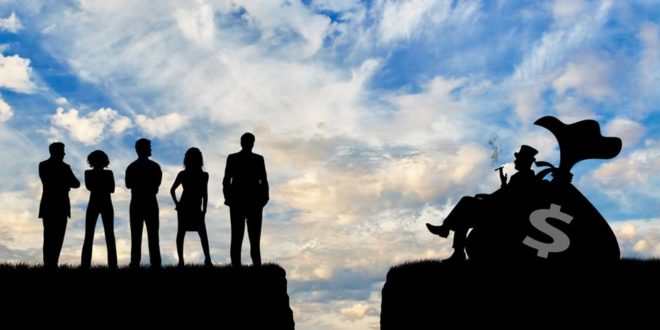
A change in presidency will not reduce the amount of time and energy some people will spend debating the issue of growing inequality between rich and poor. In fact, I expect to see such debates become more frequent and more intense.
I have written a number of articles and given many speeches on the issues arising from the claim that inequality is getting worse. These papers contain data (which can be found here and here ) that suggest that most of the claims about rising income inequality are wrong, exaggerated, or simply ignore other evidence.
What I want to do in this article is to focus on the questions that need to be asked in such debates. Specifically, I want to raise four questions that should be at the center of discussions about inequality.
First question: Are we talking about inequality or poverty?
Quite often, these two points of view get mixed up in discussions about inequality. Those concerned about inequality start talking about how bad things are for poor people. One explanation for this is this: it is assumed that rising inequality means that the rich are getting richer and the poor are getting poorer. Specifically, it is assumed that the poor are getting poorer because the rich are getting richer. That is, it is assumed that the economy is a negative-sum game [where every gain is offset by an equal loss]. So if some are richer, that wealth must have come from the poor.
So we need to clear up the misunderstandings. Make sure everyone is talking about the same thing. Because when it comes to poverty, the evidence is overwhelming: both globally and in the United States, absolute poverty has declined significantly over the past 25 years.
Second question: Are we talking about inequality of income, wealth, or consumption?
Those concerned about inequality often vacillate between income and wealth. Even this well-known video does so. It starts out by presenting data on global wealth, but in several places, including an extensive discussion on a particular graph, it refers to people's wages. That's income, not wealth.
Wealth is the sum of our assets minus our liabilities. In other words, capital. Income is the net change in our wealth over a period of time. For example, when we get paid. This is a flow of money to us. A person can have great wealth but have low income. For example, an older person can live off their savings but have a fully paid-off home. On the other hand, someone can have high income and low financial wealth. This is when someone has a large salary but spends it immediately on consumer goods. The data and implications are different depending on whether we are talking about wealth or income. It should be clear what we are talking about.
Consumption inequality is the third possibility. Here we are talking about the differences between what the rich and the poor can afford to buy. The available data shows that consumption inequality is much lower than income or wealth inequality, especially in the United States. The homes of the American poor have most of the things that are observed in the homes of the rich, the difference is in their quality. This gap between the rich and the poor on this basis has decreased in the last few decades. What we can afford to buy matters a lot.
Third question: What about income mobility?
Those concerned about inequality often argue that the rich, who are getting richer, and the poor, who are getting poorer, are the same people over time. They see claims that the top 20 percent of income earners have a larger share of the total national income than they did 30 years ago, while the bottom 20 percent have a smaller share. Given such information, they conclude that those who were rich 30 years ago are even richer today, and those who were poor are even poorer today.
But this ignores the issue of income mobility. Comparisons of two specific years, decades apart, are static portraits of a dynamic process. What these comparisons are really saying is that "those who were rich in year X had Y% of the national income, and other people who were rich in year X+25 had Z% of the national income." In other words, the households and people who make up the "rich" change every year. The same is true for the 20% at the other end of the scale.
There is a vast and contentious debate among economists about how easy it is for those who are poor in a given year to have higher incomes in later years. It is clear, however, that such income mobility exists.
The point is that you can't talk about inequality without at least discussing the degree of mobility. If what worries people about inequality is the assumption that the poor are staying poor, or getting poorer, then exploring the extent to which this is actually true would be essential to the discussion.
Fourth question: What exactly are the problems caused by inequality?
If we have clarified the positions on the first three questions, it is worth asking something like this: If the poverty rate is decreasing, and the poor have a decent chance of getting out of it, what specifically is wrong with (increasing) inequality?
In my experience, a common answer to this question is that even as the poor get richer, the ever-increasing wealth of the rich gives them unfair access to the political process. The super-rich will convert their economic power into political power, often in ways that involve redistributing resources to themselves and their friends.
It is perfectly reasonable to be concerned about such a process. But notice that the conversation has shifted, subtly, from inequality to problems of cronyism and the power that allows a state to engage in these redistributions. There are many ways to attack cronyism and reduce the ability of the rich to convert their wealth into political power that go beyond the forcible seizure and redistribution of the rich’s money or other state policies that arise to combat this inequality.
People who are concerned about these things are actually complaining about cronyism, not inequality per se. The source of this problem is the redistributive power of the state, which may gain even greater power if many of those concerned about inequality succeed in pushing through their policies.
Finally, even those who are skeptical of the arguments made by people affected by inequality can agree that there has been some redistribution of wealth from the poor to the rich in the past few decades. This is thanks to government policies that favor the rich over the poor. By this I mean everything from monetary policies and financial regulations that penalize small savers and small banks, to professional licensing and minimum wage laws that prevent the poor from finding work, to regulations and bans on Uber, Lyft, Airbnb, and other so-called "sharing economy" services.
These policies are problematic precisely because they increase both inequality and poverty. A much more interesting discussion about inequality would involve what role such public policies play in creating what we might call "negative-sum" increases in inequality, as opposed to the "positive-sum" increases that have characterized much of the past few decades.
Readers interested in the data can consult the two articles, linked at the beginning of this text. But even without the data, these are four questions worth raising in a conversation about inequality if you really want to get to the heart of the problem and convince those concerned about rising inequality to see the issue in a different light.
Translation: Zdravko Barov
Original article: HERE





Fourth question: What exactly are the problems caused by inequality? - this shows the author's mental economic capacity
Inequality causes less consumption of goods and services, that is, there is no GDP growth, etc., not forgetting that growth cannot be infinite, which is why the current structure of the global financial system is wrong because usury, etc., returns on stocks and bonds need infinite growth, that is, a new "system" and a systemic approach are needed - a resource-based and planned ecological economy.
The crisis is systemic and I have explained - https://www.facebook.com/atanas.shalapatov/posts/1752811994997027
''For Anatol Kaletzky (graduated from Oxford and Harvard)
"What crashed in 2008 was not a bank or a financial system, but an entire political philosophy and economic system, a way of life and thinking about the world."
Prof. Jeffrey Sachs, economic advisor to Ban Ki-moon (UN chief), also has the systemic crisis in mind - ''Today's growth model is inertial and short-term prosperity is bought at the price of huge crises in the future. It may continue for a while, but it will all end in tears'' - http://dnes.dir.bg/news/jefri-sax-12978498
Nobel laureate in economics Paul Krugman and Larry Summers, former US finance minister, acknowledge ''a century of stagnation'' that the crisis is systemic - http://bg.mondediplo.com/article1436.html