EKIP– Expert Club for Economics and Politics A Different Opinion
The state in which the healthcare system was left by Dr. Petar Moskov is bordering on deplorable. The National Health Insurance Fund (NHIF) again ran a deficit of 50 million leva at the end of 2016, and by now it has grown to 72 million leva. The fingerprint system turned out to lead to more losses than benefits – a 112,927 leva increase in costs since November, according to NHIF data. Moskov refused to carry out the necessary reform and transition from a centralized-state to a competitive-private (mixed) model in the healthcare system, arguing that “demonopolization will break the solidarity model.”
We remind you that attempts to reform the sector were repeatedly stopped by different governments in power, with one of them even allowing itself to redirect 2% of the NHIF reserve to fill holes in the NSSI budget. The purpose of this reserve was to feed private health insurance funds in order to achieve a smooth transition from monopoly to competition in the health insurance system. Moskov could have initiated this reform, but he did not, and each of his theses turned out to be in conflict with the reality that was left as a legacy. The NHIF budget continued to swell annually, while the status quo in healthcare remained the same.

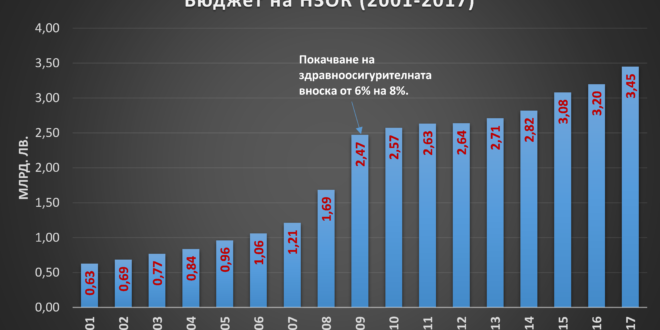
As can be seen from the graph, the NHIF budget from 2001 to 2017 has increased almost 5.5 times, and every year in the last quarter it is updated due to poor performance and the large expenses that the Fund has for hospitals. Mortality also grows in parallel with the increase in the Fund's budget, with the number of deaths in 2013 being approximately 104 thousand, and in 2015 rising to 110 thousand people.
Times are changing and a caretaker government has come to power. Dr. Moskov was replaced by Dr. Semerdzhiev, who is considered the father of healthcare reform. What are the possible useful moves before him:
- Demonopolization of health insurance and a smooth transition from a public to a private insurance model.
- Ending vicious practices and issuing false referrals and stricter control over hospitals.
- Closure of state hospitals that have gone bankrupt.
- Introduction of an electronic health record for clearer reporting of medical activities performed on the patient.
- Ending the lobbying practices of patient organizations (sponsored by large pharmaceutical companies) towards the NHIF.
These are some of the useful moves that he can push forward in these two or more months that he is an acting minister, in order to break the monopoly-corruption model in Bulgaria's healthcare system.