EKIP– Expert Club for Economics and Politics A Different Opinion
Author: Hristian Atanasov
Money has always attracted attention. Everyone wants to own it, control it, and especially have the right to produce it. Having arisen spontaneously to facilitate market exchange, it quickly becomes the darling of political power, which tries to monopolize it. The reason is more than clear to understand – the right to mint or print money brings great profits to anyone who acquires it. Nowadays, in most cases, this production is monopolized by the state, but in the past it was not at all like that.
In fact, in a number of periods of human history, state coins have competed quite freely with private or other non-state means of exchange. In practice, everyone could own different money and exchange it on the market according to their own economic interests. In recent history, we have numerous examples of the most diverse money. In general, however, there is a continuous striving for standardization, their arrangement in some system and especially their nationalization.
Salem, New York, 10 cents, 1862. Source: https://www.frbsf.org/education/teacher-resources/american-currency-exhibit/westward-expansion-2/
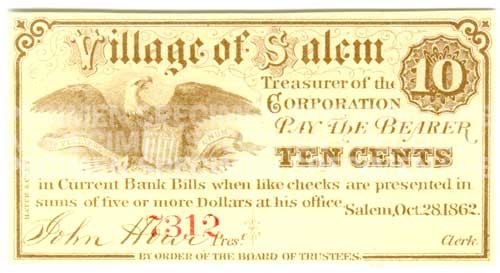
Before the Civil War (1861-1865), for example, money circulated in the United States printed by private banks, companies, associations, municipalities, churches, etc. During the war, the Northern government began issuing paper greenbacks , and accordingly, the frequent practice of printing non-state money ceased.
Private Money of a Massachusetts Hotel, 10 Cents, 1862. Source: https://www.frbsf.org/education/teacher-resources/american-currency-exhibit/westward-expansion-2/
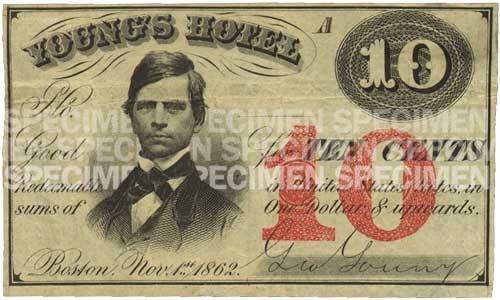
Issuing private money is not an American patent, and similar practices are found in a number of other countries, in different historical periods – in Australia, Hong Kong, Russia, and so on.
Bulgarian lands in the 19th century
At the end of the 14th century, the Bulgarian kingdoms fell under the rule of the Ottomans. For the latter, coinage (i.e., the production of money) was a monopoly of the state, which had the sultan as its representative. In the 18th century, a French traveler (Guillaume Olivier) wrote: "The minting of money in Turkey, with the exception of Cairo, takes place only in Constantinople and currently brings considerable income to the sultan, since he has counterfeited the money to such an extent that it does not have even half the value it had under the previous sultans."
And this is indeed the case. First, because only the political power in the empire could use the right of “seigniorage”, i.e. the profit between the production cost of money and its nominal value. And second, indeed, in the 18th and early 19th centuries there was an almost continuous process of devaluation of Ottoman money and an increase in prices in nominal terms. Only after 1844 was a new monetary system established with a fixed exchange rate between gold and silver (or between the lira and the grosh). After that, the government could not devalue its coins, but often looked for other ways to increase the money supply – for example, by printing paper money.
State Ottoman gold coin (100 groschen), 1856. Source: http://www.anythinganywhere.com/commerce/coins/coinpics/turkey.html

Interestingly, after the beginning of the 17th century, some institutions – specifically the church boards in the Bulgarian lands – also began to mint their own coins. I am sure that non-state money was minted by Bulgarian institutions throughout the Ottoman rule with varying intensity – strengthening or weakening of political power, but already from the middle of the 19th century the documentary material is more abundant. Since then, material evidence (i.e. coins) is known from Gabrovo, Elena, Lom, Shumen, Sevlievo, Razgrad, Targovishte, Lovech and other cities.
They are known by various names: "penyazi", "bodki", "bancheta", etc. As researchers have different opinions, to what extent these are really money. According to the late historian from Vidin Mitko Lachev: "...so called in the numismatic literature "church money" or "church coins" are actually tokens". The same opinion is shared by ahimandrite Pavel Stefanov - one of the researchers of the church and its financial activities. A. Vazov puts forward a compromise opinion, who stands somewhere in the middle, calling them "conditional monetary signs" and according to him: " Bulgarian worshipers saw in them a completely real equivalent of official monetary signs".
Vasil Haralanov and Hristo Kharitonov hold a different opinion. The latter is the most argued defender of the full value of the “church coins”, who summarizes the currently known facts and, although he admits that: “The main purpose of the church coins is to serve intra-temple payments”..., and that: “they are intended for use in them”, he adds that there is sufficient data that the coins were present on the real market and were accepted by all strata of the Bulgarian population, and in places by Muslims as well. The author concludes that they: “acquired the meaning and value of a regular payment unit”.
By the way, Nikolay Nenovski and Pencho Penchev are of the same opinion, who consider them to be money in the full sense of the term. This dispute is almost unknown to non-specialists, and in my opinion it is fundamental and extremely indicative of the theoretical level of researchers. In my opinion, “church coins” or “paper notes” (because there is such a case) are also money. First, because they are recognized by a group of people and second, because they are accepted on the market and come into contact (exchange) with the state Ottoman coins and kaymet (Ottoman paper money) of that time.
The Tryavna "tsar"
Without going into more theoretical dilemmas, I will present a case of such church money, which is also indicative of the state's attitude towards them and their creator. We are talking about the minting of such coins in Tryavna from 1851 to 1866. We learn about it from a study by Bogomil Daskalov (from 1925), dedicated to the history of the church "St. Archangel". In it, he writes:
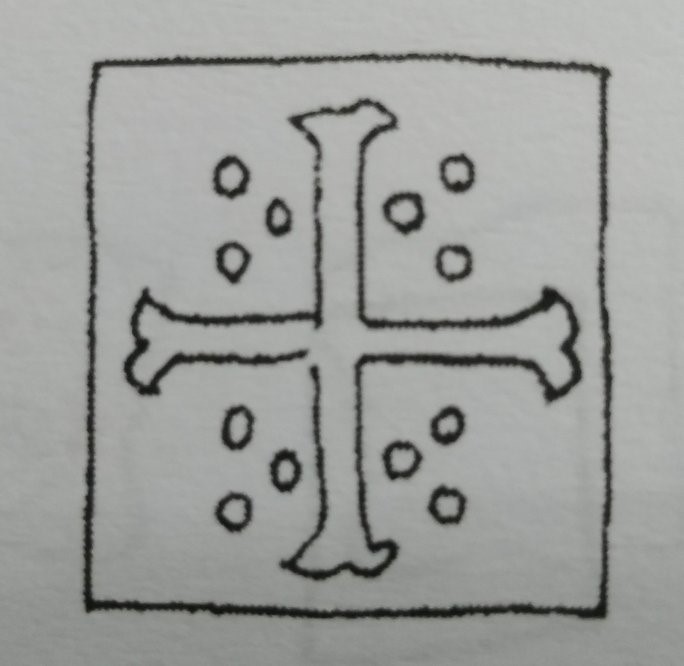
" Since 1851, the church "St. Archangel" has been putting its own money into circulation among its parishioners, which was in use even until 1866. The need for small change coins of one para [ 1/40 of a grosh, H.A. ] was felt a lot when... buying small candles, etc. Clean coins... were either rare or inconvenient. The church guardian Pencho Genev was a goldsmith by profession [ i.e. goldsmith, H.A. ] . With the consent of his comrades, Pencho invented a kind of machine "dzumba" [ i.e. zamba, H.A. ] , with the help of which he began to mint money from copper plates. These coins had a square shape (1 cm.) with a relief "cross" image on one side and were called "bancheta krestati". Their value was one para - ½ stotinka. The name "bancheta" was given to them by Pencha, who at that time had a son studying in Bucharest and was familiar with Romanian culture. For 15 years, the church issued these banchetas, which at first were only in circulation in the church, but then they also appeared in the markets and shops in Tryavna and the surrounding area, and later in the Gabrovo and even Tarnovo regions. When these coins were reported in Tarnovo and the authorities learned of their whereabouts, Pencho Genev was taken to Tarnovo, tried, his machine confiscated, and he was released through the intercession of Tryavna and Tarnovo nobles. Pencho was released on the condition that they return home and in the future not use any other money except that recognized by the Tsar. For minting money, Pencho earned the nickname "King Pencho," as his citizens called him.
Banche, reconstruction, minted between 1851 and 1866. Source: Kharitonov, Hr. Coins of the Christian Temples in Bulgaria, Abagar, Veliko Tarnovo, 2010, p. 248.
I am including the extensive quote because the example is simply for a textbook. Apparently, there was a shortage of small coins in Tryavna, both specifically for purchasing necessary things from the laity when visiting church, and in the markets. The lack of liquidity opens a niche, which the goldsmith Pencho very skillfully took advantage of, who, on behalf of the church institution, in which the population undoubtedly had confidence, began to mint money. It is certain that the profit from the seigniorage, in this case, went to cover the expenses of the church, but this is not so important. More interesting and expected are the actions of the Ottoman authorities, who reacted the moment they learned about the case. I remind you that for economic and political reasons, minting coins in the empire was the prerogative of the Sultan - it is no coincidence that Pencho was like a "king" in the eyes of his fellow citizens. Because of this, and as expected, the coiner was captured, tried, and the Ottoman authorities retained the right to a monopoly on the production of money.
A few words in conclusion
It is clear that throughout world history there have been many cases of challenging the primacy of the state over the production of money. This is especially characteristic of modern times, when technologies provide new opportunities for control and state monopoly over money, but also prospects for building private monetary systems. History is and will certainly repeat itself in the future. The state will continue to defend its acquired “right” to have supreme control over the production of money, but private individuals and public institutions will continue to challenge it. The important question is where is the interest of ordinary people in this opposition and how to defend it?