 EKIP– Expert Club for Economics and Politics A Different Opinion
Fears of a financial crisis in China have come to the fore again after, shortly before the end of 2013, 7-day interbank market interest rates jumped to levels above 10% for the second time in the last 6 months. In response, the central bank intervened, injecting about $55 billion into the banking system to lower interest rates and save many banks from bankruptcy. Some explain the lack of liquidity that led to this spike in the price of short-term loans with the large spending around the holidays and the need for cash by the local population, the Federal Reserve's decision to reduce its monthly asset purchase incentives and the Chinese central bank's attempts to slow down the growth of lending in the country. Other analysts, however, are much more pessimistic about the state of the Chinese economy and predict the outbreak of a financial crisis comparable to the one that occurred 5 years ago after the bankruptcy of Lehman Brothers.
The problems in China's economy are rooted in its governance model. Excessive state intervention in the economic and personal lives of people leads to inefficient allocation of limited resources, inflation of certain sectors of the economy at the expense of slower development of others, as well as the benefit of certain groups in society, most often those with close ties to politicians and high-ranking government officials. The Chinese Communist Party targets a certain level of economic growth to keep the country's still relatively poor population satisfied with wage growth and to prevent a possible rebellion provoked by restrictions on personal freedom. This model, however, has its price. Over the past 5 years, the Chinese government has relied on investment in infrastructure as the main engine of economic growth in China in an attempt to compensate for the decline in external demand for goods produced in the world's second-largest economy. Using the most popular indicator of a country's economic growth – GDP – and assuming that the Chinese government does not manipulate the data (which is a bold assumption), the Chinese authorities' experiment proved successful, considering that the country's economy grew by about 7-8% per year. This created jobs, helped the country's urbanization and raised the standard of living in China, but that's only the positive side of the picture.
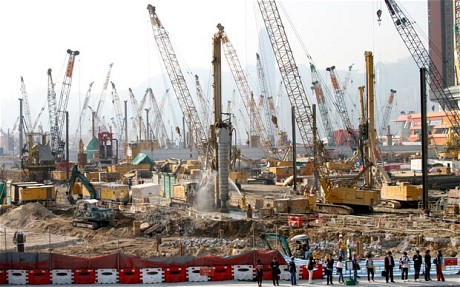
China’s growth over the past five years has been accompanied by the accumulation of a huge amount of debt. The relative level of corporate and household debt in China has increased to 215%/GDP from 125%/GDP at the end of 2008. This is an unprecedented increase considering the nominal growth of GDP (i.e. the rate of debt growth significantly outpaces economic growth). Measured in nominal terms, China’s accumulated debt for the period 2008-2012 is equivalent to about $15 trillion, which is close to the size of the US economy. Much of this money was poured into unnecessary infrastructure projects in order to create jobs and inflate China’s growth. The result is easily visible in the many “ghost cities” and deserted highways. And because these projects were built as a result of central planning (i.e. without considering their potential profitability), state-owned construction companies are now having difficulty repaying their loans, which are constantly being refinanced by state-owned banks in order to hide the size of non-performing loans in the Chinese financial system. It is precisely the ever-growing size of these bad loans and the increasing difficulty with which Chinese banks manage to refinance them that is the root cause of the brief liquidity crisis of June and December 2013. This poses a serious problem for the Chinese authorities, who must continue to increase debt in the economy if they are to achieve their set growth targets.
And so on until the bubble bursts. And then the consequences for the global economy will be enormous, given China's size and its share of global consumption of goods and services. But in the end, it may finally mark the beginning of the end of artificial economic growth generated by monetary and fiscal stimulus. The collapse of the Chinese economy will be a good lesson for central planners who think that the free market is incapable of leading a society to prosperity.
Sources:
http://www.bloomberg.com/news/2014-01-02/china-s-runaway-train-is-running-out-of-track.html
http://online.wsj.com/news/articles/SB10001424127887324906304579036592255182758
http://www.youtube.com/watch?v=pbDeS_mXMnM






Yes, the question is not "if", but "when". What I would be curious about is how, after the collapse of yet another attempt at state regulation of the economy, politicians will justify their own indiscretions, narrow-mindedness and recklessness. And what new fabrications will the Western - European leftism fabricate? Will this change China towards more market reforms or will it once again turn towards some kind of planned economy?
China suffers from mismanagement of its monetary system. If this mistake had not been made, the country would not have the current debts.
The public still does not respect harmful state behavior and painful evils are increasing.
The possibilities are:
1) If the mismanagement of the monetary system continues, the damage will increase.
2) Proper management of the monetary system ensures sustainable social prosperity.