 EKIP– Expert Club for Economics and Politics A Different Opinion
Several years after the start of the financial crisis and the subsequent launch of the quantitative easing program, politicians and central bankers reported a positive change in the values of some economic indicators, reading this as a signal of improvement in the general situation of the economy and the labor market. In order to achieve some of the desired effect, after the official termination of monetary stimuli in October, the monetary authorities (the Federal Reserve) began to prepare the ground for another intervention, this time in the direction of raising interest rates or returning them to “normal” levels.
Several fundamental questions stand out in the path of monetary stimulus and the conditions necessary for economic growth. Has quantitative easing helped to heal the economic environment, or has it achieved more of the effect of taking a painkiller? Is the US economic development sustainable and how stable is the recovery in the labor market if we focus not on unemployment but on employment? Will central bankers have the courage to proceed with an increase in federal funds rates when the country's public debt is reaching unprecedented levels and the economy's dependence on low interest rates has become a major driving force?
Boom & Bust
Economic recovery is a long-term process that requires cleaning the system of misinvestments created during the economic boom. A period during which it is necessary to adapt the production structure to the desires of consumers and to accumulate more savings and fresh capital resources with which to compensate for losses. Unfortunately, however, after the crisis, everything continued in the way that fundamentally led to it. After low interest rates no longer gave the desired result, the Federal Reserve continued even more aggressively with the policy of easy funds, printing a huge unsecured amount of paper money, which served to buy up the so-called “bad” assets from commercial and investment banks. Since the beginning of the crisis, the US central bank has expanded its balance sheet by 4.5 trillion dollars, [1] of which nearly 2.6 trillion dollars are held as excess reserves in commercial banks’ deposit accounts at the Fed.
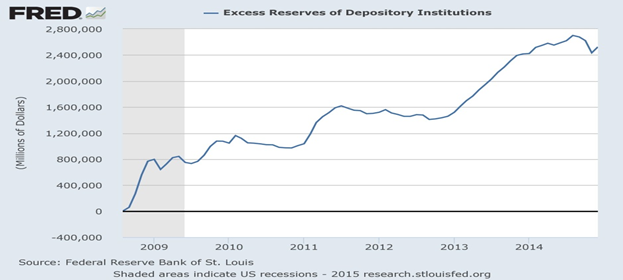
In fact, this explains why consumer inflation remains low and causes concern among government planners, remaining below the central bank’s target “level” of 2%. Obviously, the huge liquidity resource is not reaching the real economy. On the other hand, stock market indices in the US are at record highs, and excess reserves on commercial banks’ deposit accounts with the central bank continue to grow. But if this liquidity flows into the economy, central bankers’ concerns may turn out to be much greater, but with the exact opposite sign, which will change the economic picture (or in such a scenario, interest rates may rise) and will bring to the fore the unstoppable consequences of a long period of increasing the quantity of money.
Central bank intervention does not lead to recovery, but to a chronic illness. When interest rates are kept artificially low and credit is not based on real savings, market signals are distorted, leading to distortions in the production structure and economic processes. In a free market, interest rates do not perform a different function than all other market prices (future prices versus current prices), namely to be a source of information for economic agents. And this is so, because the interest rate is not just a random variable that can be fixed, modeled, or calculated by a few great minds. The interest rate is the price of time. Price signals encourage producers to invest in projects and offer more of those products whose prices are rising and less of those where the opposite trend is observed, i.e. entrepreneurs follow the directions given to them by consumers through the market and the banking system as road signs. When interest rates on deposits are low, it means that there is enough money in the banking system. For entrepreneurs, low interest rates are a sign that consumers are currently saving more than they are consuming. If you are an entrepreneur and you want to take out a loan to invest in future production, you want to be sure that consumers have enough saved so that they can afford to consume future production. [2] But artificially lowering interest rates creates the illusion that there is more capital available for investment than there actually is, which encourages capital investment in the wrong direction and leads investors astray.
The end is always dramatic, as the credit expansion caused by the artificial reduction of interest rates misleads investors. Even if we assume that some entrepreneurs have learned from the previous crisis and can correctly predict the future economic outcome, is it possible for them to adequately calculate the price of the interest rate? Or to close and wait for the period of economic boom to pass, observing economic processes from the sidelines as spectators, rather than as direct participants? Let us assume that initially their business continued its normal functioning, and they would prefer to finance their activities with their own capital rather than with borrowed capital, remaining more reserved in the long term in view of the expected turbulent times. In contrast to them, however, there have always been and will be economic agents who do not manage to satisfy consumer needs and preferences so well. As a result, they make losses, not profits (part of which they can set aside to finance their future investment projects), and they do not stay on the economic scene for long, unless they find the right way to satisfy consumer needs. When the central bank increases the money supply, the situation for them changes significantly. Cheap credit turns out to be an attractive alternative. At some point, however, the situation for the former will also begin to change. Since the increase in the money supply does not lead to an increase in scarce resources (it only leads to their reallocation), production costs will inevitably increase, and economic agents will begin to feel an increasing need for additional financing. Competing with other market participants for the means of production they need, they will be forced to resort to borrowing and enter the vicious circle of monetary stimulus. [3] But the false prosperity continues until the foundations of the economic boom collapse and it turns into a severe but cleansing recession.
True recovery?
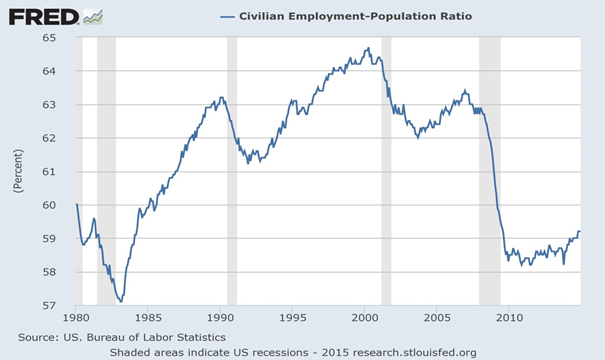
A certain amount of skepticism may also be useful when looking at the state of the labor market and the jobs created since the beginning of the financial and economic crisis. The unemployment rate is falling, but if we look at employment, we can maintain our optimistic outlook for better times. For example, the decline in unemployment is largely due to the fact that more and more people are leaving the labor force. The jobs created are mainly in sectors that do not require the employment of highly qualified and highly productive personnel, and the newly created part-time jobs further distort the statistical data. In addition, there is a trend of increasing the number of employed people over the age of 55, while employment among working-age people under 55 remains significantly lower than pre-crisis levels, but well masked by the huge injection of money into the US economy. [4] Unemployment may be falling, but employment remains at record lows.
Raising interest rates would mean the inability to refinance the debt. The Fed may raise interest rates, but the unprecedented levels of federal government debt, reaching about 18 trillion dollars, will soon remind of themselves and knock loudly on the fiscal door. As a result of the influx of liquidity, the government has been able to finance itself more and more cheaply. The yield on 10-year government securities is currently at a record low of 1.93% - far lower than the historical 4.8%.
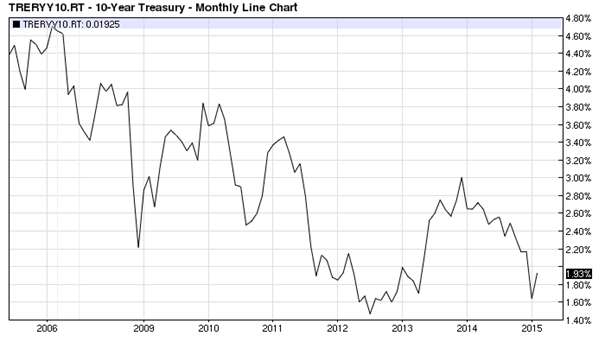
Graphics 1 [5]
Tightening US monetary policy in the current economic climate seems more wishful thinking than realistic. One thing is clear: increasing the money supply is not leading to a recovery in employment, productivity, and sustainable economic growth. Consumer inflation remains low because new money is not reaching the real economy, and as a result, raising interest rates at this time portends more expensive financing of the government debt and the possibility of the federal government defaulting.
____________________________________
[1] http://www.federalreserve.gov/releases/h41/current/h41.htm#h41tab9;
[2] https://www.youtube.com/watch?v=Tq8wk_bnvaU
[3] http://mises.org/library/economics-real-people
[4] http://www.zerohedge.com/news/2015-01-09/old-vs-young-story-americas-two-labor-markets
[5] http://www.barchart.com/charts/rates/TRERYY10.RT





Good analysis, but it's clearly not understood that the "system" has failed and I think "they" have known it for a long time, that they got caught in their own webs
In one sentence - my idea is (not that there is any other way out) a ban on offshore companies, etc. regulations and a luxury tax in order to invest budget surpluses through the state bank and public procurement (Keynes' multiplier) in precisely defined things in order to avoid the 3 planetary catastrophes and to maintain unemployment at 2-3%.
Inflation reduces people's purchasing power and from there the final demand, etc. No matter where I look at it, it still smells like REDISTRIBUTION, but "they" don't want it, even though they stole the money with "loopholes" in the laws.
My idea is redistribution, but not to pay interest on debts or indiscriminate social assistance, but to deal with planetary catastrophes, and I have ideas on how to keep unemployment to 3%, and the UN proposal for a 4-day workweek is for the end.
In 2012, the income gap between the average top manager and his average worker in the US grew more than ninefold – from 30 times in the late 1970s to 277 times today?!
The average hourly wage in the US from 1975 to 2010 grew 10 times less than productivity - meaning they have to work 10 times less or get paid 10 times more
Human beings will have to work less with the rise of machines, according to British economist John Maynard Keynes. In the 1930s, he predicted that by 2030 the world would face "technological unemployment" and people would have to work 15 hours a week to maintain high levels of employment in the workforce.
''Debt is simply a way of 'disguised' confiscation of wealth'' - Alan Greenspan
At the end of my post there are web addresses - https://www.facebook.com/atanas.shalapatov/posts/1574304312847797
Inflation is a type of tax, confiscation and redistribution is needed, etc.
''10. Inflation leads to waste and natural resources become more expensive''
Prof. Hanno Beck - inflation is a kind of tax, an unfair tax, which mostly affects citizens with lower incomes, he says and adds: "In principle, inflation is a kind of tax on keeping cash. In my opinion, it is a rather undemocratic tax, because people cannot vote for it - In order for the debts to be paid off, politicians would have to raise taxes. That would be the most honest and open solution."
Count Lawrence Kotikoff (professor of economics at Boston University) says it exactly - ''To close the fiscal gap, the American government will have to immediately and permanently raise taxes by 57% or reduce public spending by 37%'' - if necessary, 100% will be raised like under Roosevelt, but first a ban on offshore companies, which will make the 3% budget deficits of the US and the EU disappear, i.e. they become 2-3% surpluses.
Finances need to be specifically explained
I have read and watched a lot and in the ocean of information I collect, sift through the more important in order to inform more people and they also as a geometric progression so that there is a strong civil society so that we can take measures and monitor what is being done and pressure the state authorities to act correctly with petitions, referendums, etc. constitutional rights.
IT IS A QUESTION FOR OUR LIVES AND THE LIVES OF OUR CHILDREN AND GRANDCHILDREN BECAUSE IF MEASURES ARE NOT TAKEN IMMEDIATELY (within 1-2 years) TO START THE TRANSFORMATION, THERE WILL BE BILLIONS OF VICTIMS.
3 planetary catastrophes are coming and they can be avoided if the right measures are taken immediately - http://atanasio.blog.bg/drugi/2013/09/16/otvoreno-pismo.1148972
I have sent the open letter to the 3 state authorities, ministries, DANS and BAS, and the "4-powers", and the European Commission, Parliament, and the UN, but I don't know if they have read it, understood it, and when I have time I write everywhere in order to inform more people and they more people so that there is a strong civil society - I can't do anything myself.
I think strategically and geopolitically, almost everything is clear to me and I "ring the bell", but for the technical and legal shaping of some things, there are narrow specialists and academies of sciences for further shaping, calculations and analyses.
In one sentence, my idea is a ban on offshore companies, etc. regulations and a luxury tax with the goal of 6% budget surpluses which, through the state bank and public procurement (Keynes' multiplier), are invested in precisely defined things to avoid catastrophes.
I like the conclusion. "New money does not reach the real economy" fact! How is the effect of the inflation we paid in the heat of the mortgage bubble 🙂 Nice 🙂