EKIP– Expert Club for Economics and Politics A Different Opinion
Eduard Hess
In early January, four people in the UK died[i] as a result of using something that looked like ecstasy (MDMA). Before we understand why the war on drugs contributed to, rather than prevented, the deaths of these four people, let’s look at ecstasy itself.
MDMA was first synthesized in Germany in 1912 as a weight loss drug, but was ignored in medical circles until the 1960s, when it began to be used as an aid to psychotherapy. At the time, the drug was called "empathy" and no one was using it recreationally. It wasn't until the 1980s, when it began to be sold under the name ecstasy in nightclubs, that its popularity skyrocketed. Like amphetamines, ecstasy increases energy, making it particularly suitable for partying. Like psychedelics, it creates a feeling of warmth and empathy for others.
Ecstasy causes these effects by releasing serotonin and dopamine in the brain and central nervous system. Serotonin is a natural neurotransmitter (a chemical that helps carry signals to the brain) and helps regulate sleep, appetite, muscle contractions, mood, and bowel movements. Dopamine is a pleasure neurotransmitter. Users begin to feel the effects of MDMA 30-60 minutes after taking it, and the effects last for 4-6 hours.
Does ecstasy kill?
The first deaths involving ecstasy were in young men who died from dehydration [II]. Several studies have shown that the neurotoxicity of MDMA comes from an increase in body temperature [III]. This increase in temperature is particularly important in poorly ventilated nightclubs where ecstasy users dance.
Therefore, to reduce the possible damage from MDMA, we must keep the body cool and well hydrated. At the same time, we must avoid overhydration, as this can lead to death, as happened in the famous case of a young girl [IV] who thought she was fighting the harmful effects of MDMA, but overdid it. To avoid such a development, the use of alpha-lipoic acid and vitamin C, which are antioxidants, is recommended. A recent study [V] shows that alpha-lipoic acid protects against the neurotoxicity of MDMA even if the body temperature rises.
Ecstasy use has been shown to cause death from cerebral hemorrhage in several people, as it increases heart rate and blood pressure. These rare but fatal reactions are similar to allergies. As tragic as such deaths are, they are extremely rarer than other potentially fatal allergies, such as peanut allergy[VI].
Apart from these rare [VII] but deadly effects, does ecstasy cause brain damage?
Regular MDMA users have been shown to suffer from cognitive impairment and memory loss, but these effects are mild, temporary, and almost always reversible after ecstasy withdrawal [VIII].
One of the problems with studies that involve examining the effects of MDMA on drug users is that it is difficult to know whether the harmful effects they experience are from ecstasy or from other substances they are taking at the same time. An interesting study involving Mormon youth using MDMA without any other drugs or alcohol allows us to track the effects of the substance without any other influences. When comparing the results, no differences were found in the mental state of those Mormons who used it compared to those who did not use any drugs [IX].
In terms of medical use, one study has shown very promising results in the treatment of post-traumatic stress disorder (PTSD). In 10 out of 12 patients, after two sessions of ecstasy-assisted psychotherapy, the effects of PTSD were no longer observed [X]. Cancer patients are allowed to be treated with highly toxic drugs that can damage their organs or cause secondary cancers later, but the legal status of ecstasy prevents thousands of people suffering from PTSD from making a much less risky, life-changing medical decision [XI].
Thus, the scientific reality of ecstasy is far from the fantasies that seem to be rooted in people's minds. The point is not to deny the risks and harmful effects, which are very real. It is to understand that even beyond medical purposes, it is possible, as with alcohol, to use MDMA for recreational purposes in a way that minimizes harm to health. Many sources of information on reducing health harm are available online, clearly describing how to use MDMA safely and which supplements minimize the risks [XII].
Therefore, one would wonder: why have 4 people recently died in the UK after using ecstasy?
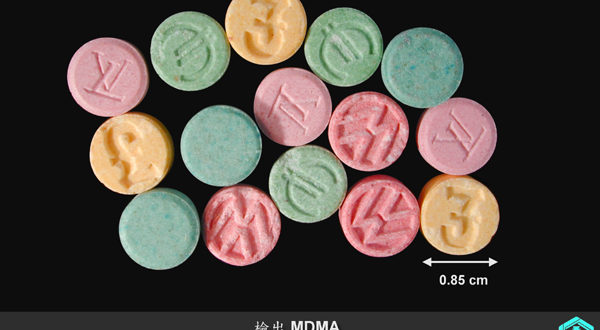
Shortly after the fatal incident, it was discovered that the Superman-branded pills these people had taken were not MDMA but PMA, a similar but much more toxic drug. The users themselves did not know what they were consuming: they are now part of the long list of victims of the war on drugs.
In a society where drugs are legal, users will have access to real information about the substances. By keeping the drugs on the illegal black market and in the hands of criminals, the state has prevented these 4 people from knowing what they have taken and therefore indirectly killed them.
But beyond the lack of information, the resurgence of PMA is also a direct consequence of the war on ecstasy. As Dr. David Nutt explains in an article for the Guardian, a little history will be helpful in understanding this phenomenon. [XIII]:
Since earlier UN drug control conventions had apparently not worked, in 1988 a further attempt was made to limit drug use by making it harder to manufacture, by banning a number of chemical precursors. One of these was safrole, a precursor to MDMA. In 2010, 50 tons of safrole were seized in Thailand. This led to a significant breakthrough in the availability of MDMA production, so chemists looked for an alternative source of a suitable precursor. Anise seed oil seemed like an ideal alternative, as it is chemically very similar to safrole, so they chose it. Unfortunately, the product that results from using the process to produce MDMA with anise oil is PMA or PMMA. Therefore, these substances exist on the market because MDMA production is blocked.
This isn't the first time we've seen dangerous drugs replace safer ones after the latter were banned. The most famous example is the Prohibition era in the US, when many people replaced alcohol with hard liquor, or ethanol, which is much more toxic than beer and wine.
To combat this deadly phenomenon, the war on ecstasy must end. One solution comes from the British foundation Transform, which proposes legalizing reasonable doses of MDMA (80 mg/day) for declared users in a regulated manner. This solution would be a good step towards more individual freedom compared to the current prohibition regime.
How many more will have to die before we can finally stop this deadly ecstasy ban?
Translation: Stoyan Panchev
Original text: http://studentsforliberty.org/europe/2015/02/17/end-the-drug-war-the-case-for-legalizing-ecstasy/
[i] http://www.theguardian.com/society/2015/jan/02/fourth-death-linked-superman-ecstasy
[ii] David Nutt – Drugs without hot air (2012)
[iii] http://link.springer.com/article/10.1007%2FBF02740694
http://www.ncbi.nlm.nih.gov/pubmed/21924843
http://jpet.aspetjournals.org/content/270/2/752.short
[iv] http://en.wikipedia.org/wiki/Leah_Betts
[v] http://www.ncbi.nlm.nih.gov/pubmed/10619665
[vi] http://www.newscientist.com/article/mg20126953.300-editorial-drugs-drive-politicians-out-of-their-minds.html
[vii] In « Drugs without hot air », Dr David Nutt estimates that ecstasy has a subsequent harmful effect once every 10.000 pills
[viii] http://www.ncbi.nlm.nih.gov/pubmed/16856221
[ix] http://www.ncbi.nlm.nih.gov/pubmed/19195429
[x] http://www.ncbi.nlm.nih.gov/pmc/articles/PMC3122379/
[xi] David Nutt – Drugs without hot air (2012)
[xii]http://www.reddit.com/r/Borax/comments/w5c1x/a_stepbystep_guide_to_reducing_mdma_neurotoxicity/
https://www.erowid.org/chemicals/mdma/mdma_faq.shtml
[xiii] http://www.theguardian.com/commentisfree/2015/jan/05/superman-pill-ecstasy-pma-deaths-drugs-policy