 EKIP– Expert Club for Economics and Politics A Different Opinion
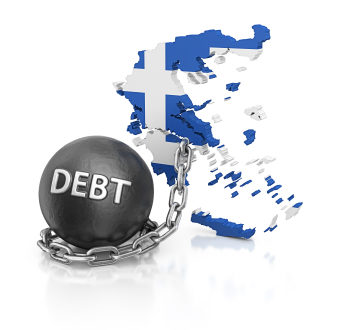
Two days ago it became clear that the European Commission is proposing a new bridge loan for Greece. The idea is that our southern neighbor will receive 7 billion euros with a maturity in 3 months, with the money to cover the repayment of its debts to the IMF (3.6 billion euros) and the European Central Bank (3.5 billion euros), which are due by the end of the month. In addition, Greece will need an additional 5 billion euros to repay its debts next month. If the proposed scenario happens, the loan to Greece will be implemented through the European Financial Stability Mechanism (EFSM), whose budget is replenished by all countries of the European Union, not just the members of the Eurozone.
Socialism, promises and illusion
In the very first sentence of the proposal for a decision by the European Commission, we read a statement that is significantly at odds with reality: “In view of the severe economic and financial turmoil caused by extraordinary circumstances beyond the control of the government, Greece has officially requested financial assistance from the European Union…” In reality, it is exactly the opposite. The severe “economic and financial turmoil” is caused precisely by the government’s control, the politicians’ promises of an easy life and social benefits, and the colossal debt through which the administration in Athens financed all of this.
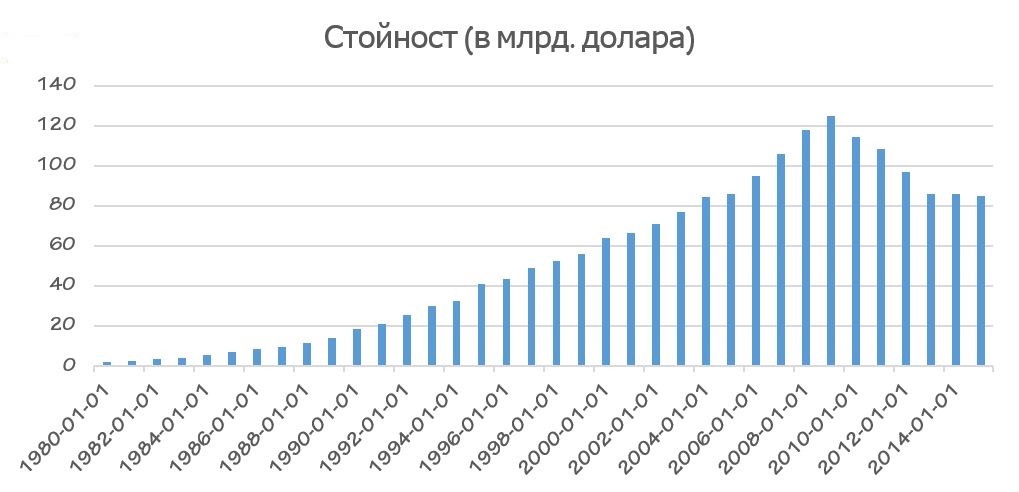
Let's look at the dynamics of Greece's government spending over the past 20 years. It is reflected in Chart 1.
Chart 1: Absolute value of Greek government bonds (1980-2015)
Source: Ministry of Finance of Greece
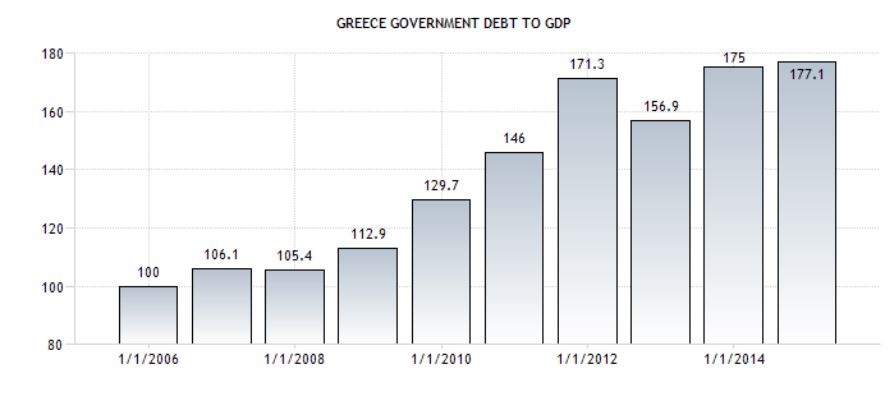
Now let's look at the ratio of Greece's debt to the country's gross domestic product - it is reflected in Chart 2.
Chart 2: Greece's debt to GDP
Source: Eurostat, Tradingeconomics
These two graphs provide a very valuable insight: the debt problems and high government spending are entirely of the country’s policy-making, especially since it joined the European Union in 1982 (although the trend of rising debt has been there since before that). They are not simply some equivalent of an economic natural disaster hitting Greece that no one could have predicted or controlled. There are clear reasons for them, including not only the politicians’ desire to be re-elected, but also the country’s fundamentally anti-capitalist culture and the voters’ demand for “free” benefits.
Some critics, most notably economist and Nobel laureate Paul Krugman, have argued that Greece’s problems arose because the country resorted to so-called “austerity”; that is, according to Krugman, politicians cut government spending, which threw the economy into recession. This view is completely refuted by the first graph. It clearly shows that the only thing that has been cut from government spending is the part of it that was added in the period 2005-2009. In other words, politicians in Greece are not making any colossal cuts in their spending, but are simply returning it to the level of 2005. If we allow ourselves to make a more conversational analogy, the situation in Greece is equivalent to a person with diabetes reducing his daily consumption of chocolates from 7 to 5 and complaining that all his problems are caused by cutting back on chocolate and the sugar in it.
Forced solidarity?
Having seen that the problems in Greece are both the fault of politicians, who have increased government spending more than 20 times over the past 30 years, and of voters who have voted for such moves, let us consider the proposal of the European Commission. According to its parameters, and if it comes into force, all countries in the European Union will become complicit in Greece's loans, regardless of whether local taxpayers want to do so or not. It should be noted that if the EC's idea is accepted (which requires a qualified majority), we will witness another act of (almost) forced solidarity, after our southern neighbor receives aid, liquidity for the country's banks [1] and a €100 billion debt write-off at the end of 2011.
It is interesting to note that such solidarity is not directed by Greece towards relatively poorer countries; for example, towards those where pensions are significantly lower (this includes Bulgaria).
Who should pay?
One of the basic principles of the free market is that individuals are not only free to contract with whomever they wish, but also responsible for their actions. For example, if a person buys a property for 500 thousand leva even though his income is 600 leva per month, he should take responsibility for his actions and be punished when he stops repaying his debt to his bank.
We should apply this principle to Greece. After more than 3 decades of irresponsible policies and progressively increasing government spending, it is the Greeks who must take responsibility and the consequences of their actions. This does not only include the country's political class; it also includes the voters who effectively allow this to happen through their votes, and even the creditors who finance the endeavors of Greek politicians.
Another dose of financial solidarity with the difficulties that our southern neighbors are themselves in means creating a colossal moral hazard. This move could be interpreted by the other indebted governments as giving them a blank check. Any rational politician in the Eurozone countries would say to himself: “If the European Commission has this approach to failing countries, then I can also spend as much as I want, and when the next government comes to power, it will simply ask for support from the EU and other institutions.”
We should not forget that the idea behind the creation of the European Union was to establish an area in which people in individual countries could trade freely with each other, as well as travel between different countries without restrictions. The idea behind this institution was not that politicians could spend as much as they wanted, with taxpayers in other countries footing the bill. We can expect that the policy of “solidarity” with the irresponsibility of others will lead to even greater indebtedness of the countries in the Eurozone and the EU, and to an even greater decline in incentives to carry out reforms towards liberalizing markets and privatizing pension systems. In other words, more “solidarity” significantly increases the risk of unbridled government spending [2] and more bankrupt states at some future point in time.
[1] It was obtained against the provision of Greek government bonds as collateral. This created colossal moral hazard, as well as a strong incentive for banks to finance the Greek rulers.
[2] We do not believe that the Maastricht criteria are adequate for reducing government spending and the role of the state apparatus in the economy. But although they are extremely liberal towards the activities of politicians, even in their current form they are not respected and de facto fail completely given the purpose for which they were introduced.





And Japan? The stupidest thing about this article is that it is only part of the truth. And when the Great Depression begins tomorrow, who will be to blame? And it is inevitable. The truth is that Greece should not have been accepted into the eurozone, as well as other weak economies such as Spain, Portugal, and in 2010 at the latest it should have gone bankrupt and private creditors should have taken a sip of cold water, but oh my, they are saving Greece and they are the ones who are saved, not the Greeks. This scheme of draining a country by politicians and bankers, by the financial oligarchy will be repeated and repeated until someone saves private creditors. But Greece is irrelevant because it is small. What if Italy goes bankrupt? Then what do we do? Bankruptcy is inevitable. Why is there not a word about the deep reasons that cause the increasing deflationary pressure, growing debts, stagnant incomes, high unemployment and low growth in the EU. Greece is just a piece of the big puzzle, of the global picture.
No one has the right to live beyond their means and the increase in government spending is frightening, but the shadow economy is not taken into account, which is 50%, that is, about 30 billion euros are damaged annually in the budget (in our country it is 5 billion leva), plus the thefts through budget spending and offshore companies, it becomes interesting because there is a lot of money and I have explained - - https://www.facebook.com/atanas.shalapatov/posts/1630500093894885
I want to comment on this - ''One of the basic principles of the free market is that individuals can not only enter into contracts with whomever they wish, but also bear responsibility for their actions. For example, if a person buys a property for 500 thousand leva even though his income amounts to 600 leva per month, he himself should take responsibility for his actions and be punished when he stops repaying his debt payments to his bank.''
1) Since 1996, there have been IMF accounting standards and the finance minister goes to jail if he gives wrong data.
2) Mario Draghi worked at Goldman Sachs from 2002 to 2005 as a managing director, and since 2006 he has been the governor of the Bank of Italy, meaning he knows how Greece and Italy hide their debt and budget deficit - he is involved in the fraud!!!
3) Regarding the liability of individuals, the Constitution of Bulgaria states that everyone is equal before the law, meaning that just as there is a law for bankruptcy of legal entities, there should also be one for individuals, which is how banks are disciplined when they give a loan of 500,000 BGN and the income is 600 BGN.
Such was the deception of the USA and the professor explains it beautifully - https://www.youtube.com/watch?v=-FRvpsBL6Vs&feature=youtu.be
Hello TEAM - YOU ARE EXPOSING!!!
"One of the basic principles of the free market is that individuals can not only enter into contracts with whomever they wish, but also be responsible for their actions. For example, if a person buys a property for 500 thousand leva even though his income amounts to 600 leva per month, he himself should take responsibility for his actions and be punished when he stops repaying his debt payments to his bank."
I read and I can't believe how far the indoctrination of the mind can go.
So I go to the bank and say I want 500,000 and I want to mortgage my house and the banksters send an appraiser who says the price is that much, etc. At one point I go bankrupt and the first fraud and violation of the Constitution shines through because before the law all are equal, that is, since there is a law for bankruptcy of legal entities, there should also be one for individuals, like the USA - 2 options for bankruptcy
The professor explains well how the BANKSTERS inflated property prices and how Bernarke and Greenspan as heads of the FED refused to control and stop the fraud - https://www.youtube.com/watch?v=-FRvpsBL6Vs&feature=youtu.be
The frauds of the banksters are many and with LIBOR alone trillions have been stolen, etc. encyclopedias could be written.