 EKIP– Expert Club for Economics and Politics A Different Opinion
Since coming to power in 2003, Brazil's Workers' Party has pursued an economic policy of creating wealth through increased public spending. Until the end of 2010, this model seemed to be working successfully. Government spending rose, consumer demand increased, and economic growth increased at an extremely rapid pace for several years in a row.
But while initially the eyes were drawn to the optimistic GDP growth figures, at a later stage we can expect the inevitable collapse of an artificially created economic prosperity. Unfortunately, only then will the moment come when political leaders will have to face their impotence and realize that they have no other way out but to proceed with the long-delayed structural changes. Whether the current Brazilian President Dilma Rousseff finds herself in a similar situation, as she is already starting to lose support among her supporters, remains to be seen.
The end of the illusion of state-created economic prosperity
The international rating agency Standard & Poor's recently downgraded Brazil's credit rating to junk, and over the past year the country's economic growth has slowed sharply, and it has been in recession since the second quarter of 2015. Official data showed the economy contracting by 1.9% compared to the first quarter of this year and by 2.6% compared to the same period last year. At the same time, public debt has registered one of the highest increases in the BRICS group of countries, and the budget deficit has already grown to nearly $7 billion. The picture is even bleaker given the raging political crisis, in which the corruption scandal surrounding the state-owned oil giant Petrobras [1] plays an important role, which has dealt a serious blow to investor confidence.
To curb the high budget deficit, the Brazilian government has announced a $17 billion budget package, including cuts to government spending and increases in tax revenues. The savings are expected to affect public health and social housing programs, infrastructure investments, agricultural subsidies, and civil servant salaries and bonuses. The plan to temporarily reinstate the financial transaction tax (CPMF) has also sparked public controversy. If adopted, it is expected to generate 32 billion reais (or just over $8 billion) in revenue next year. Cutting government spending is undoubtedly a far more effective tool for balancing public finances, but it is often neglected or pursued behind the scenes by those in power, as its implementation requires determination and firmness. On the other hand, raising taxes is a form of disguised encroachment on the property of individuals who are already experiencing the direct effects of accelerating inflation, which has reached an unprecedented 9.57% on an annual basis.
Congress has so far passed most of the fiscal measures to cut public spending. Those that have been put on hold include higher early retirement benefits, a pay raise for the judiciary and a new formula for calculating pensions. If Rousseff's veto of these spending bills is not overturned, the finance ministry estimates that government spending will jump by 128 billion reais ($31 billion) by 2019.
Risks and misconceptions in a world of constant state intervention
With the country’s investment-grade rating downgraded, another door has been closed to Brazil’s leaders. A lower credit rating often means higher risk premiums demanded by lenders. This is evident from the yield on 10-year government bonds denominated in dollars, which rose to their highest levels since their issuance in October 2013. The situation is no different for 10-year government bonds denominated in the national currency, which rose to levels close to those of late 2008.
Chart 1: Yield on 10-year government securities
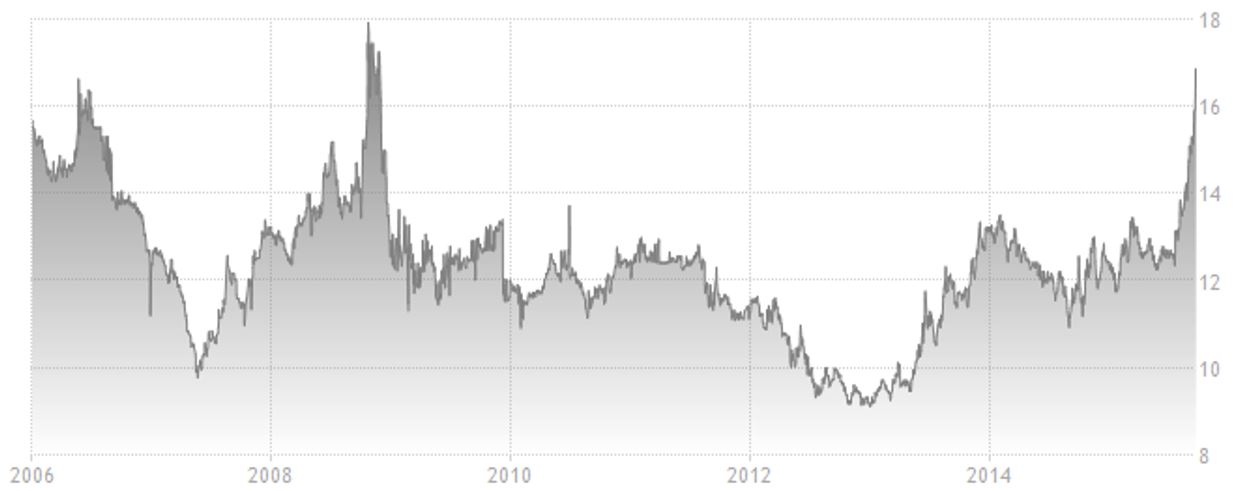
Source: National Bank of Brazil
Over the past week, the Brazilian real has fallen to a new record low against the US dollar. This has prompted the Central Bank to intervene in the foreign exchange market. In an attempt to stop the depreciation of its national currency, it has intervened in the foreign exchange market by offering currency swaps and loans through auctions. This move is not new to market participants, considering that in 2013 the financial institution launched a similar swap program, which was terminated earlier in 2015. After it did not bring the expected result, the president of the Central Bank gave a clear signal that, if necessary, he will use all instruments, including the country's international reserves, amounting to $ 371 billion, to support the national currency. His statement was reflected in the change in market sentiment, after the Brazilian real sharply rebounded from the record lows it had recorded in recent days. Unfortunately, however, it would be naive to delude ourselves that the Central Bank can erase all the problems in the economy with one button. On the contrary, it can only deepen them even more.
This is because new money in the economy completely distorts the guidelines that entrepreneurs use to channel their resources to their most sought-after uses. Additional intervention by the National Bank of Brazil will simply create a sense of profitability in companies or in the financial market, but it will not be countered by real demand from consumers, but simply new paper money, which is the classic recipe for inflating a bubble.
Chart 2: USD/BRL change as of September 25 on a daily basis
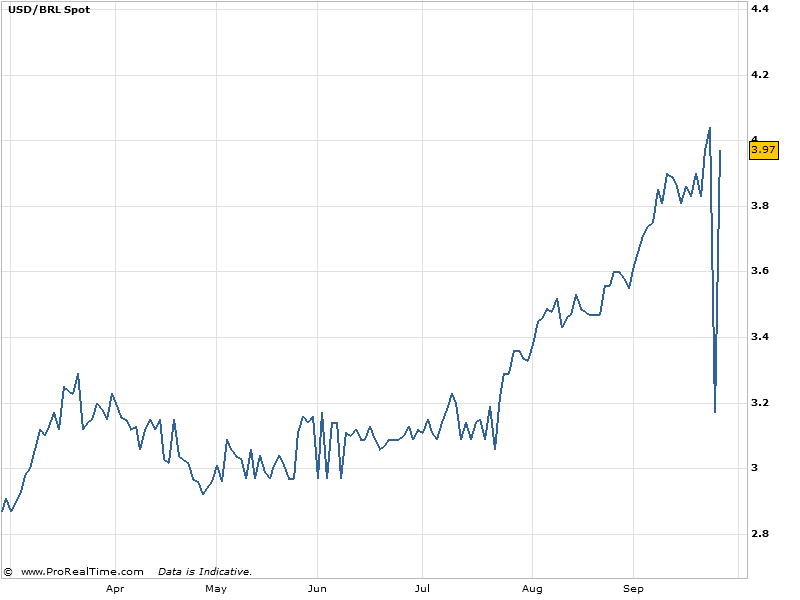
Source: www.fxstreet.com
Amidst all the risks and pessimistic forecasts for Brazil's economy, what is more worrying is the fact that the entrepreneurial function has been relegated to the background, burdened by numerous administrative burdens and bureaucratic procedures. The time it takes to start a business in Brazil is 16 times longer than in the United States and almost three times that of China and India.
Chart 3: Number of days needed to start a business in Brazil in 2015
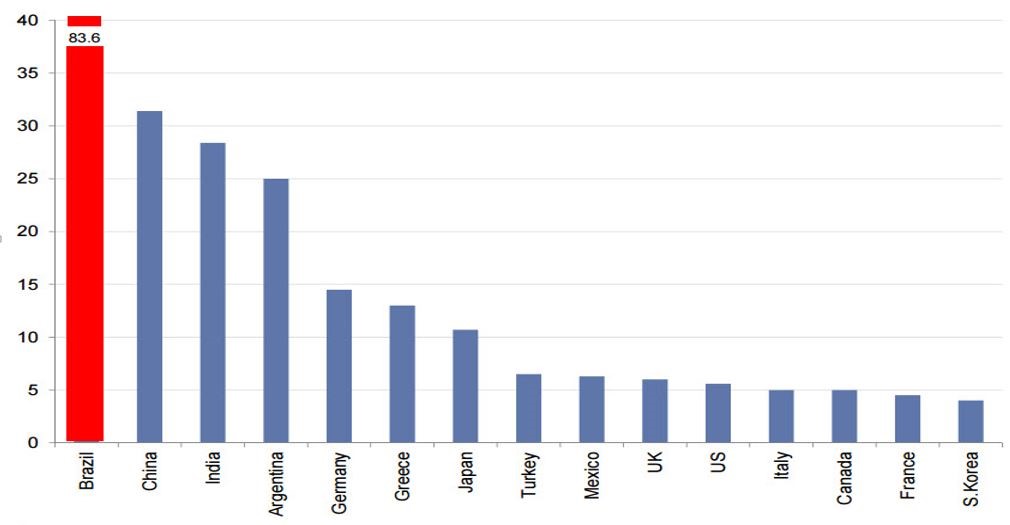
Source: World Bank
In conclusion, we can say that despite the series of protests, corruption scandals and pessimistic forecasts for the Brazilian economy, the light at the end of the tunnel for the country is the calls coming from the streets. “Less Marx, more Mises” was the message that captured attention during the anti-government demonstrations and showed that a significant part of the population no longer wants the state fiasco, which culminated around and after the World Cup, to continue.
[1] The accusation is directed at several directors who took bribes from construction companies and directed the funds to parties in the ruling coalition.





Brazil still does not recognize the existence of a flawed monetary system and is ensuring itself catastrophic crises and debt cancer.
For clarification:
The debt cancer crisis is a problem debt with identifiable damage.
I always say that the problem is the incompetence of civil servants and morals because they steal, and a professor with a Nobel Prize in economics said it well: "worse than state monopolies are private ones," etc. The topic is big.
It is about a systemic crisis explained by Mr. Hitov (PhD in Economics and lecturer at the University of National and World Economy) - (comment #2) - http://darikfinance.bg/novini/111777#comments
Prof. Jeffrey Sachs, advisor to Ban Ki-moon (UN chief), also says it well - ''Today's growth model is inertial and short-term prosperity is bought at the price of huge crises in the future. It can continue for a while, but it will all end in tears and a deep reform of the global financial system is needed.
Milton Friedman has industrial capitalism in mind when he talks about the free market, not financial capitalism, meaning that financial capitalism requires strict regulations, and Friedrich Hayek only means industrial capitalism by free market.
Milton Friedman - The American economic system is socialism for the rich and free enterprise for everyone else. If the average person can't pay his debt, he's forced to live in his car. If a banker can't pay his debt, he relies on the taxpayers to bail him out.
The "invisible hand" of the "free" market has plunged the world into planetary catastrophes, meaning the biggest cause of the catastrophes is the deregulation of financial capitalism, because industrial capitalism is more special and requires neoliberalism, but to some extent.
In other words, the so-called crises of capitalism, "business crises", are simply theft through banks, inflation, etc. "methods".