 EKIP– Expert Club for Economics and Politics A Different Opinion
In a world where market signals are confused, central banks – extremely dependent on macroeconomic indicators, reforms, savings and investments with their own capital – are left in the background, and economies are so fragile in the face of unpredictable events, it is interesting to return to the basics and analyze through the eyes of economic laws and principles the nature and importance of debt instruments, in particular public debt issued by governments.
Latest developments on the bond market
Last week saw a major sell-off in the bond market, raising concerns that the end of the bond bull market is near. The Bloomberg Barclays Global Aggregate Total Return Index, which tracks global bond returns, fell 4% in November, the biggest drop for the index since its inception in 1990.
At the same time, yields on government securities (take for example the 10-year US Treasury) are rising to their highest levels since the beginning of the year.
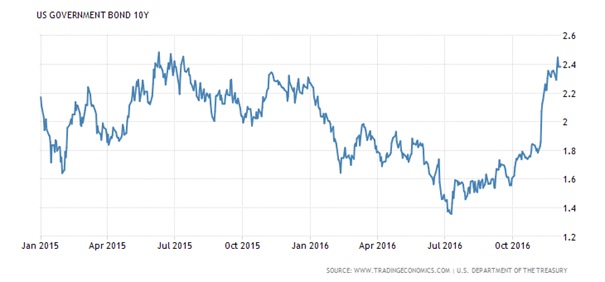
Chart 1: Change in the yield on 10-year US Treasury bonds. Source: Trading economics
Earlier, Goldman Sachs predicted that the increase in yields on long-term debt instruments could lead to large losses for investors holding such assets in their portfolios. According to the financial institution's calculations, a 1% increase in interest rates could wipe $1.1 trillion off the Bloomberg index. However, in November alone, losses exceeded the estimated value, reaching $1.7 trillion off the value of the global index. Among the reasons for this development, analysts point to Donald Trump's victory and his promises to cut taxes and increase spending on infrastructure projects.
Along with some upbeat data on the state of the US economy, these filings have given companies optimism that the conditions for doing business in the US may improve, leading them to shift some of their bond holdings to riskier assets such as stocks. But the key point here is the sensitivity of bonds and the risks they carry, accumulated over years of easy monetary policy and misguided central bank stimulus.
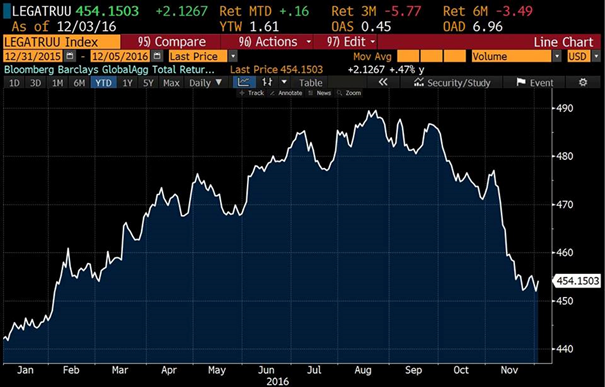
Chart 2: Change in the Bloomberg Barclays Global Aggregate Total Return Index since the beginning of the year. Source: Bloomberg Terminal
It should also be noted that in December, investors will also be focusing on the meetings of some leading central banks. The probability of a Fed rate hike is very close to 100%, and overseas, the question of whether the ECB will extend its bond-buying program beyond its March 2017 deadline is on the agenda. In this context, bonds will be particularly vulnerable to potential actions and changes in interest rate policy, which pose serious risks to the financial system.
In recent years, bond yields have been depressed [1] by central bank policies that have kept interest rates artificially low and increased the risks of substantial capital losses for bondholders in long-term debt instruments as a result of potential interest rate hikes by central banks. Given this predictability, it is interesting to consider why investors buy long-term bonds, particularly long-term government bonds and securities?
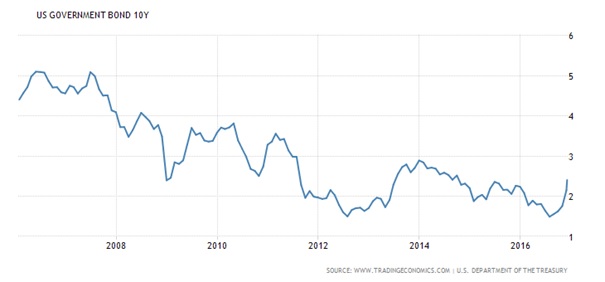
Chart 3: Change in US Treasury yields in recent years.
Nearly seven decades ago, the Austrian economist Ludwig von Mises explained why investors resort to long-term government debt, guided by an illusion. He pointed out that their behavior is based on the belief that the wealth accumulated as a result of investments in risky assets can be protected from the competitive and uncertain dynamic market and preserved forever by a guaranteed income from the state . [ 2 ] By investing in bonds issued by the government, the individual is freed from risk with the promise of a secure income against any shocks. But is this really so?
Economist Joseph T. Salerno emphasizes that the attempt to find an inexhaustible source of income outside the framework of a market economy is futile and would lead to much more serious negative consequences. He gives several arguments for this - first, the real value of interest payments on debt may not be fixed because of the changing purchasing power of money. In the context of the money supply, an indebted government has an incentive to deliberately create inflation by increasing the money supply from the central bank in order to alleviate the real burden of debt service. Second, the funds invested in government bonds are used for current government expenses and do not generate income from productive activities that add value to the real economy.
On the other hand, since resources are limited, investments in government debt lead to missed opportunities for investment in areas that would satisfy the needs and wants of consumers. Of course, these investments may turn out to be unprofitable and punish with losses any wrong and inefficient decision, but the path to economic development does not follow government spending, but productivity, innovative and productive results.
Another economist, Murray Rothbard, points out that deficits and rising debt create an increasingly unbearable burden on society and the economy, as they not only increase the tax burden but also divert scarce resources from productive entrepreneurs to "parasitic" crony capitalists and the public sector. Moreover, when deficits are financed by credit expansion, the situation becomes even worse, as abundant credit leads to rising prices, and hence to a wave of boom and bust business cycles.
Going back in financial history, we see a gradual increase in the amount of public debt. And from here we can logically ask ourselves the question? Does anyone believe that countries (take, for example, the public debt of the United States) can repay their obligations by paying interest? It is obvious that sooner or later all these debts will be liquidated in some way, but it is certain that this will not happen with interest payments and repayment of the nominal value at the maturity of the bonds. [3]
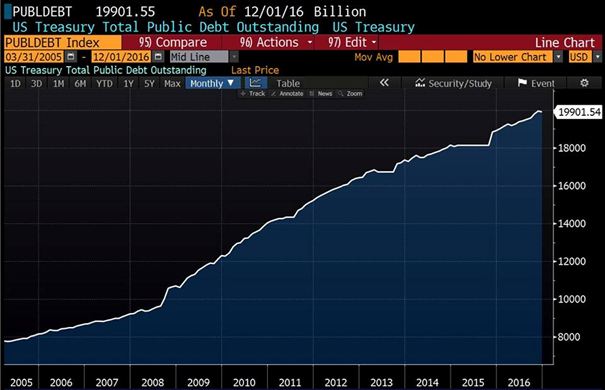
Chart 4: The dynamics of US public debt. Source: Bloomberg Terminal
In this line of thought, we can conclude that investing in long-term government debt poses more of a risk, skillfully disguised by governments and central banks, than a security.
[1] See chart 3.
[2], [3] 1998, Ludwig von Mises, A Treatise on Economics, Human Action; Auburn, Ala.: Ludwig von Mises Institute;






Apparently over 95% of people with an economic education do not understand the problem of why the crisis is systemic - https://www.facebook.com/atanas.shalapatov/posts/1713014525643441
In short, leaving aside the topic of division and productivity of labor, the crisis is systemic because economic growth cannot be infinite, because the final demand from the state and citizens cannot be infinite in a closed system like the Earth, and because of exhaustible energy sources (oil, gas...), and because of global warming - in other words, in order to have infinite growth, we need another Earth and tens of billions more people/consumers of goods and services.
BUT the current structure of the global financial system due to usury, etc., the yield on stocks and bonds needs endless growth, and since this is impossible, a new "system" and a systemic approach are needed - a resource-based and planned ecological economy without interest and inflation, in short, and Jacques Fresco talked about this back in 1974.