 EKIP– Expert Club for Economics and Politics A Different Opinion
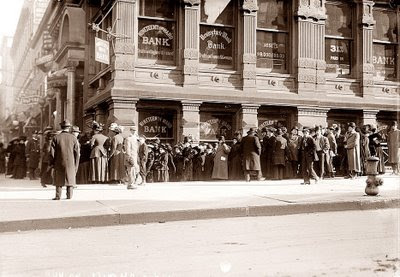
The Governor of the Bulgarian National Bank told the media today that Corporate Commercial Bank is not bankrupt. Not that we can expect another statement from an institution created to save banks from the effects of the credit expansion they generated, but we should note that there is some truth in his words. Without publicly available facts, it is difficult, and unnecessary, to guess what exactly caused the sudden loss of confidence in the bank – and yet, the case is yet another illustrative example of how fragile the banking system is.
Trust is the key word – trust in the bank’s ability to repay the money you deposit according to the terms of the contract, usually without notice. The problem is that under the current system of fractional reserve banking, this trust is misplaced. Not only do banks keep only a small percentage of the required funds in cash (the rest is given out in the form of loans), the vast majority of the money in circulation does not physically exist.
By mixing deposit and credit banking, banks create money substitutes through credit expansion, which is built like an inverted pyramid on paper issued by the central bank. Thus, if all or even a significant minority of depositors in a bank decide to withdraw their money from any bank, the bank will become insolvent because it does not have it, and it cannot have it, since it does not physically exist. The non-existence of cash (i.e. banknotes) in itself is not a serious problem, since such can be printed at almost zero cost. However, this in turn would lead to hyperinflation, because each unit of base money is multiplied many times by passing through the system of fractional banking.
In this sense, Iskrov's statement is true to the extent that CorpBank is no more insolvent than any other bank. It's just that the institution in question, for one reason or another, has now fallen out of favor. Such incidents are especially dangerous for the fractional reserve banking system, because shaken confidence in any bank has the power of a self-fulfilling prophecy, leading to the disclosure of its inherent insolvency. That is, there is always the risk of "contagion" to other banks, which is nothing more than the realization of reality by depositors.
Historically, such events are anything but rare. Fractional reserve banking has caused business cycles and mass bankruptcies since its inception. This practice is not limited to banks; similar actions are possible to varying degrees with other homogeneous commodities such as wheat or oil, for example, and there is no shortage of historical examples of this.
However, creating money substitutes is by far the most tempting option, since other homogeneous goods are always consumed at some point, while money (especially in its current paper form) serves only as a means of exchange and in most cases does not need to physically change location to pass from one owner to another.
Of course, the fraud is inevitably exposed, but while the scheme lasts, it is very profitable. And profitable enough that the state judiciary not only does not punish the practice, but encourages it with various privileges. For example, at the moment, Corpbank has not been declared bankrupt, but all its obligations have been frozen, while its debtors must continue to repay their loans. This different interpretation of bank insolvency compared to other industries is just one of the privileges that the banking lobby has won. By far the most important prerequisite for the viability of partial banking is the presence of a lender of last resort – the central bank.
Here we should ask ourselves what makes the banking industry so special? Why is there no hosiery manufacturer or hairdresser of last resort? Why should the bankruptcy of one company be potentially fatal to its competitors? We owe all this to the fraudulent and immoral practice of fractional reserve banking, which creates money substitutes out of thin air and redistributes wealth in favor of those who acquired the new money first. Unfortunately, the path to restoring a stable monetary order (money created by the market) and returning banking to normal legitimate operation seems to pass through a total bankruptcy of the banking system, in which a huge number of innocent people will lose their savings.






One comment
Pingback: The problem with deposit protection – EKIP – expert club for economics and politics