Georgi Vuldzhev September 23, 2019 Economy, Economic and fiscal policy
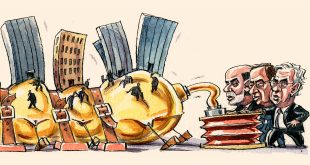
Author: Mark Thornton, Mises.org We are constantly told that unprecedented levels of money printing by the Federal Reserve and other central banks are necessary to stimulate the economy, create jobs, and generate economic growth. The truth is, this is a scheme to covertly steal purchasing power…
More » Georgi Vuldzhev September 19, 2019 Economics, Economic and Fiscal Policy, Translation
By Jeff Deist, Mises.org Bloomberg Terminal, the financial software used by countless analysts and traders around the world, has a problem: its system can’t price bonds that use negative interest rates. The programmers never even considered such a situation possible, so they didn’t …
More » Christian Atanasov July 26, 2019 Economic and Fiscal Policy, Culture and History
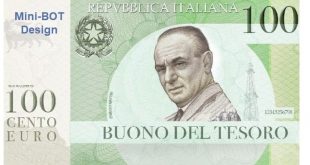
Author: Hristiyan Atanasov About a month ago, The Wall Street Journal published an article explaining the intentions of the Eurosceptic parts of the Italian political sector to issue mini-bonds (mini-BOT from Buoni Ordinari del Tesoro – i.e. lit. “small ordinary treasury bonds”) with a face value of €50[1], according to other sources €100. The idea of …
More » Stoyan Panchev June 21, 2019 Economy, Economic and fiscal policy
The common European currency is not particularly successful in its task of bringing the peoples of the Old Continent closer together – this is easily seen in the division of Europe into one or two speeds, the groups of countries that comply with and do not comply with the Maastricht criteria, and of course the severe tension between center and periphery, north and south, expressed most clearly...
More » Daniel Angelov June 19, 2019 Economy, Economic and fiscal policy
Author: Frank Hollenbeck, Mises.org The gap between the rich and the poor continues to widen. In 1975, the top 1% of the U.S. population owned 8% of the economic wealth. Today, they own more than 20%. This is a striking change from the 1950s and 1960s, when the top 1% owned just over 10%. A study by Emmanuel Saez found that …
More » Krasen Stanchev May 19, 2019 Economy, Economic and fiscal policy
In the midst of Brexit, about which I[i] wrote on June 22, 2016[ii] and where nothing unexpected has happened since the then-forecast, and in the midst of domestically important political topics, the approaching expected actions for Bulgaria’s entry into the “eurozone waiting room” and membership in the zone itself were completely forgotten. If we exclude the statements of …
More » Guest Author April 23, 2019 Economics, Economic theory
Author: Kristiyan Korelov It has been more than a decade since one of the largest stock market panics in the United States occurred. Credit markets had completely stopped functioning (Gorton, 2008), and the situation was very similar to that of the panic of 1907, when banks were in massive need of liquidity and a huge part of …
More » Daniel Angelov March 20, 2019 Economics, Economic and fiscal policy, Economic theory
Wherever we turn, deflation is always portrayed negatively, and every author is quick to present the fight against deflation as the absolute minimum for economic competence. There are two definitions of deflation: one is a “fall in the price level,” as measured by the so-called Consumer Price Index; a definition common to mainstream economists. …
More » Georgi Vuldzhev November 30, 2018 Economics, Economic theory, Translation
Author: Frank Shostak, Mises.org According to many mainstream economists, the lack of a strong correlation between money supply growth and growth in various price indices casts doubt on the theory that increases in the money supply are the main source of inflation. It is also argued that before 1990 there was a positive correlation between …
More » Slavcho Marinov September 06, 2018 Economy, Economic and fiscal policy
Emerging Market Pain May Be a Sign of Future U.S. Trouble Emerging markets are on fire. In the past week, Turkey’s currency crisis has been joined by similar financial conflagrations in Argentina and Indonesia. The central bank of the Gauchos raised its key interest rate to 60% (the world’s highest) from 45%, after …
More »
 EKIP– Expert Club for Economics and Politics A Different Opinion