EKIP– Expert Club for Economics and Politics A Different Opinion
Based on “a broader perspective”, the European Commission has once again taken the step of expanding market regulations and its powers at the expense of individual and corporate freedom. The Tobacco Products Directive was due to be voted on on 10 September, but the bill will be considered again on 8 October. Despite the good-sounding clichés of “sustainable development” and “healthier Europeans”, the prepared intervention is nothing short of health fascism.
If the proposed version of the Tobacco Products Directive is approved, it will bring into force the following changes from 2014[1]:
- "harmonization" of the legislation of the member states
- increase in excise duty per 1,000 cigarettes from 78 euros to at least 90 euros by the end of 2018.
- regulation of electronic cigarettes - cigarettes with a nicotine content above 2 mg. will only be sold as pharmaceutical products in pharmacies
- ban on flavored tobaccos and cigarettes (except pipe tobaccos and cigars)
- strengthening control of tobacco trade over the internet
- introduction of a system for tracking traded tobacco products and tightening control over smuggling; introduction of markings guaranteeing the authenticity and origin of cigarettes (perhaps in addition to the already existing tax stamps)
- mandatory placement of warning text and a photo on 75% of the front and back of cigarette packs (for hand-rolled tobacco and pipe tobacco packages, these percentages will be 30% of the front and 40% of the back surface, but it is planned that these values will be increased to 75% in case the demand for these products increases among the young population)
- replacing the carriage with information about tar and nicotine content with warnings about the negative effects of smoking
- introduction of a minimum number of 20 cigarettes per pack (i.e. ban on small packs)
The introduction and increase of excise duty[2], in the name of protecting consumers from products that they themselves want to consume, is an extremely inefficient and harmful mechanism for the economy. This is especially true for goods with inelastic demand and a lack of substitutes, such as tobacco products. Let us remind the officials in Brussels, who think they know better than us how to make us happier and healthier, exactly what effects follow from this tax.
One cannot fail to pay attention to the groups of people most affected by health fascism. It is always about the most vulnerable categories of consumers – people from the lower social strata. This is because, while for other consumers of tobacco products the increase in the excise tax rate represents a smaller percentage of their disposable income, for people with low incomes, a higher tax has a greater burden on the personal budget. In other words, if the disposable income of a middle-class individual is 2,000 leva per month and the excise tax on cigarettes is 50 leva, this will constitute 2.5% of his income, while for a person with a salary of 500 leva, this percentage is already 10. If individual consumption of tobacco products is maintained despite the increase in the tax, as it happens, given the elasticity of demand, the excise tax will make poor tobacco users even poorer.
The increase in the tax rate will certainly create incentives among consumers to seek out cigarettes “on the black market” – this trend is already clearly visible even with the relatively lower excise taxes. Undoubtedly, this will be most pronounced among smokers with the lowest purchasing power. Researchers on the illegal tobacco markets indicate that a huge part of the goods traded on the black market originate from China, Pakistan or Taiwan and are of extremely low quality[3]. The result will be a direct increase in the health risk of people who will switch to illegal products.
The effects of increasing excise duty are valid not only at the individual, but also at the national level. That is, the illegal trade in tobacco products will have the strongest impact on the poorest member states. This means more smuggling and less tax revenue (if this is of course a bad thing), as well as an increase in the health risk for smokers, due to low-quality products. The poorer EU members are also those in which healthcare is at the lowest level. The end result of the excise duty in these countries (including Bulgaria) will be an increase in the health risk for smokers, who cannot afford to pay the good intentions of European bureaucrats, and a greater risk of fatal outcome from their diseases, due to poor healthcare. Exactly the opposite of what is intended by introducing and increasing the tax on tobacco products.
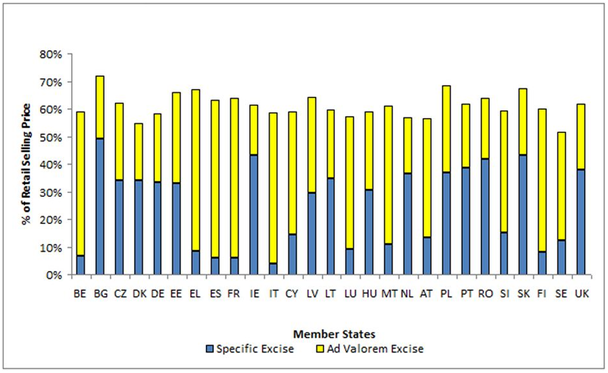
These findings are fully consistent with empirical data from the tobacco market. Due to increased taxes, which constitute a huge percentage of the cost of tobacco products across the EU (see Chart 1), the traded quantities of legal cigarettes are indeed falling.
Chart 1: Excise tax as part of the sales price in EU member states
Source: European Commission, 2010.
Although the officially traded quantity of cigarettes decreased, revenues increased in the period 2000–2010 – again due to higher tax rates (Table 1).
Table 1: Market value and traded volumes of tobacco products
value (2000) |
value (2010) |
change (%) |
volume (2000) |
volume (2010) |
change (%) | |
cigarettes |
90,7 |
121,3 |
33,8 |
793,7 |
608,8 |
-23,3 |
hand-rolling tobacco |
4,1309 |
9,3 |
123 |
53,1 |
75,5 |
42,2 |
pipe tobacco |
0,576 |
0,48 |
-17 |
6,33 |
4,03 |
-36 |
cigars and cigarillos |
4,62 |
4,65 |
0,6 |
7,81 |
9,92 |
27 |
chewing tobacco |
0,48 |
0,83 |
73 |
5,3 |
5,9 |
10 |
values are in billion euros, and volume - in billion short tons or tera tons | ||||||
Source: Euromonitor
While the trade in legal cigarettes is declining, the black market is growing with each passing year, with steady growth over the last six consecutive years (Chart 2).
Figure 2: Market share of contraband tobacco products in the EU

Source: KPMG, 2013, Project Star 2012 Results
More smuggling as a result of increased excise duty means less revenue for the coffers of the member states. According to the cited report, in 2012 alone, the losses for the EU countries amounted to 12 billion euros. If the directive in its current format comes into force in 2014, given the existing trends of shrinking consumption and increasing smuggling, it means that the losses for the coffers of the EU countries will increase.
The bureaucratic drive for a better world through central government and higher taxes will in no way pass by business. As has already become clear, increasing taxes on tobacco products will reduce the amount of “original” cigarettes, at the expense of illegal ones. This will reduce the revenues of companies engaged in legal trade. Lower revenues can only lead to one thing – a reduction in production and an increase in unemployment. It is very difficult to calculate exactly what decline in employment in the sector the new measures will lead to. Roland Berger estimates that the unification of cigarette packaging and the ban on flavored cigarettes will cost the EU at least 175,000 jobs[4]. According to the author, Bulgaria would lose 29,000 jobs. Moreover, the study does not consider the negative effects that will be present after increasing excise taxes on cigarettes; i.e. it can be expected that the number of lost jobs will be even greater. From what has been said so far, it follows that not only will those who continue to consume legal cigarettes become poorer, but those who have lost their jobs will also be deprived of their income if the fetishes for regulating the happiness of the central planners of the European Commission are satisfied.
Apart from the economic and health aspects, the directive, which will be voted on on 10 September, is completely morally unjustified and contrary to the values of a free society and capitalism – values that are the foundation of the EU and which it should protect, not destroy. As Ron Paul says: “When we give the government the right to make decisions for us about our health, we are effectively admitting that the state owns our bodies.” The planned restrictions and increase in excise duty are a direct deprivation of individual freedom, in the spirit of totalitarian states such as Nazi Germany and the USSR. Ludwig von Mises identified the desire of bureaucrats to shape society according to their ideas of “right” and “wrong” – respectively, their desire for dictatorship – back in the mid-20th century. The Austrian economist states: “Every dictator plans to breed, raise, train, and train his fellow citizens, as a cattle farmer does with cows. The aim is not to make people happy, but to bring them to a state that makes him – the dictator – happy. He wants to tame them, to reduce them to the condition of cattle. The cattle farmer is also a well-intentioned dictator.”[5]
Of course, there is no guarantee to EU citizens that bureaucrats will ever curb their health fascism. Similar market-distorting and individual-freedom-taking regulations can follow anywhere – salt is also harmful, for example. Taken to its extreme, the totalitarian social engineering of bureaucrats can best be seen in the US. The “war on drugs” is a huge black hole for taxpayers’ money, which gives special privileges to law enforcement and judicial structures over the individual freedom of people who “harm” only themselves. Their European counterparts have also taken the same path of individual-freedom taking.
The EC's plan to introduce a centralised law to regulate the tobacco market at a supranational level, taking away the right of individual member states to decide for themselves, is economically disastrous. If the planned directive comes into force, the shrinking cigarette market will inevitably suffer an even greater collapse, and the disposable income of individuals and the profits of companies will fall, which will further increase unemployment in the union and reduce the purchasing power of smokers. The regulations will limit the freedom of individuals to dispose of their own bodies. The only beneficiaries of them will be the bureaucrats in the EC themselves - at the expense of absolutely everyone else.