EKIP– Expert Club for Economics and Politics A Different Opinion
Yavor Ganchev
 I've been living in a state of confusion for the last few days. I want Oresharski's #resignation, but if possible, Klisarova to remain Minister of Education for as long as possible. There has never been a more useful Minister of Education.
Let me summarize Klisarova's work over the past year. For a year, she was mainly busy making statements to the media about how the new education law would be ready "by the beginning of next month, or by the middle at the latest" - only to finally announce that there would be no new law until a public consensus was reached on all issues and therefore a "public discussion" was launched.
By habit from the times of socialism, the Bulgarian (if you will allow me to generalize) is used to life happening to him, not him creating his life. The unfree person, the non-citizen lives a life that is administratively predetermined for him. He is educated, given a job and housing, his salary and taxes are raised, he is provided with social benefits, free education, healthcare, television and a pension. His children are looked after in nurseries, kindergartens, schools and universities, then he looks after them until he is 40. They can't even give him a wife/husband, but this is becoming an increasingly less important part of his life, the important thing is to be with a condom. Naturally, in all areas of life, some people have been overcoming passivity for a long time with varying success and actively determining their lives. But in the field of education, we have the least of these. Because while in other areas it is considered normal for people to determine their own lives, when it comes to education, it is considered normal for its content to be determined by the state and its processes to be managed by it. That is, in education, as in communism, "nothing depends on us."
Everyone is talking about education reform, but it is not happening - so there is something that is preventing the reform and of course it is not us (after all, nothing depends on us) - it is necessarily something external. That is why the talk about the reform focuses on the obstacles to the reform - these are a) the lack of a new law and b) the lack of public consensus on important issues of education. Now, the question is, why is the minister talking about the same things - who does she depend on to get the reform done? And, it is true, she is waiting for public consensus; and society (this one with the consensus) is waiting for a new law, and it cannot, because, right, there is no consensus. It rhymes with nonsense. But this is precisely what the ministry's new initiative is about - public discussion with the aim of achieving consensus: "According to the leadership of the Ministry of Education and Science, only with consensus can a law be adopted that will be truly useful, workable and will engage everyone in its implementation." ( http://mon.bg/?go=news&p=detail&newsId=663 )
Referring to public consensus as a factor for any action, however, is very controversial. First, as has already become clear, it is an ideal excuse for doing nothing, because there will never be a consensus between groups with different interests. Second, a free society can live just fine without necessarily having a consensus on all issues; on the contrary, in a free society, diversity and disagreements are the engine of development and it is enough for everyone to look after their own interests without harming others. Consensus, however, is a value for authoritarian systems, because there it is a necessary condition and justification for their functioning; and it is usually nothing more than a euphemism for someone's ideology, imposed by force. Which brings us to the third point - the education system in Bulgaria is not exactly a free society, let alone the opposite. There, all decisions are made by the Minister and so the system lives in a constant and complete "consensus" imposed from above. And that is why the Minister himself is talking to you about "public discussion" in education is, to put it mildly, schizophrenic.
Having mentioned doing nothing, Yakov Hecht in his book "Democratic Education" (published by Iztok-Zapad, 2013) makes a very good summary of the three types of reactions that serve to avoid change in the system. 1. The problems are denied ("Our education is world-class because we have very smart children who win Olympiads") 2. Efforts at "reforms" that do not create a danger of change (for example, this is the constant writing of new rules) and 3. More of the same nonsense that caused the problems (for example, more "discipline" and punishments for students). The thing is that while for Hecht these mechanisms are obvious, for us this realization is yet to come, due to the mentioned problem - those on whom "nothing depends", always in their analysis put the cart before the horse - they attribute the cause of the problem to its victim; If something in the education system is not working, it is necessarily because its objects (the unfortunate students, parents and teachers) are not sufficiently adapted to the system or do not cooperate with it sufficiently. Therefore, the pitiful imitation of public discussion that is currently taking place is precisely imitation (Hecht classification - No. 2) - in essence, it is a call for cooperation to achieve the desired consensus and accumulate material to clothe the next authoritarian decision in democratic clothes. And when this does not work, the reason will not be the fact that the fundamental issues for discussion are absent from the discussion - the reason will be that citizens have not cooperated.
How indicative in this regard are the reactions to the latest pearl of the Ministry of Education and Science - the concretization of the monopoly on textbooks (Hecht classification - No. 3)! There will not be three approved textbooks per subject, but only one. The new, only approved textbook will be printed in the printing house of the Ministry of Education and Science, supposedly so that the publishing houses that have monopolized this sweet business for the last 10 years do not profit from it, thanks to the system invented by... the minister. Not by this one, by some previous one. Although the cancellation of one scheme for stealing money is no guarantee that it will not be replaced by another scheme, right? But since the social experience of those who live a life handed down from above is zero, for them "profit" is in itself a dirty word and when you tell them "the state printing house of the Ministry of Education and Science will operate without profit" - they nod their heads intelligently in agreement and feel joy that the evil privateers will be screwed. By whom will they be screwed? From the same country that is the source and cause of the fraud? Seriously? But this last consideration is very complicated for most people, so "screwing up the bad privateers from the good country" is always good PR.
Quite naturally, a large part of the teaching profession supports this stupidity (one approved textbook for one subject). For them, the presence of a textbook is a conditio sine qua non for practicing their profession. They must be told what to learn, otherwise learning stops. The presence of choice (even the false choice that has existed until now) scares them because it means that a decision must be made. Quite logically, the idea of textbooks and programs free from ministerial approval, of free online textbooks, not to mention the abolition of textbooks altogether and the transition to learning dynamically structured by the teacher himself according to the needs of the group and the personality of the student, cannot be grasped in the minds of these teachers. This would mean creating a system that is adaptive to the needs of the student, and not the other way around. Absurd!
In my opinion, the way to overcome this situation is precisely to bring everything to complete absurdity. For example, there should not only be one approved textbook per subject - let there be one textbook for all subjects for one class, something like a calendar - a notebook, with instructions on such and such a date, read from such and such a page. Let the teaching profession be regulated, so that no one who does not have a diploma as a teacher, issued necessarily by a council of idiots, can teach children, if they want to be as talented as Steve Jobs and Maria Montessori. Let them introduce a licensing regime for children's centers, but not only - let every parent, in order to read a book to their child, have to do it according to a program licensed by the Ministry of Education. Let them bring back uniforms, "class-stand-class-peacefully", introduce full-day, weekend, summer and military training. In the meantime, let's write a new draft law on education that is even more absurd than Milena Damyanova's draft - the latter may seem downright impossible, but let's not underestimate the golden bureaucratic combination "fool + initiative + power".
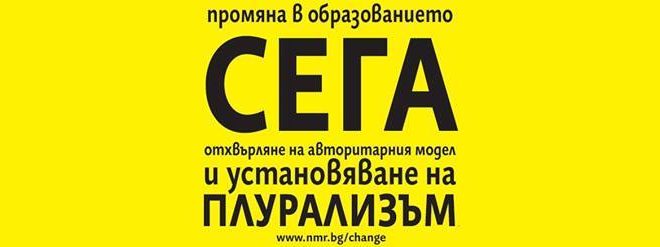
If you've read this far, you're probably already wondering why I find Klisarova a very useful minister? In my opinion, she has all the makings to cope with the task of bringing the system to complete absurdity. Maybe then, finally, teachers and parents will stop running after every slur thrown by the ministry; they will stop rejoicing like children who have been paid attention to when they are presented with clumsy surveys with the loud name "public consultation"; they will stop waiting for society to "ripen for reform" and "reach consensus" - and will take matters into their own hands. All these things for which the ministry is seeking consensus to mask the failure of their management. And it is failing in its management for no other reason than because it is not its job to manage them. It is our responsibility to manage our own education. And the greater the absurdities of this management usurped by officials, the more likely it is that we will finally swallow the fact that just as the Ministry of Culture does not write our books; Just as the Ministry of Agriculture does not sow and reap what we eat; and just as the Ministry of Trade does not sell us in stores – so too the Ministry of Education cannot educate us. This is our job – if we want education, let us do it. And the Ministry should step aside and not interfere ( http://nmr.bg/change ).