EKIP– Expert Club for Economics and Politics A Different Opinion
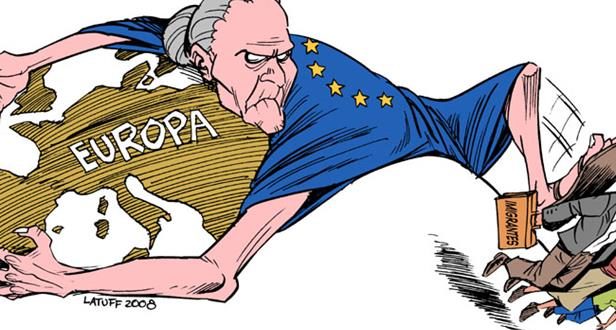
The focus of media and politicians in recent weeks and months has been the so-called “refugee crisis” in the EU. Whether they view it as a “wave of Islamization in Europe,” as many on the right do, or as a “humanitarian crisis,” as many on the left interpret the events, most miss the main reason for it – the total regulatory and political failure of the EU and its member states in the first serious test of the bloc’s border policy. As in many other cases of “external threat,” the possible problems are overexposed and the positives are ignored.
Facts about the crisis
The refugee wave that began last year, primarily the result of several major military conflicts in the Middle East and North Africa, is the largest the continent has faced since the end of World War II. The number of refugees is growing by the day, with Germany alone – one of the countries that has taken in the most of them – expecting 800,000 new refugees to arrive this year alone – four times as many as in 2014.
However, these figures need to be put into perspective. Eurostat data [1] for the whole of last year show that even in Sweden – the country that has accepted the most refugees relative to its entire population – their number is less than 320 per 100,000 people. In Germany, they are only 50 per 100,000, and in Bulgaria – just under 100. [2] In the entire EU, refugees make up only 0.03% of the entire population. From this perspective, it becomes clear that talking about “mass Islamization” and an unbearable flow of refugees is untenable, even if these numbers increase 3-4 times this year.
However, the number of victims among refugees trying to reach "Fortress Europe" for the same period is shockingly high - according to data from the International Organization for Migration for 2015, over 2,600 have died so far, and by the end of the year their number will most likely increase significantly.
The Inadequate European Union
The main reason for the refugee wave turning into a crisis is the policy of Brussels and a significant part of the EU member states. Although the large increase in refugee flows has been visible since the beginning of last year, it took the European administration many months to recognize this as a challenge to its current policy in the area (despite clear signals from Italy and Greece that they are unable to cope with the people arriving on their shores on their own) and even more so to reach an appropriate (in their opinion) solution.
Brussels’ attempt to introduce a quota system for redistributing immigrants clearly demonstrates the EU’s inability to reach consensus and balance the interests of its individual members. While this is not a particular problem in the “day-to-day work” of the union, [3] the indecisiveness of the European administration in such moments of crisis only leads to a deepening of the already existing problems.
Brussels’ sluggishness aside, the EU’s proposed plan to impose mandatory quotas for distributing refugees among countries is a very bad idea. One reason is that it takes into account the population size of the receiving countries, rather than the need and capacity of their economies to absorb refugees. [4]
The bigger problem with this policy, however, is that it completely ignores the willingness or unwillingness of countries to accept refugees and, above all, the choice of immigrants themselves in which European country they prefer to settle and start a new life. Thus, the EU's intention to introduce a quota-based mandatory resettlement scheme goes against everyone's interests, but it does meet Brussels's notion of "fairness" and "solidarity."
The latest ideas put forward by the EU to deal with the crisis [5] are no less totalitarian in nature. On the one hand, they envisage Frontex being given the right to deport “economic migrants” (who, obviously, have no place in the European Union) and to redistribute refugees according to established quotas. Brussels also plans to create a list of “safe countries” from which migrants will be returned, regardless of the circumstances that led them to embark on their journey to Europe.
The solution
To answer the question “what would be a good EU refugee policy,” we must first recall the history of borders and border control. They are relatively new inventions, with their widespread use only beginning after World War I. The goal back then was to create a tool to monitor and control both the movement of people and trade.
As we have seen above, the EU and the individual countries that have received a large part of the refugees are unable to deal with the new wave in the way they are usually used to – by “administering” it. The final solution to the “refugee problem” in this sense can only be found in the refusal of further such “administration”.
The main reason for the deaths of large numbers of refugees is their need to rely on illegal smugglers and smugglers to bring them to European shores and cities in appalling conditions. However, the reason for resorting to the services of such people is the policy of strict border controls and rejection of people from outside the EU.
Viewing refugees as invaders and conquerors is untenable. Equally untenable, however, is the rejection of “economic immigrants” and the distinction between the two categories in general, given that the goal is the same – achieving a better life.
For this reason, the only successful policy towards refugees could only be the abdication of any policy whatsoever – the refusal to redistribute them according to quotas, scatter them among countries, detain them at borders and in camps.
The only adequate “care” for refugees could be to open the borders to them and remove restrictions on their access to the labor market. They could – and will, if allowed to – become the solution to a number of problems that many European countries are facing today. However, as long as the EU continues to “control” the crisis through quotas, borders, and refugee camps, the number of victims will continue to grow, and refugees themselves will continue to be seen as an “external threat.”
[1] Illustrated, for example, at http://www.economist.com/blogs/graphicdetail/2015/09/daily-chart
[2] It should also be borne in mind that a significant portion of these immigrants do not come from the Middle East and North Africa, as many would have us believe.
[3] In fact, I would add, the slower most regulations are adopted, the better.
[4] Which is partly due to the perception that refugees should be the subject of social policy and assistance, instead of becoming part of the labor market.