EKIP– Expert Club for Economics and Politics A Different Opinion
At the beginning of the year, I received an invitation to participate in the Urban Drug Policies conference, which was held in the Polish capital Warsaw. The idea of the event was to bring together Polish officials responsible for formatting and implementing state drug policy with representatives of the sector from other countries with similar or radically different approaches to the problem. The task was to jointly develop a joint declaration with which to send a message to the upcoming UN UNGASS assembly, where a serious revision of the global approach to drugs and citizens who use them is expected. Here I share my impressions
Where is the Iron Curtain on drug use?
Perhaps it is most reasonable to start with what Poland represents on the map of drug use and prevention. Like almost every country from the former Eastern Bloc, in addition to a serious policy of prohibition, drug addicts are also systematically excluded and stigmatized by society. Poles have a history of alcohol abuse, which in the generation of the so-called millennials (18-30 years old) is changing to abuse of new drugs.
Possession of prohibited substances (including cannabis) is punishable by imprisonment in the same way as in Bulgaria. The only difference with our regulation is that with the domestic police you always have a real chance to get away with a bribe, while in Poland this is almost impossible. As a result of the prohibition and the difficulties in finding traditional substances, the use of so-called designer drugs or RC (research chemicals) is becoming increasingly fashionable in Bulgaria. Poland is a kind of leader in the spread of RCs, with the reported use being at least 3 times higher than the average according to the Global Drug Survey 2015.
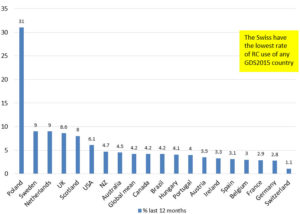
There are cases when in one day, in a medium-sized city, 500 people are hospitalized after problematic use of any substance. Again, the development of this trend resembles Bulgaria. At first, these substances are sold in special stores and behind the production and distribution are businessmen who have no interest in their customers ending up in hospitals or coffins. Then the state decides that this is not the way to go and closes the stores, which leaves the drug market in this 40 million-strong country in the hands of the underground, which in turn transfers it to the Internet. Most ads are not even on the unindexed darknet, but can be reached through a normal Google search. The offers are more advantageous than each other, offering free samples, seasonal discounts and of course… home delivery.
The favorite RC of the Poles is mephedrone, a synthetic cathinone, which has gained fame under the name "bath salts". It is unnecessary to explain the effects of long-term use. It is also unnecessary to talk about the failure of the authorities to limit the supply through prohibitions. It is simply that if you ban mephedrone, metamephedrone appears tomorrow; if you ban it, ethylcathinone appears, and so on ad infinitum. The RCs offered in Poland are so numerous and so diverse that it is practically impossible to influence this process in any way.
The state's approach to the problem is very similar to ours. Police officers are tasked with telling children what hellish torment their lives will be like if they touch any drug, including weed. Videos are filmed of people writhing in agony, ending in a painful death. More and more users are being locked up in prison. Schools are being forced to prepare reports on their prevention activities. Of course, teachers are good at reporting, but not good at prevention...
The conference has begun.
In this environment, the mayor of Warsaw opened the conference. Local officials came out on stage with undisguised annoyance to hum dry data on arrests, convictions, published poetry collections and songbooks, treatment of addicts with methadone. This story is now clear. We have been watching it for decades in Bulgaria. It turned out that they are watching it almost everywhere east of the Iron Curtain (the Czech Republic is the golden exception). Serbia, Macedonia, Hungary, the Baltic states, Russia, they all suffer from the same problem – restrictive legislation regarding drugs is supported by terrifying stigmatization of users by society and health workers.
In Russia, it is believed that any project to provide clean needles to injecting drug users or methadone substitution programs actually encourages people to use drugs, and therefore the authorities do not support them. The chance of getting any medical help as a drug addict is minimal. It is better for society and the state if you are dead, so they try to speed up this process in every way. I was shaken by the story of two women from Kazakhstan who travel 2 hours every day by intercity bus in -20 degrees to get their daily dose of methadone, and this turns out to be their happiest time of the day, if only because then someone exchanges a few words with them. No one from their community recognizes them as alive. If they fall on the street tomorrow, no one will even bother to pick them up. It is unnecessary to mention again the epidemic proportions of HIV and Hepatitis in this part of the continent. Everything is tied up. If you treat people who need help as criminals and enemies, you always get this result - death, broken families, a broken society, a thriving mafia, and all of this paid for by your taxes.
Yes, in terms of the attitude towards drugs, drug addicts, and people in need, Europe is still divided into Eastern and Western. While one is introducing experimental programs, a decentralized approach, and is subjecting the issue to debate among communities, the other, the so-called “Russian school,” has been looking away from this problem for thirty years. The rule is “if you don’t see it, if you deny its existence, then there is no problem.” Much to our regret, our legislative and executive branches excel in this approach. The chairwoman of the National Council on Narcotic Drugs is a Russian graduate, and I bet she hasn’t read a single document in English on the subject. To give you an idea of where we are headed, it is estimated that about 3 million people are infected with HIV and Hepatitis in Russia, while only 1% of the country’s population (1.5 million) is infected with HIV. One of the most common drugs (at least 200,000 use it) is homemade Desomorphine (Krokodil). Crocodile is manufactured in garage conditions by extracting codeine from popular over-the-counter medications, and the necessary phosphorus is obtained from the tips of matchsticks. Russia is probably one of the worst places in the world to be addicted to drugs. Look, if you're an alcoholic, you won't have any problems...
I will stop part one of the story here somewhere. This gloomy picture was important to understand where we stand on the map. In Bulgaria, the people who forge drug laws still believe that cannabis causes schizophrenia and that drug addiction is actually a moral decline that should be corrected (with prison), instead of treating these people as sick and offering them help. In the next part, we will look at several examples of countries and cities in Western Europe where they have adopted a radically different approach… and have achieved success.
This article is part of the collaboration between EKIP and the Bulgarian Libertarian Society 's legalization campaign - Liberty420 - ahead of the "Freedom for Hemp" March, which will take place on April 24, 2016.