EKIP– Expert Club for Economics and Politics A Different Opinion
Adam Ozimek
Disney's second film in the Star Wars franchise isn't perfect, but it succeeds on many levels that George Lucas' second trilogy (Episodes I, II, and III) didn't. For the second time, Star Wars gives us a reason to celebrate the profit motive of a greedy corporation that achieves better results than a visionary writer and artist. Disney's films are not only better, they are also more respectful of the specific story than its creator. Thank you, profit-hungry, impersonal, and greedy corporation. You saved us from the artist.
If you imagine how a corporation would treat a story compared to an artist, you probably assume that the artist would treat the story with more respect than the corporation. The corporation is interested in maximizing its profits, and you can imagine how this could lead to tasteless and exploitative decisions that would squeeze out every last drop of potential profit without much consideration for the overall artistic integrity of the work.
However, in my opinion, in this case, George Lucas is the one who behaved in this way, and Disney has been doing the opposite so far.
First, think of all the times George Lucas has made contradictory plot decisions without even trying to tell a coherent story. When he created the second trilogy, Lucas made R2-D2 and S-3PO pivotal characters with decades of adventures alongside Obi-Wan Kenobi. This is in stark contrast to A New Hope, in which Obi-Wan doesn't recognize the droids at all. That's the most obvious example, but there are others that require explanations ranging from the bizarre to the nonsensical. For example, in Return of the Jedi, Leia tells Luke that she remembers their mother, but in Revenge of the Sith, their mother dies at birth. Leia may have somehow used the Force or simply remembered something wrong, but that explanation also requires her adoptive parents to have lied to her for some strange reason about how young she was when her mother died. Overall, Lucas demonstrates that he doesn't care about such plot elements that simply don't fit.
In comparison, Disney is so consistent about the consistency of the story that they even clean up Lucas's messes. Rogue One is not only a better film than the first three episodes, but it actually bolsters Episode IV by explaining one of the main plot weaknesses: why does the Death Star have such a serious structural weakness? You can read the fan complaints about this detail on the Stack Exchange forum in 2011, and the best explanation you'll find since then is "it's impossible to program software without any bugs." That's obviously not a very good explanation, and it's definitely a flaw in Lucas's plot. But now, thanks to Disney, Rogue One gives us a very good explanation: the structural weakness was intentionally put in by an engineer who sympathizes with the Rebels but is forced to work for the Empire. So Disney basically made an entire movie cleaning up George Lucas' messes and improving the plot of Episode IV.
The Disney films are also much more visually consistent with the original episodes than the second prequel trilogy. George Lucas loved to show off his CGI tricks without worrying about whether it would cause friction with the later story. For example, in the prequels, the Droidekas are powerful druids who are usually used by bad characters. However, the Empire later does not use these droids at all, although in many situations they are more effective than Stormtroopers. An argument could be made that in Episodes I to III the technology is better than in Episodes IV to VI, because the galactic war leads to much larger-scale destruction. However, it is obvious that if the Empire can build a Death Star, then it can also build droids.
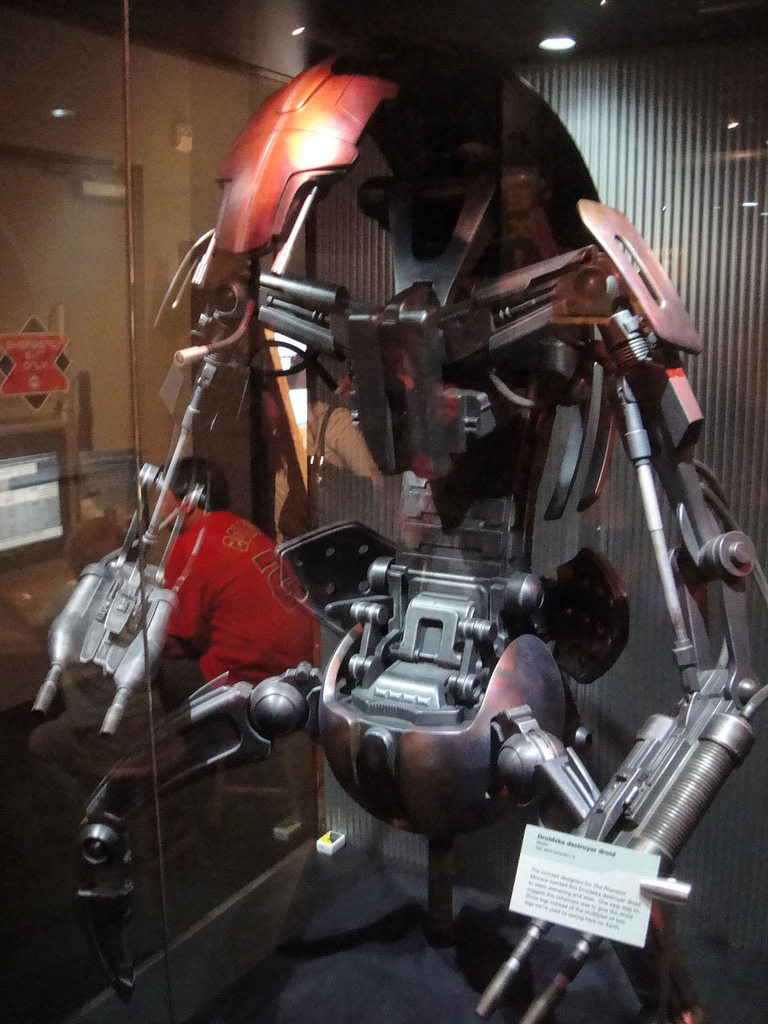
The Disney films are much more in sync with the original trilogy in terms of technology and visuals than the second trilogy. We could criticize Disney for going too far with the nostalgia at times, but they still did a much better job than Lucas, who didn't try hard enough to create a consistent world.
Lucas didn't create a consistent world because he loved using modern CGI technology to create impressive visual effects, no matter how much it weakened the plot. Disney is much better at this. Can you imagine Disney installing CGI effects into the original trilogy that look completely out of place, like Lucas did in the 90s with his "Special Edition" of Episodes IV, V, and VI? No, and that wins them serious points. The CGI effects look extremely dated these days and are too obvious compared to the practical effects of the original trilogy, which still look good. I actually think Disney will one day re-release a restored version of the original trilogy with the CGI effects removed to please fans.
Although George Lucas deserves credit for creating the Star Wars universe, after the original trilogy he seriously failed in his attempts to recreate that universe. He stubbornly followed his artistic vision at all costs without caring about the opinions of others. Disney, through their greedy profit motive, have shown themselves to be much more interested in the opinions of fans and have demonstrated much more foresight as the owners of the Star Wars franchise. Let's thank the greedy corporation.
You can see the original article HERE.