EKIP– Expert Club for Economics and Politics A Different Opinion
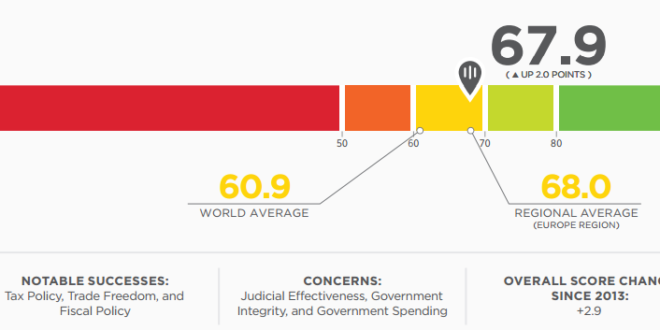
For the past 12 years, the Heritage Foundation, one of the leading and most reputable institutions in the field of economic freedom and policy research, has published its annual Index of Economic Freedom in countries around the world. 2016 is no exception, and Bulgaria reports better results compared to last year's performance, but with our 47th position we are still below the European average. Let's look at the main elements of the index and the reasons for the ranking
Index of Economic Freedom
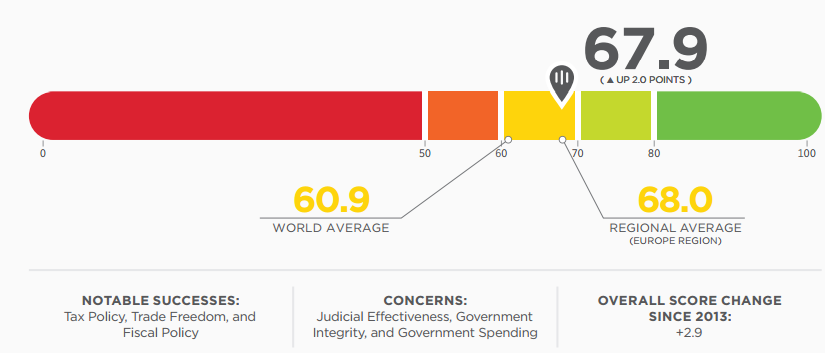
The four main categories, each containing 3 components to calculate the index, are:
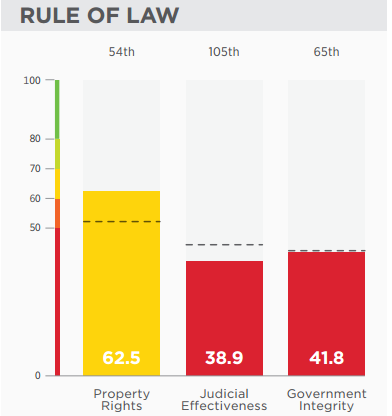
1. Rule of law (property rights, integrity of the state, efficiency of the judicial system);
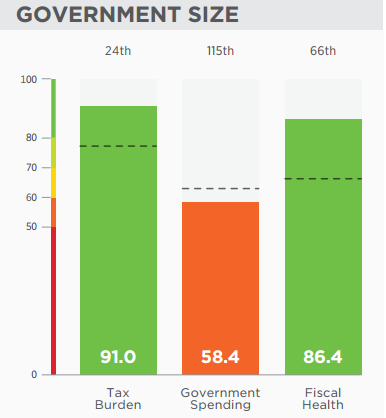
- Limited state intervention (fiscal freedom, public spending, taxation);
- Regulatory effectiveness (business freedom, labor freedom, monetary freedom);
- Open markets (trade freedom, investment freedom, financial freedom).
Rule of law
Property rights are not well protected in Bulgaria. It is well known that private investors are uncertain when it comes to investing in our country due to pressure from NGOs and the state apparatus. And when they seek their rights, they are faced with two main problems with the rule of law – the effectiveness of the judicial system and the political susceptibility to corruption. The criticism from the European Commission and the apparent lack of results in the fight against such phenomena are also reflected in the unenviable 105th place in the judicial efficiency indicator of the Index. The deteriorating conditions for investment are also complemented by political instability and the lack of straightforward policies in various economic spheres.
Limited state intervention
Here, thanks to the still existing flat tax of 10%, Bulgaria performs well, with the total tax burden reaching 26.5%, which makes us an attractive destination for business development. In macroeconomic terms, we also perform relatively well, despite the doubling of our external debt in recent years (26.9% of GDP). Public spending represents 37.2% of GDP, with the largest share in the social sphere, something that does not stimulate personal economic independence and is always a target for political debates and tricks.
Regulatory effectiveness
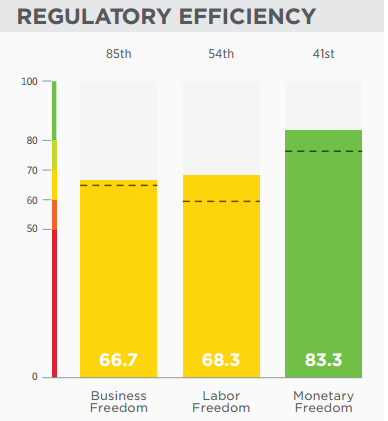
The process of starting a business has been made easier in order to catch up with European standards in this regard. State subsidies have been reduced in some sectors such as energy, but there is still a state monopoly in healthcare, education, postal services, etc. More privatization deals and concessions are needed to liberalize the market and improve the quality of services provided. The main problems in the labor market are the huge "brain drain" annually to other countries and the growing gap between the specific needs of businesses and people looking for work. Flexible labor legislation and a relatively equal level of employment between men and women can be noted as positive aspects.
Open markets
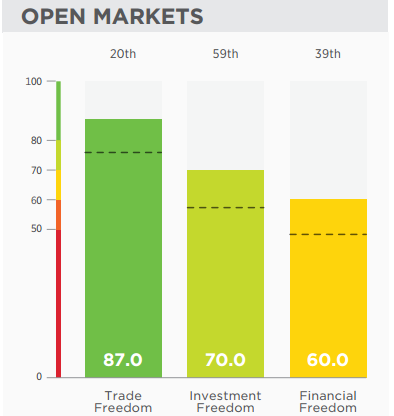
Fortunately, trade freedom in our country is at a good level, mainly due to our membership in the EU, which is a chance for free trade in a large and highly competitive market. Our favorable geopolitical location and ports also serve for imports and exports, which together represent 131% of the country's GDP. As for investment freedom, the legal framework is in line with European and international standards, providing protection against discrimination for foreign investors - despite some recent attempts to change this by domestic nationalists.
The Bulgarian Investment Agency is making efforts to attract foreign investment, but due to problems such as the lack of quality labor in some areas of the economy and corruption, their task is becoming increasingly difficult. In turn, the banking sector has stabilized, which was also reflected in the banks' stress tests. However, doubts remain about certain banks due to documented journalistic investigations in this direction, the EC's refusal to publish the specific results of the stress tests and the impunity after the Corpbank affair.
Conclusion
All identified problems can be solved with clear, concrete and non-populist policies. Unfortunately, the pre-election period is unproductive in this regard and we are witnessing a race of promises that are in the exact opposite spectrum. If quick measures are not taken in the fields of education, healthcare and pension reform, the quality human potential will continue to decrease drastically, which will have a detrimental impact on the economy. The debate on corruption and the need for judicial reform must continue, as well as the monitoring of the European Commission. We hope that at least the flat tax will remain in order to preserve one of the few advantages of our country in Europe.