EKIP– Expert Club for Economics and Politics A Different Opinion
Highlights:
- Higher inflation rate, both in production and consumer goods, for the first time since April
- In the industrial sector, this is mainly due to higher inflation in energy products
- Retail trade continues to grow at a high and stable pace, slowing slightly in July
- Growth in industrial production accelerates slightly, thanks to the manufacturing industry
- The dynamics of the business climate are mixed
Inflation accelerates again across all categories of goods
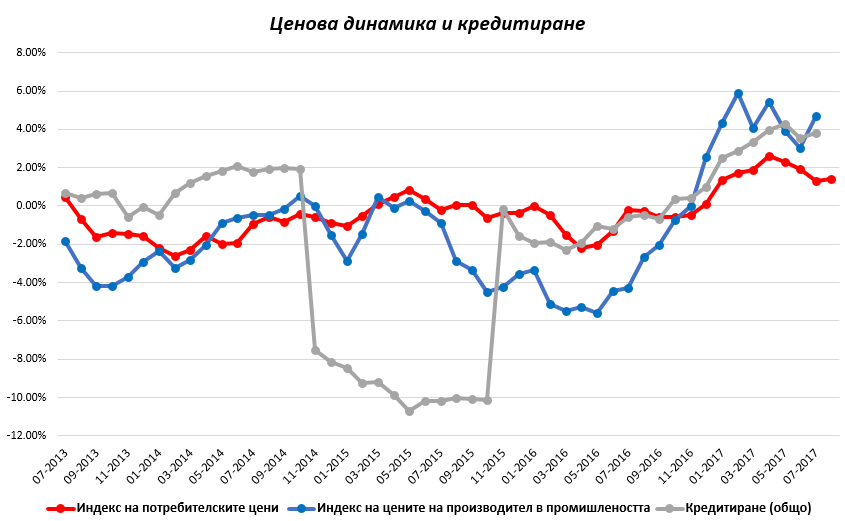
NSI data finally showed an acceleration in inflation for both consumer and producer goods, after three months of continuous decline. Consumer prices rose by 1.42% year-on-year in August, compared to 1.28% in July. Meanwhile, the rate of inflation in producer prices in industry accelerated to 4.68% in July, from 3.03% in June.
Of all the categories, the largest contribution to the acceleration in consumer inflation in August was made by food prices and transport prices. Inflation in both categories of goods accelerated noticeably and reached 2.71% and 0.95%, respectively. However, it should be noted that in general, prices in most categories of goods either grew at a higher rate in August or at least fell at a lower rate. Some of the major exceptions are prices in the tourism sector (restaurants, hotels, entertainment and culture), home furnishings and household goods, and clothing and footwear. In the latter, deflation actually accelerated significantly and reached 2.52% in August from 1.67% in July.
 Source: NSI, BNB
The NSI's alternative breakdown shows that prices in all major consumer categories – food, non-food, and services – are growing at a faster pace in August, and this is the main reason behind the overall acceleration in the inflation rate.
As for the prices of manufactured goods, the higher inflation there is mainly due to the production and distribution of electricity, heat and gas. The prices of products in this sector increased by 10.01% in July, compared to 2.99% in June. This is the highest growth rate since September 2012, i.e. in almost 5 years! Meanwhile, in the other two large sectors – mining and manufacturing – inflation rates are actually slowing down. In the mining sector, the inflation of manufactured goods in July was 6.84%, almost 2 points lower than in June, and in the manufacturing sector it was 2.80%, only slightly lower than in June.

Source: NSI
The alternative breakdown of the NSI confirms these data and shows that inflation in energy products accelerates the most and contributes to the greatest extent to the accelerated growth in the overall price index. Meanwhile, prices of intermediate consumption products, investment and durable goods grow at lower rates. Only inflation in consumer non-durable goods accelerates slightly and reaches 2.14% in July.
Relatively slow credit growth is not necessarily a bad thing
Meanwhile, the BNB's monetary statistics show an acceleration in lending growth. Credit growth increased by 3.80% in July, after slowing to 3.57% in June. Despite this acceleration, lending growth remains below the level reached in May, which was the highest in at least the last 4 years.

Source: BNB
The growth of lending to non-financial corporations accelerated the most. It reached 2.80% in July, compared to 2.10% in the previous month. However, lending to households grew at a lower rate in July compared to June – 5.49%. Interestingly, despite the overall slowdown in the growth of loans granted to households, both consumer and housing loans grew at a higher rate in July. Accordingly, the slowdown in lending to households is due to lower growth in loans granted, which falls under the category of "other loans" in the BNB's classification.
In recent months, there has been much talk about the level of lending in Bulgaria and its alleged relatively low growth. We often hear media experts say that credit growth in our country remains low, even though deposits are growing much more significantly. The fact that credit growth has not yet accelerated much is not necessarily a bad thing. At least considering that only three years ago the banking system in our country was facing its biggest crisis since the Great Recession (2008/2009), there is nothing strange in the fact that banks continue to be cautious. And in fact, despite this, growth in our country remains relatively high in most sectors, and in some (construction), there are even indications that there is a risk of bubbles forming (if they have not already happened).
Moreover, given that the ECB is expected to start tightening its monetary policy soon, in general it is actually better to grant less credit than more. Because if banks grant too much credit to riskier borrowers, their financial situation could seriously deteriorate when the ECB's quantitative easing is terminated and interest rates rise. Yes, Bulgaria is not part of the Eurozone, but our banking sector is very much integrated into the European one, and therefore the ECB's policy cannot but affect the banking system in our country. Not to mention that the lev is still at a fixed rate to the euro.
Retail growth remains high and stable
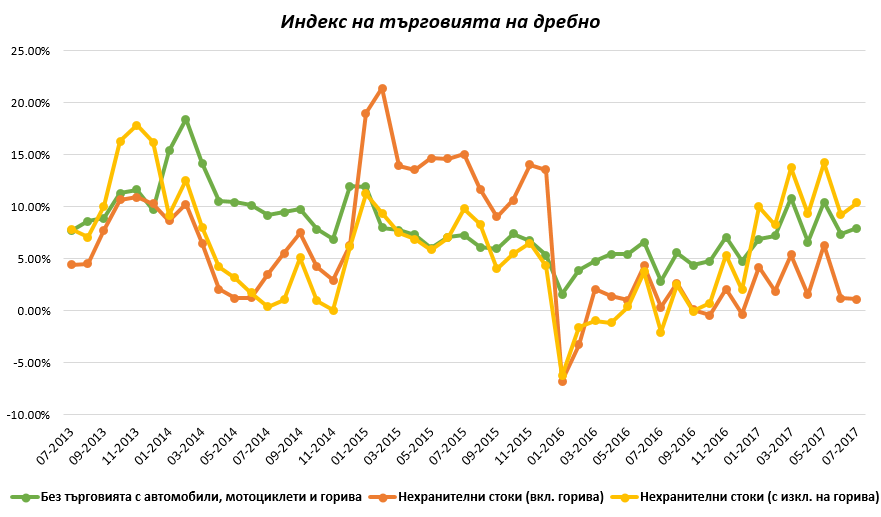
Retail trade growth did not change much in July. It remained relatively high, marking a very slight acceleration compared to the level reported in June and reaching 7.92% on an annual basis in the category excluding trade in cars, motorcycles and fuels. And while the growth rate in this sector is accelerating in our country, it is slowing down in the EU as a whole. The average growth rate among the member states of the union is 2.9% in July, compared to 3.4% in June. Bulgaria once again ranks among the leaders in retail trade growth – only Romania has reported a higher growth rate.
Source: NSI
Trade in non-food goods (excluding fuels) in Bulgaria accelerated by over a full percentage point to 10.36% in July, while the average growth rate in this category for the EU was only 4.0%. However, sales of non-food goods, including fuels, slowed down and grew by only 1.07% in July – the lowest level since December 2016.
По-подробната разбивка на НСИ показва, че най-значителни нива на растеж са отчетени в търговията на дребно с компютърна и комуникационна техника, с разнообразни стоки, и със фармацефтични и медицински продукти. Търговията на първата категория нараства с 20.3% през юли, тази с разнообразни стоки с 18.1%, а тази с фармацефтични и медицински продукти със 7.9%.
Източник: НСИ
Overall, the data indicate that retail trade continues to grow at a strong and stable pace in the early second half of the year, after quite high growth rates in the first. This suggests that consumption in Bulgaria has been growing at a high and steady pace since the beginning of the year. This is also a logical development given the higher levels of lending and the good state of the labor market, which is characterized by accelerated wage growth and the highest levels of employment in several years.
Industrial production is growing faster, while construction is growing slower.
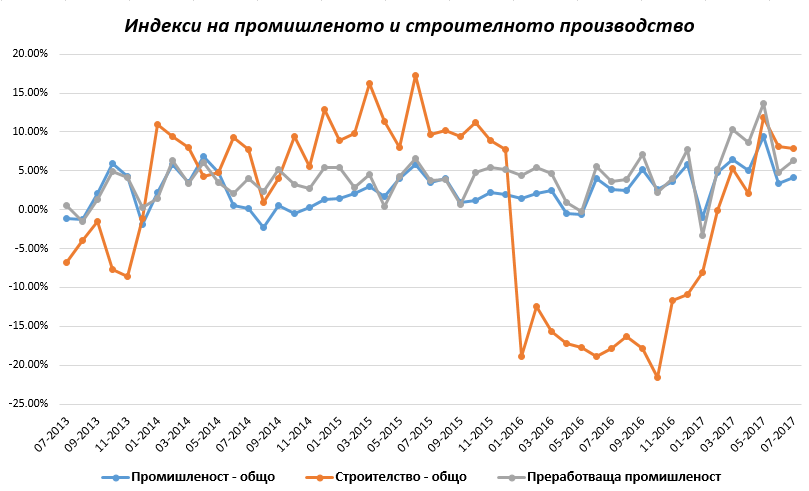
NSI data on the growth of the industrial production index show an acceleration to 4.16% year-on-year in July, from 3.33% in June. This is mainly due to faster growth in the manufacturing industry – 6.32% in July. Meanwhile, after two months of quite strong growth levels, the extractive industry reported a decline of 0.85% year-on-year in its production. In the context of the EU, growth in our country continues to be higher than the average for the union, which is 3.1% in August and we climb several positions up in the ranking to 12th place in industrial production growth, compared to 15th in June.
Source: NSI
Construction output continues to grow, but the overall pace of growth in the core index slowed in July. The growth rate in construction fell from 8.09% in June to 7.92% in July. This was due to a slight decline in civil/engineering construction, after two consecutive months of growth. Building construction, however, continues to grow, and at an increasingly rapid pace. The growth rate in this construction category reached 15.88% in July, almost a full percentage point higher than the level recorded in June.

Source: NSI
Overall, since the beginning of the year, building construction has been growing at an extremely high rate, which raises concerns about the long-term sustainability of this growth. In the context of still very cheap credit at the European level, supported by the highly expansive monetary policy of the ECB, such record-high growth rates in building construction cannot but raise doubts about overpricing and bubbles in the property market. However, the last crisis was the result of a global boom in construction investment, as a result of such a monetary policy.
Industrial turnover grows in parallel with production
Промишленият оборот също отчита по-висок темп на растеж през юли и достига 11.41% на годишна база, в сравнение с 8.78% през юни. Динамиката в под-секторите е много сходна с тази в данните за промишленото производство. Продажбите в преработващата промишленост растат с по-бързи темпове през юли, докато растежът в продажбите на добивния сектор се забавя значенително. Междувременно, продажбите в енергийния сектор растат с 4.10% през юли, което е най-бързия темп на растеж отчетен от началото на 2015 г. насам.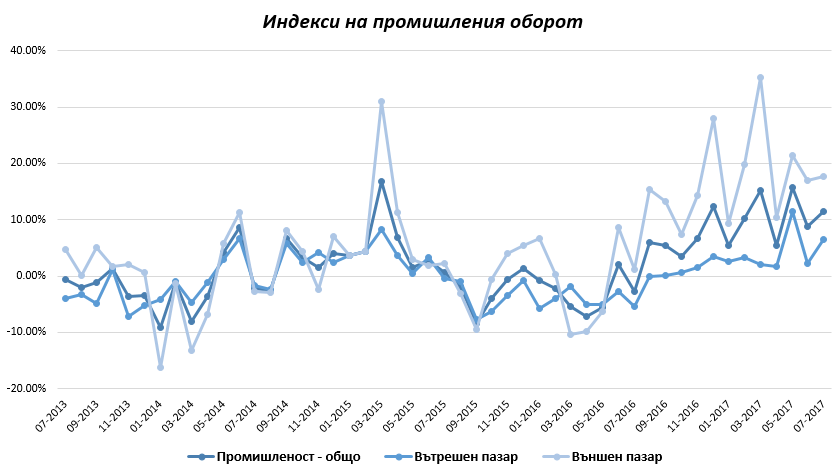
Източник: НСИ
Sales on the foreign market continue to grow at a high rate, which marked a slight acceleration and reached 17.65% in July. What is more remarkable, however, is the growth of sales on the domestic market. It reached 6.57% in July, marking an acceleration of over 4 percentage points compared to the level reported in June. Overall, the data show that the growth in industrial sales continues to improve. In July, the average growth rate in this indicator for the last three months reached 11.97%, which is nearly 2 points higher than the level reached in June – 9.96%.

Source: NSI
Business climate data is mixed
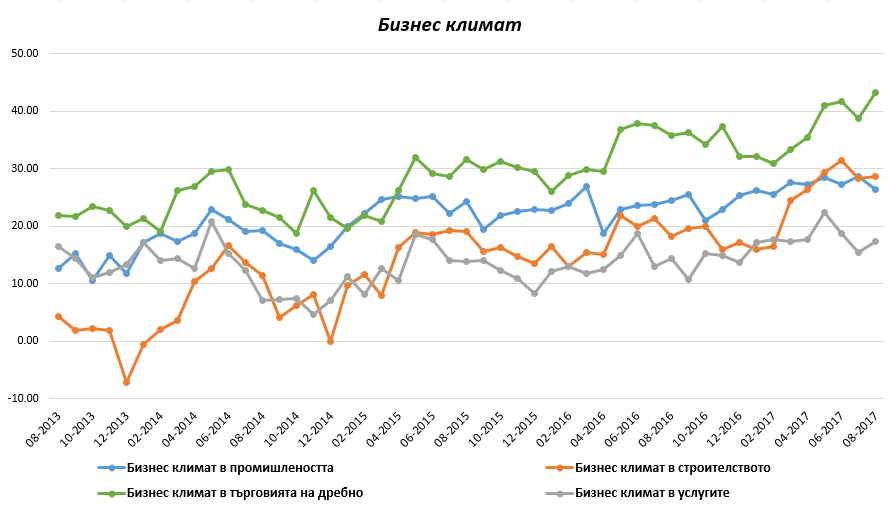
The NSI data on the economic situation in general show mixed dynamics – improvement in some sectors and deterioration in others. Even at the level of individual sectors, the dynamics are mixed.
The business climate in industry worsened by 2.2 points in August, as a result of more reserved assessments and expectations of entrepreneurs about the state of their enterprises. According to the NSI survey, the sector is expected to maintain the current production activity and expectations for activity in the next three months are slightly more favorable. At the same time, the shortage of labor is starting to have an increasingly noticeable negative effect on the development of the sector, according to entrepreneurs. Its influence has been especially strong in the last month. Despite this unpleasant trend, manufacturers are not yet predicting an increase in the prices of their products.
Source: NSI
The business climate in the construction sector in August is practically the same as in July, recording a very slight improvement of 0.4 points to 28.6 . The NSI survey indicates that there is an improvement in the assessments of construction companies for their current business situation, but expectations for the next six months are worsening. Here too, as in the industrial sector, the labor shortage is starting to have an increasingly noticeable negative effect on the growth of the sector in the last month, or at least that is the opinion of the construction companies. In this sector too, no increase in sales prices is forecast in the next three months.
In retail trade, the business climate improved the most, with the index increasing by 4.5 points compared to July, reaching 43.3 points in August. This is the highest level reached in the sector since 2008. The improvement is a result of more optimistic expectations of businesses in the sector about their future financial situation, as well as higher forecasts regarding orders to suppliers on both the domestic and foreign markets in the coming months. Here, the shortage of labor is not cited as a serious problem - entrepreneurs in the sector emphasize insufficient demand and an uncertain economic environment as the main factors that threaten the development of their businesses.
The services sector also reported an improvement in the business climate - the index rose by 1.9 points in August. The reasons for this are similar to those in retail trade - improved expectations for the state of enterprises in the next few months. At the same time, however, the forecasts for the demand for services in the next quarter are less favorable. Here, as in all other sectors, no increase in prices in the sector is expected in the coming months.