EKIP– Expert Club for Economics and Politics A Different Opinion

The brothers Evlogi and Hristo Georgievi were born in Karlovo at the beginning of the 19th century. The older brother Evlogi was born on today's date, October 3, in 1819, and the younger brother Hristo in 1824. Settled in Romania, they participated in the trading company of their relatives (their uncles) Nikola and Hristo Puliev, increased its capital many times, established their own banking house and became one of the most notable Bulgarian entrepreneurs not only of the 19th century, but of all time.
Success in entrepreneurship and early revival activity
Merchants and bankers with an entrepreneurial spirit, Evlogi and Hristo Georgiev managed to turn the enterprise "Pulievi-Georgievi" into the largest Bulgarian trading company during the Revival with offices in Galati, Bucharest and Braila and a network of traders and agents in France, England, Italy. Their income began to increase from financial operations. Supporters of the tactic of peaceful diplomatic actions, during the Revival they were among the founders and leaders of the largest and most active organization of the Bulgarian big bourgeoisie - the Virtuous Company - and played an important role in all its political and charitable endeavors. They supported schools, community centers, churches, a number of societies and public organizations with material means. There was no charitable initiative in which the Georgiev brothers did not participate with significant amounts.
After Hristo's death in 1872, Evlogi Georgiev settled permanently in Bucharest and took over the entire management of the company, but he also actively participated in the socio-political and economic life of the Principality of Bulgaria after the Liberation in 1878. With his business activities and connections, he contributed to the development of trade, industry and banking: he participated with capital in the construction of the Tsaribrod-Vakarel railway line, built a textile factory in Karlovo, had an active share in the export of cereals, and mediated for the Bulgarian government to secure foreign loans.
Evlogi Georgiev - a capable investor and generous donor
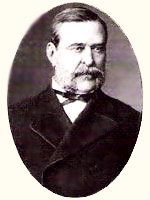 Оценяйки високо значението на просветата и науката за просперитета на нацията, Георгиев насочва дарителските си жестове в тази област. Редовно издържа стипендианти, отпуска помощи на ученици и студенти за следване в реномирани учебни заведения. Особено внимание отделя на просветното дело в Македония и Одринско и допринася за поддържането на националния дух и самочувствието на българите в тези области. Благотворителната дейност на Евлоги Георгиев е насочена и към подпомагане на пострадалите от войните и бедстващи жители на различни селища из цяла България, нкато проявява специални грижи за своя роден град Карлово.
Having lived in Romania for 60 years, he made generous donations to educational societies and organizations. For this activity he received the sincere gratitude of the Romanian public.
Skilled in financial operations, perfectly familiar with the legislation and enjoying influence among local authorities, Evlogi Georgiev managed to preserve and increase the donations made by other patriotic Bulgarians. At the end of the 19th century, the capitals of over 15 wealthy Bulgarians were stored in his banking house, and he personally monitored the proper use of the funds and assisted in their formation as donor funds. He granted loans and purchased shares, as the guiding principle in his activities was strict adherence to the will of the donors.
Georgiev did not keep any free cash in hand. All his capital was invested in various types of short-term loans and banking operations - mainly in intermediary transactions. Under the leadership of the resourceful Karlovy Vary resident, the banking house "Evlogiy and Hristo Georgiev" prospered: in 1839 the capital was 145,000 groschen, and in 1878 the company's main capital was already 11,631,000 Vlach groschen (the initial capital had increased 95 times!)
The legacy that Evlogi Georgiev leaves to Bulgaria
Evlogi Georgiev died in 1897 in Romania. An enterprising, experienced, dexterous and uncompromising merchant, financier and banker, Evlogi Georgiev left over 23,000,000 million leva. Both brothers have no direct heirs - the main part of their inheritance was bequeathed for public benefit. The honor and responsibility of being a universal heir was entrusted to Ivan Evstratiev Geshov, who took care of the implementation of all the testator's instructions.
"Only my hope that I too will be able to participate in the prosperity and greatness of my fatherland makes me die peacefully."
Evlogi Georgiev, considered the richest Bulgarian merchant and banker in the 19th century, was convinced that it made sense to bequeath lands, money, shares, and properties in order to build a modern country. Geshov and General Parensov wrote in their memoirs that “no serious undertaking aimed at the improvement of Bulgaria could do without it.” With the pragmatism of a business man, he correctly assessed that the prosperity of Bulgarian society was unthinkable without higher education.
 В точка 13 на завещанието изрично е посочено: да се отдели от цялото състояние 6 000 000 лева, вложени в ценни книжа и в недвижими имоти. С доходите от тях да се разпорежда сформираната ефория: тя „… ще основе и поддържа едно висше училище в един град на България или Румелия, гдето тя намери за уместно. Това училище да носи името: Братия Евлогий и Христо Георгиеви от Карлово . Ефорията ще постави в салона на училището портретите ни, а в двора на училището ще въздигне в наша памет две мраморни статуи."
Georgiev also specified what types of subjects should be taught in this school - with an advantage being the positive sciences applicable in industry. With the surplus income from the school, Georgiev bequeathed to the Ephorate to " send abroad young people from Karlovo and Macedonia to improve their education in some scientific branch that the Ephorate will determine." These young people, after completing their education, should return to their homeland and serve as professors for four years. The Bulgarian National Assembly will have the right to control the income of this fund .”
The function of the euphoria of the new higher education institution
The will also constructs the formation and activity of the ephory: “ The ephory, charged with the opening of this school and the management of the funds intended for it, will be composed as follows: the Minister of Public Education of Bulgaria and two members, elected by majority vote by my heir and the executors of the will…All members of the ephory will be elected for a five-year term…The decisions of the ephors will be issued by majority vote of the members present. No decision, however, will be issued if 2/3 of the number of members are not present.”
Throughout its existence, the euphoria functioned as a government instrument - its actions remained connected to the state and political structures. With each change of government, the euphoria staff was replaced by individuals from the new ruling party. The execution of the will was also delayed by lengthy lawsuits by disappointed relatives. The motive for the challenge was that, according to them, Geshov had changed the will of the testator.
After many years of disputes, the already existing Higher School (established on October 1, 1889) with a law, history-philology, and physics-mathematics faculty, according to the ephory's interpretation of the testamentary provisions, was restructured with the idea of opening new faculties.
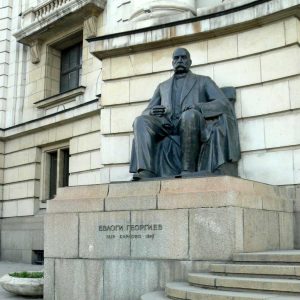
The construction of the Sofia University building began in 1924, and 10 years later it was completed. On December 16, 1934, in a solemn atmosphere, the new university building was consecrated. In front of the facade of the Rectorate, impressive bronze figures of Evlogi and Hristo Georgiev were placed. The sculptors were Kiril Shivarov. In 1935, in contradiction with the legal provisions adopted until then and the traditional respect for donors, Sofia University adopted St. Kliment Ohridski as its patron.
Image source: stara-sofia.blogspot.bg, bulgarianhistory.org, manager.bg