EKIP– Expert Club for Economics and Politics A Different Opinion
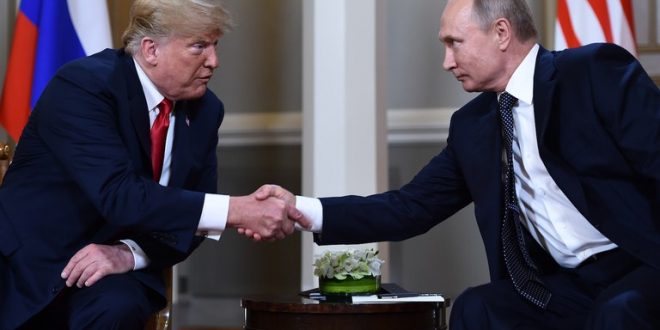
From Helsinki with… love?
The meeting between Trump and Putin in Helsinki was highly anticipated after the sparks that flew between the US president and the leaders of NATO countries last week. The focus was on what tone Trump would set for Russian-American relations amid his conflicts with US allies. The reactions after the press conference were thermonuclear. But what actually happened at this “historic” and “unprecedented” (as some local influencers characterized it) press conference? Well… nothing special.
The speeches of the two presidents contained nothing substantial. The standard diplomatic pleasantries were exchanged, garnished with recitations of old points of support for the cooperation of the two countries in the fight against terrorism, nuclear disarmament and international organized crime. In other words - boring and old points of support, familiar to us from the administration of Bush Jr. The insignificance of the talks was further emphasized by the lack of specifics. No serious treaties, mutual commitments or even declarations were signed, let alone those that would change the strategic circumstances of relations between the United States and Russia.
The only interesting moment came when, in response to a journalistic question, Putin acted defiantly towards the political legitimacy of the US president, offering Russia to cooperate with Robert Mueller’s investigation into the Trump campaign. This was obviously a bluff, part of a psychological game by Putin (who was, after all, a KGB agent), since the logical consequence of this offer was that suddenly the political fate of the US president began to depend on documents provided by the GRU. Of course, this could not be accepted by the Americans, and the press conference continued in the same boring manner.
In short, Trump and Putin saw each other, told each other that there were problems in the relationship, said it would be good to work on these problems, and said that they would eventually work on them in a hypothetically indefinite future in a hypothetically indefinite way.
The reactions
So far - nothing special. But let's look at the interesting part of this story, namely the extremely emotional reactions to this otherwise so banal event:
All Democratic leaders, without exception, have declared that Trump has committed “treason” and his behavior is a “national disgrace.” Prominent New York Senator Chuck Schumer even made an interesting comparison:
Can you imagine if Pres Kennedy believed Khrushchev when he said there were no missiles in Cuba?
Can you imagine if Pres Reagan believed Gorbachev without verifying that the USSR would reduce its missile stockpile?
We’d be living in a much different world than we are today.
— Chuck Schumer (@SenSchumer) July 17, 2018
Democratic Leader Nancy Pelosi was not far behind in her final reaction:
Every single day, I find myself asking: what do the Russians have on @realDonaldTrump personally, financially, & politically? The answer to that question is that only thing that explains his behavior & his refusal to stand up to Putin. #ABetterDeal
— Nancy Pelosi (@SpeakerPelosi) July 16, 2018
Of course, the left-liberal media outlets CNN and MSNBC responded accordingly.
Key Republicans from the party's neoconservative wing joined in the criticism of Trump, effectively echoing Democrats' points. Prominent Bush-era hawk Senator John McCain Jr. delivered a scathing statement that drew a standing ovation from Democrats.
Ohio Republican Governor and unsuccessful 2016 presidential candidate John Kasich criticized Trump on Twitter and then on CNN:
My full statement on President Trump's misguided meeting with Putin: pic.twitter.com/aIHhKUeQCl
— John Kasich (@JohnKasich) July 16, 2018
These attacks are based on statements made by Trump during a press conference criticizing US intelligence agencies for their poor handling of the investigation into Russian interference in the 2016 election. The charge against Trump is that making these criticisms to Putin undermines the US position with one of its greatest enemies, as he appears to trust Putin more than his own services. And while it is true that this is bad international PR, characterizing it as “national treason” is a sign of profound insanity. The reason this argument is untenable is obvious. Trump has made such criticisms many times in public before, and repeating them to Putin cannot create the impression that Trump does not trust the investigative institutions, not least because the Russian president is fully aware of the circumstances surrounding this investigation.
To this we can add the fact that the existence of a political dispute between institutions on a specific domestic issue in no way affects their joint work on foreign policy issues and, accordingly, does not weaken the geopolitical position of the United States towards Russia. Incidentally, inter-institutional conflicts are constantly taking place in the Kremlin, but they rarely become public knowledge due to the comprehensive censorship that reigns in Russia. Of course, they cannot escape the attention of American intelligence services and analysts who pay attention to the picture. And the scandal with the statements of the US President will be forgotten within a few weeks.
The majority of Republicans remained neutral and did not comment on the Helsinki press conference, refusing to defend the president's position. Instead, the focus of their public communication was on defending the nomination of Judge Brett Kavanaugh to the Supreme Court. Such inadequate public behavior can hardly be explained by anything other than internal partisan misunderstanding and a lack of leadership at the Congress and Senate levels.
The hesitancy of the Republican majority, as well as the aggressive anti-Trump behavior of some internal lobbies, de facto gave the Democrats the opportunity to claim that Trump has no support in his own party. In this case, the good old maxim “you lose 100% of the battles you refuse to fight” applies with full force. Of course, it is worth noting the positive exception - the libertarian wing of the Republican Party, led by Rand Paul, were the only ones who defended the president and expressed hope that opening new communication channels with Russia would de-escalate tensions and move the two sides away from war.
Dialogue is especially important when hundreds of millions of lives are at stake, as is the case in relations between the United States and nuclear-armed Russia. https://t.co/6aBndKOhKq
— Rand Paul (@RandPaul) July 16, 2018
Interestingly, Bernie Sanders apparently doesn't think the Helsinki press conference "scandal" is a viable issue from an electoral perspective. Instead of commenting on it, the Vermont senator focused on his #CEOsvsWorkers campaign, which directly accuses the directors and owners of Disney, Amazon, and other large corporations of unfair pay:
Walmart plans to buy back $20 billion of its own stock to enrich its executives and shareholders over a two-year period—not to pay its workers a living wage #CEOsvsWorkers https://t.co/sfpsXH5Fml
— Sen. Bernie Sanders (@SenSanders) July 17, 2018
Ultimately, the Vermont socialist supported Republican John McCain's criticisms, rather belatedly.
The conclusions
Although the reactions to the press conference were very emotional, the conclusions from it are just as expected and banal as its content.
First of all , the political elite's frantic desire to attack Trump at every opportunity is once again confirmed. A pattern has also emerged in which these attacks are played out - the media focuses attention on a certain detail of a given story that makes Trump look bad, the Democrats react violently in tandem with the neoconservatives, and the majority of Republicans fold and do not defend their party. I expect this pattern to be repeated until the 2020 elections, but without bringing the desired result to the president's opponents. Given the state of the Democratic Party and their chosen electoral strategy, a second term for Trump is very likely.
However, it cannot be ignored that in this and several other cases Trump gave his enemies a lot of fuel with his chaotic behavior. His ability to speak without scripts and express his thoughts well is one of his great advantages, but it played a very bad joke on him in Helsinki. The subsequent hastily concocted “clarifications” - that he simply got one word wrong in his answer - cannot be taken seriously and only worsen the situation. And although he usually emerges victorious from such emotional confrontations with Democrats, yesterday the exact opposite happened. The lesson for Trump is that he needs to weigh his words much more carefully if he wants to maintain his advantage over the Democrats and be re-elected.
Secondly, it became clear that there is a sufficiently large bipartisan anti-Russian majority in Congress and the Senate, which cuts off any possibility of a real warming of relations between Washington and the Kremlin. No matter how many pleasantries Trump and Putin exchange at international conferences, foreign policy is done with treaties and agreements. Such are not possible given the current domestic political circumstances in the United States.
Finally, I cannot help but mention the fact that it has once again been confirmed how deep the information distortion is in Bulgaria when it comes to news and analysis from the US. Practically all established media outlets and the influencers and analysts they invited repeated every single point of support for the Democrats one by one. Here is a vivid example:
I continue to wonder what the use is of analysts who do not present their own reasoned reflections on the subject based on facts, but only repeat on air what they have read in the left-liberal Western media. It is encouraging that the other point of view is slowly making its way into our country.