EKIP– Expert Club for Economics and Politics A Different Opinion
"I will not close hospitals under my administration"
Pre-election situation and political promises
The elections are approaching, the political situation is intensifying, the promises to the electorate are becoming more and more radical and unarguable. Each of the candidates is trying to reach interest groups and satisfy their needs and desires. In this turbulent political time, the most pressing problems of each of the systems managed by the state, including the healthcare system, are emerging. That is why we hear exclamations for changing the status of hospitals by removing them from the list of commercial companies, as well as promises for the construction of new state hospitals, as well as for not closing non-working ones "I will not close hospitals during my term".
In March of this year, a crisis occurred at municipal hospitals due to the fact that the value of clinical pathway No. 56, concerning “Diagnosis and treatment of diseases of the cranial nerves (cranial nerves), nerve roots and plexuses, polyneuropathy and vertebrogenic pain syndromes”, was reduced. The association of municipal hospitals independently conducted an analysis that proved that 50% of their revenues depend on the above-mentioned clinical pathway. In this situation, none of the politicians dared to ask the question why most of the municipal hospitals are called “multi-profile”, since they mainly work with one, very narrow profile. The second question that was not asked is – to what extent can each of these hospitals provide adequate and highly qualified medical care for their patients?
What the data tells us
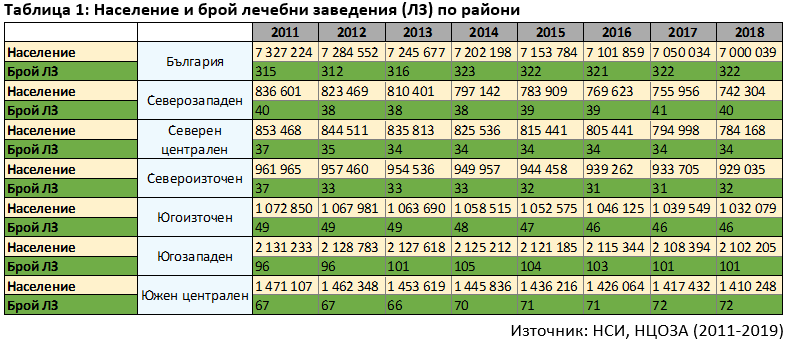
Over the past decade, the number of hospitals in Bulgaria has been growing at a moderate pace annually. The latest data show that there are 65 state, 130 municipal and 115 private hospitals in the country. The number of private hospitals is growing compared to state and municipal hospitals, which are stagnating. Despite the increasing regional population disparities and the relocation of large groups of people from Northern to Southern Bulgaria, the number of municipal and state hospitals, many built more than 50 years ago, remains the same. The stagnation is also due to the fact that 72 of the public companies are on the national privatization ban list. It contains a total of 178 state-owned companies, which means that hospitals form 40% of the enterprises on it.
Another part of the hospitals in the public sector are maintained on "artificial respiration" and are more like municipal social assistance companies than medical institutions. The question that can be asked here is - what is the incentive for a manager of a public medical institution (state or municipal) to maintain high quality and strive to improve its condition, since the political authorities are always ready to help it in case of bankruptcy, as has constantly happened in recent years? The answer is that there is no incentive and thus the burden falls on the shoulders of taxpayers to support inefficient public companies that provide low-quality service.
The situation with private hospitals is different, in case of bankruptcy they should close. There is no state financial protection for them, which is why they are not placed on an equal footing with state and municipal hospitals. But on the other hand, private hospitals carry out unregulated practices of the “hospital within a hospital” type, which aim to redirect patients from the state to the private company with the consent of the managers on both sides. Another negative trend created by the poorly regulated financing system is the creation of private hospitals for patients suffering only from certain types of diseases, which are in the best-funded clinical pathways (CP), namely those for cardiovascular and oncological diseases. Ultimately, the one who eats the pie is not crazy, but the one who forges the regulation. Despite this, private companies offer patients better hospital infrastructure, as well as new and high-quality treatment for various diseases. That is why both the demand and supply of such are increasing.

The lack of timely information
The key information for healthcare is still transmitted in Excel format files between the local structures of the NHIF and the headquarters. Its timely processing depends on the fast and high-quality compilation of data, as well as the optimization of time. All these prerequisites are missing. That is why in March 2017, the project for a National Health Information System was launched with a term of 22 months. At present, none of its elements has been completed or implemented. Electronic healthcare in the country has collapsed several times in recent years after an otherwise secure start.
A few years ago, the National Audit Office issued an audit indicating that over the years there have been several unsuccessful attempts to implement projects to create a National Health Information System (NHIS), with public procurements being terminated for various reasons, and the current project has not even been started. Over the years, due to the termination of public procurements, 9.7 million leva of financial assistance were not utilized once in 2012 and a second time 12 million leva from a European program in 2014. These unsuccessful attempts show, according to the auditors, that "the overall organization of the process of planning and implementing e-health projects and public procurements is ineffective and needs significant improvement."
What is the solution?
Everything in healthcare is connected, so there is no unified right solution to the problems in the field, but steps can be taken in the right direction. Viewed through the angle of financing - revaluing CP according to the needs of the population or moving from CP to diagnostic related groups (DRGs) would reduce the selection of patients based on how much CP costs for their disease, as well as create equal treatment between everyone in the system.
Looking at the number of hospitals and the quality of treatment they can provide, there is only one solution, but after a thorough analysis - consolidation, privatization or liquidation of inefficient state and municipal companies. On the one hand, this will improve the quality of medical services, providing it only to hospitals that meet the standards of good medical practice. On the other - financial and human resources will be freed up for the needs of the system, as well as lighten the burden on the taxpayer's pocket.
O proof: Politicians think short-term - until the next election - any such decision will inevitably deal a blow to their reputation, which means they will not make it. We should not expect correct policies in this direction. We should demand them!