EKIP– Expert Club for Economics and Politics A Different Opinion
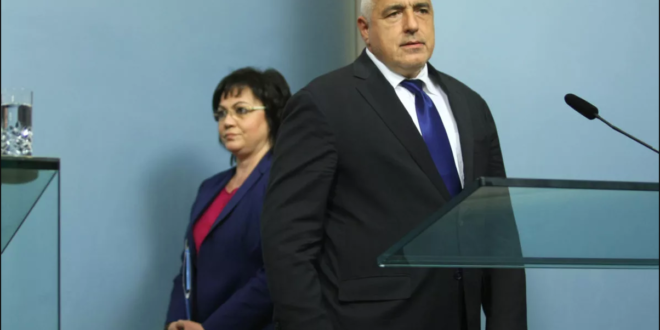
Daniela Daritkova has probably had more pleasant Friday nights than last night. The chairwoman of the GERB parliamentary group was locked up for hours at BNT after her appearance on Panorama. In her appearance, she called for dialogue with the protesters, but a little later it turned out that there was a considerable gap between words and actions. Daritkova was taken out with the help of dozens of police officers, and in the end she even had to run through neighboring yards to finally get home.
This is hardly the sense of stability that GERB wants to convey. The comparisons between Daritkova's exit from BNT and Prime Minister Oresharski's escape through the back doors of the Council of Ministers in 2013 cannot be avoided and will add further grist to the mill of protests. However, this is the least that can be done as a comparison between the BSP and GERB. Boyko Borisov's party has successfully become a clone of its biggest electoral opponent and it would be quite natural if it leaves in the same way.
GERB has become the BSP in many ways – economic policy, way of speaking, media presence and, of course, supporting points why they should stay in power. While in 2013 Boyko Borisov asked the BSP if they were not embarrassed to shout thousands of people under their windows every day, today he has borrowed the vocabulary of Plamen Oresharski and Maya Manolova. While in 2013 he openly urged people to take to the streets, now he hopes that the rearrangement of furniture in the cabinet, proclaimed as a “major renovation”, will make them shut up. And while seven years ago GERB mocked the BSP’s counter-protests, two weeks ago they organized dozens of buses precisely for a counter-protest - after only one day of vocal discontent towards the Council of Ministers.
If only we were like you.
The transformation into the BSP is not from today. The jokes about BKP1 (BSP) and BKP2 (GERB) are nothing new. Usually they were based not so much on the policies of the two parties, but on the fact that both are heavily infiltrated by former State Security agents.
Borisov himself is the best example of this two-party schizophrenia. On the one hand, in his words, GERB protects Bulgaria from “communists coming to power.” On the other, he is proud of his past as a member of the Bulgarian Communist Party and bodyguard of Todor Zhivkov, comparing everything he has achieved with what Zhivkov has achieved. And although the communists killed his grandfather (again in his words; an unproven claim), according to Borisov, his work with Zhivkov was “like a university.”
GERB openly accepted the economic doctrine of the BSP, without saying it out loud. The state entered the economy abruptly, the creation of a state-owned chain of gas stations began, some gambling sectors were partially nationalized, and changes were adopted in others, in favor of only the biggest players. Newspaper distribution was also nationalized, and our entry into ERM II also came after sharp state intervention. Economically speaking, the third GERB government is the most left-wing that Bulgaria has had since Zhan Videnov.
This is also one of the reasons why there is no real opposition in parliament: the BSP simply likes what GERB is doing and wishes it could be in its place – to do exactly the same. What’s more: a large part of today’s BSP still cannot forgive Stanishev’s sin of introducing a flat tax and, again, quite logically, said nothing (at least nothing bad) about GERB’s plans to change the tax system.
Nothing shows GERB’s transformation into BSP better than embracing the idea of the Belene NPP. For years, Borisov spoke out against the project, until he came to the BSP’s position – with too much money poured in and no way out. The only logical option was to end all attempts to make Belene happen. Instead, GERB decided to adopt one of the BSP’s most key policies and raise the bill for the theoretical nuclear power plant by a few billion more, even though the chances of it becoming a reality are still minimal. However, the chances of spending huge amounts of money despite all this are growing.
GERB openly adopted the rhetoric of the BSP. "This is not the people" and "the protests are being led by the scum of society" became emblematic of 2020, just as "Sofia is not Bulgaria" and "the people want a chance for Oresharski" were emblematic of 2013.
However, there are some changes. GERB and Borisov himself openly state what they fear – not so much from early elections (which would be pointless, because regular ones are coming soon anyway, says the prime minister), but from a caretaker cabinet formed by President Radev (which will break the state, says the prime minister again).
Both arguments are meaningless and easily refuted. In February 2013 (yes, it was a long year) GERB demanded elections, and there was less than half a year left until the regular elections. Almost four years later, at the end of 2016, without anyone asking him for it, Borisov resigned again. There was no official cabinet for a long time and it was formed only after Rumen Radev officially became president. So it turns out that when it is convenient for Borisov and GERB, there is no problem in resigning less than a year before the regular elections, nor do Rumen Radev's official cabinets break countries. On the contrary, GERB took quite a few personnel from this cabinet.
Merchants of fear
GERB has become an improved version of the BSP in another aspect, and a particularly important one: the fear mongering. Although the differences between the two parties are becoming smaller and the protesters do not want either of them (Daniela Daritkova was not the only one with interesting incidents on Friday night), GERB's last remaining argument for why it should be in power turned out to be not because they are the best for Bulgaria, but because they are the lesser evil compared to the "communists."
This fear-mongering is especially easy when you have been in power for almost 11 years – and when all the media, with minimal exceptions, work for you. The media comfort that GERB has cannot be compared even to that of the BSP in the party's strongest years after November 10 - the ruling party can sell whatever support it wants without receiving even the slightest critical questions. The main argument for their stay in power is not that they are the best – but that the others are worse, so let's leave them alone. This tactic is perhaps the most successful creation of GERB, because it spreads even among people who do not perceive themselves as supporters of the party.
Today, however, the fear is more in GERB than among the protesters or the opposition parties. There is no right move for GERB. Borisov could resign and go to early elections, which is risky in itself. But he might not resign and go back the way the BSP did in 2013 – when the party lost nearly two-thirds of its election result in just one year. The situation will be even worse because Bulgaria will enter the economic crisis caused by the coronavirus with a delay. GERB’s present and future look an awful lot like the BSP’s past. And this is completely natural.