EKIP– Expert Club for Economics and Politics A Different Opinion

The second wave of the Covid-19 epidemic and the enormous difficulties of the Bulgarian healthcare system in dealing with it brought to public attention issues surrounding the functioning of healthcare, which were already making their way to the forefront of important public topics.
One of these issues is related to the size, training and remuneration of the medical staff – doctors, nurses, orderlies and others. In recent weeks, the labor market in the healthcare sector has also been one of the main justifications of the political leadership in the country for the catastrophic situation in medical institutions. The argument is that the eight months since the beginning of the pandemic were not enough to train/find new doctors and nurses, therefore there was no way to prevent all the problems that arose. Let's review the situation to evaluate this statement.
Number of doctors and nurses
According to the latest available data from Eurostat, the number of doctors in the country in 2018 was 29,625, of which 4,199 were general practitioners, 11,162 were specialists, and 8,292 were surgical specialists. As an absolute value, the number of doctors in Bulgaria is greater than those in countries such as Denmark, Finland, Croatia, Ireland, Slovakia, etc. The exact comparison, however, must be made according to how many doctors there are in relation to the country's population.
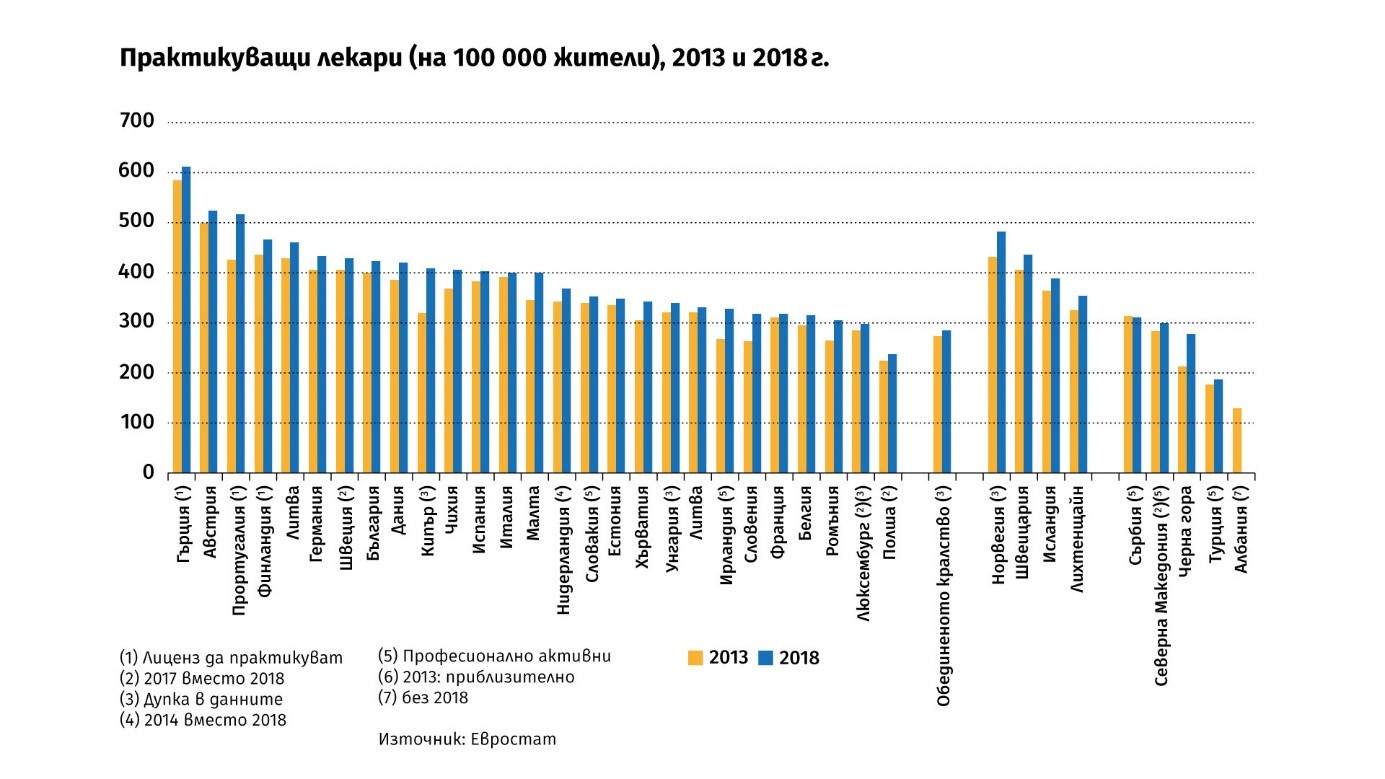
As can be seen in Chart 1, somewhat surprisingly given the rhetoric, Bulgaria ranks impressively 8th in the EU with an enviable 421 doctors per 100,000 people. Behind us in the ranking are countries such as Italy, Spain, the United Kingdom and the Netherlands. Moreover, some countries such as Greece, which demonstrate better indicators, also include retired, non-practicing doctors in their statistics, which artificially pushes them further up the ranking. It is interesting to note that despite serious migration, in the last 10 years, the doctor/population ratio in our country has actually improved by just over 20/100,000.
Here is the time to point out that the age structure of the medical staff is still a serious problem. Young doctors are only about 10%, while over 60% are over 51 years old. Obviously, the system is failing to attract young specialists, which is especially unpleasant, considering that at the same time it educates quite a few of them, as will be seen a little below.
The situation is at the other extreme for nurses. In 2018, nurses in absolute numbers were almost as many as doctors – 30,589, with 73% of them being in. It has been repeated many times that the doctor/nurse ratio should be significantly higher than 1/1 – the average for OECD countries is 2.8/1. That is, over 80,000 in our case.
Graphics 2

From Chart 2 we see that only four countries in the EU have a worse level of nurses compared to the population than our 435 per 100,000 people – these are Romania, Greece, Slovenia and Croatia. That is, we have too few nurses both to the number of doctors and to the total population. Unlike doctors, we observe a slight decline in the ratio of nurses to 100,000 people. According to the latest Eurostat data for 2019, Bulgaria is the country in the EU in which nurses and midwives represent the smallest percentage of all employed – only 1.1%.
Migration of doctors and nurses
We recently showed that the number of Bulgarian doctors working in Germany has more than tripled in the period 2009-2019 - from 652 to 1834. From the database of regulated professions in the EU we can look at the broader picture, which does not cover the entire migration flow, but probably covers a significant part of it. The database of regulated professions shows us how many doctors have gone through the process of recognition of qualifications when moving to another country in the Union.
According to the data, from Bulgaria's entry into the EU until 2020, 3,670 doctors have emigrated, with another 313 in the process of equivalence of diplomas, waiting for a decision and adaptation. This is about 13% of all working doctors in our country in 2018. For nurses, the numbers are 1,876 already emigrated and 734 awaiting a decision, which represents 8.5% of practicing nurses in 2018. These data can be interpreted in the direction that fewer nurses are leaving compared to doctors, at least those who officially use the system for recognition of qualifications. Also, from the large number awaiting a decision, we can speculate that there are a large number of nurses who have recently tried to leave the country and work elsewhere in the EU.
Bulgaria ranks among the countries that are net exporters of doctors, who are mainly from Eastern Europe, but this group also includes richer southern countries such as Italy and Greece. In absolute terms, many more doctors left Poland (approx. 9,000) and Romania (approx. 14,000) during this period, for example, but it is important to compare them again to their number in each country (thus taking into account the differences in population size). Using the ratio of those who left in 2007-2020 to those working in 2018, we can gain some relative insight [1]. It shows us that the situation in Romania, Slovakia, Hungary is worse than in Bulgaria. In all the others, it is a net import of doctors or an export that is proportionally smaller than that of Bulgaria.
When it comes to comparing the migration of nurses, the situation is more complicated because in many EU countries the classification system for this type of medical professional is different from the Bulgarian one. While in our country we only count nurses, the statistics of the majority of European health systems count associated health care specialists, health assistants, etc. In this sense, a precise comparison is beyond the scope of this article, but the main trends are clear. Most European countries have problems attracting nursing staff, with the most successful in this being the United Kingdom, Ireland, Switzerland, Germany, Austria, Norway and Belgium. The rest are losing nursing staff in one form or another.
"Production" of medical personnel
Since it cannot expect immigration flows of medical personnel, the Bulgarian healthcare sector must rely mainly on locally trained personnel. This amounts to about 1,000 doctors per year in 2018.
Statistics also measure this process with graduates per 100,000 people – for us in 2018, this is 15/100,000. The positive trend that the data shows is the almost double increase in graduates per 100,000 people since 2008. A significant part of these new students are foreigners who want to take advantage of the relatively low cost of medical education in our country, which they acquire in an EU member state. Compared to other countries in Europe, we fall in the middle of the ranking in graduates per population.
The situation is significantly worse for nurses. There are almost half as many graduates per 100,000 people – 8.8 in 2018. Moreover, in all EU countries, significantly more nurses graduate per 100,000 people each year than in our country, from two to three times more in some cases. This is a particularly serious problem, given the low base, the aging population and emigration processes.
Income of medical personnel
Salaries and opportunities for higher incomes are a key factor in the state of any labor market. Unfortunately, there are no easily accessible and comprehensive statistical data on the incomes of doctors and nurses in Bulgaria. Publications by Prof. Petko Salchev and Emilia Staneva with data from the National Center for Public Health and Analysis can be found, but they only cover the salaries of doctors in medical institutions until 2016. Very recently, the salaries of hospital directors for the past year were published in the newspaper Kapital.
The most suitable for international comparison are the data from the National Statistical Institute on annual salaries by economic activity. There, the professions of interest to us are classified under the activity "Human health and social work" and the annual salary is 13,962 BGN - 12,978 BGN for the public sector and 16,573 BGN for the private sector.
In its report on the health care labor market [2], the Vienna Institute for International Economics compared the incomes of health care workers in the EU and the European Free Trade Association (EFTA) with the average wage in the top 15 EU countries (EU-15). The results are shown in Figure 3, which shows that Bulgarian medical professionals earn just over 20% of the EU-15 average wage. As can be seen from the chart and the data in the article by Kapital, there are huge disparities in the wages of medical personnel – both depending on their profession and their specialty.
Graphics 3
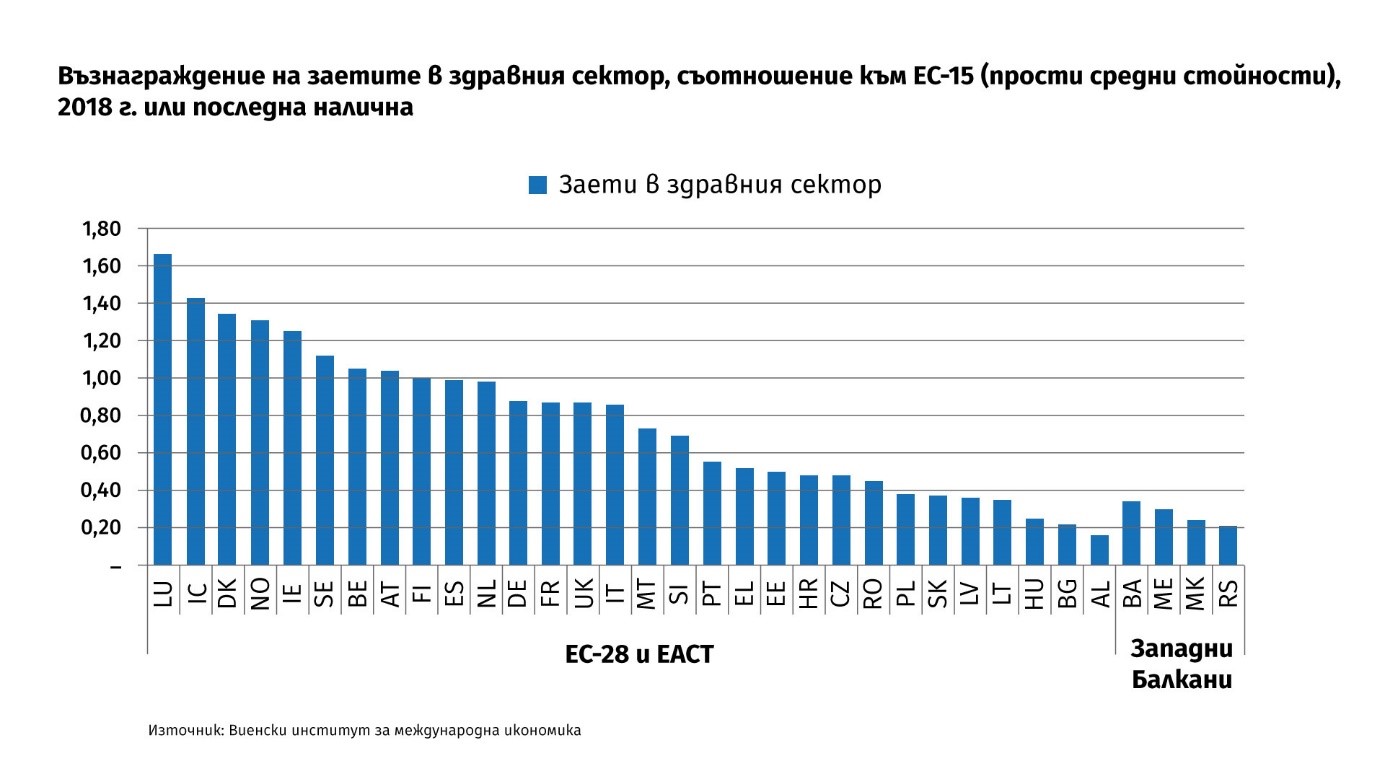
Additional work needs to be done to find and organize more detailed and usable data on the incomes of not only medical personnel in general, but also separately for doctors, nurses, and administration. Either way, the lag is visible and expected.
Conclusions
- Bulgaria is rather at the forefront of Europe in terms of the number of doctors relative to the population.
Given these figures, it is difficult to argue that the rapid collapse of the system in the second wave was primarily due to the number of doctors. It seems that little has been done to prepare in the last eight months.
- Nearly 50,000 more nurses are needed to reach international standards. The nursing shortage is particularly serious and concerns not only the Covid-19 epidemic, but also the overall functioning of healthcare, even in calmer times.
- The education system produces a satisfactory number of new doctors, although there are some leaving, the total number is increasing. At the same time, it is clear that there are significant imbalances between the different specialties. Those with good conditions stay here, those with bad ones go abroad.
- New nursing graduates are few and far between. This is easily explained by the available information – on the one hand, salaries in Bulgaria are very low, while the demand for nurses abroad is particularly pronounced.
- The question remains why the deepening deficit and the large number of people leaving the country are not accompanied by an increase in wages and improvement in working conditions.
[1] More precise comparisons are also possible based on the average number of doctors working and leaving during the period, which also take into account other dynamics that are omitted here.
[2] Mara, Isilda, “Health Professionals Wanted: Chain Mobility across European Countries”, Vienna Institute for International Economics, Report Number 45, 2020
Data source: https://ec.europa.eu/eurostat/web/products-datasets/-/tps00167