EKIP– Expert Club for Economics and Politics A Different Opinion
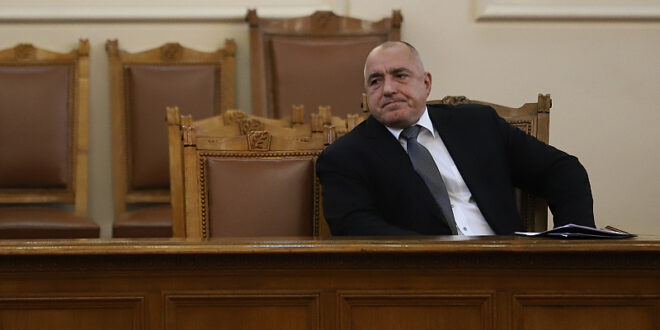
Boyko Borisov is living out his last days as Prime Minister of Bulgaria. It cannot be said that he is doing it particularly calmly: just two hours after the end of election day, he basically scolded the other parties and ordered them to first form an expert cabinet with him, and then to form a cabinet themselves, with his support, as long as there is no caretaker government and early elections. Borisov clearly does not realize that he is now only a pro forma prime minister, in reality he is just an MP - one of 240. The slow and painful break with power also clearly showed the end of a huge myth: that GERB is the lesser evil, compared to the BSP or any other party.
In fact, GERB is the greatest evil. And the reasons for this are not few.
GERB militarized the administration like no other before. The number of civil servants was expanded, and they were told that if someone else came to power, they would be out of a job. With all their shortcomings, the BSP has never done anything like this, as is evident from their results in 1997, 2009 and 2014 – after each of their governments there has been a huge collapse in votes. Under GERB this year there was an outflow of about 350 thousand votes compared to 2017, which realistically should have been much greater if it weren’t for all the tricks to win votes – bought votes, corporate votes, administrative votes or other forms of controlled voting. There are hundreds of stories and reports about each type. This also explains why GERB and Borisov are ready for anything, but not a caretaker cabinet and elections that are not organized by them.
GERB militarizes state resources like no other party has ever done. In practice, the entire 2021 Budget is simply part of GERB's election campaign. Anyone who gets to meet the prime minister, if they catch him at all in Sofia, where he has not appeared very often since July 2020, leaves his office with money. Not the prime minister's money, of course - taxpayers' money, although Borisov always speaks in the first person. Absolutely all free state resources were militarized so that GERB could buy itself a little more time in power, month after month. No government since 1989 has allowed itself such a blurring of the boundaries between party and state, not even the "communists", from whom Borisov, Todor Zhivkov's former bodyguard, believes he is protecting Bulgaria.
GERB has become the electoral wing of the MRF. As a true leader of a corporation, Ahmed Dogan has turned his party into a financial holding company rather than a political machine. The electoral weight of the MRF is controlled and kept artificially low. Why? Because there is no need for it. When the MRF needs to pass a law, this happens through GERB, and vice versa – when GERB needs votes, the MRF is there for it. The BSP has been in coalition with the MRF several times, but when it did, it was overt, not covert.
The media environment was destroyed. A few days before the elections, Tsvetanka Rizova asked Deputy Prime Minister Tomislav Donchev what he thought about the US State Department's finding that there was no media freedom in Bulgaria. Donchev answered the question with a question: did someone write Rizova's questions and whether there was pressure on her. Without realizing it, he actually showed clearly what the report was about: clear pressure on air on a journalist. Because what is the answer to such a question? If the journalist is pro-government and pressured, he will answer "no". And if he is not, he will still answer "no", in general everything is wonderful. Rizova, by the way, answered quite cleverly: "this is not my quote".
And yet, Donchev's question cannot be compared to everything else that GERB has done to the media sector in Bulgaria. And "causes" is the right word. After 12 years of Borisov, the number of media outlets that even allow themselves to write against the government can be counted on the fingers of both hands. Most of them are print, their publishers are constantly attacked by the prosecutor's office, although the state prosecution suffers success after failure.
National television stations are competing to invite only GERB candidates in their most watched hours (this has never been more obvious than in recent weeks), and their most talented journalists have either been fired or left on their own in the last decade. Television investigative journalism has completely disappeared as a genre on BNT, bTV or Nova. Interviews, when they exist at all, have obviously pre-approved questions from both sides (anyone who has worked in a ministry press center knows how these interviews really go). We won’t even cross out the topic of the PIC and the personal preferences of Borisov and other GERB representatives towards Nedyalko Nedyalkov and Petyo Blaskov. The former was promised that there would be no more interviews with GERB on his website in 2019, after he allowed himself to release porn with the wife of a mayoral candidate for Sofia. The promise lasted less than a year.
The media environment in Bulgaria has never been perfect, but it has never been this bad either. With all their negatives, Kostov, Saxe-Coburg and Gotha, and Stanishev largely let both good and bad journalism in Bulgaria develop. Borisov, on the other hand, took a lesson from his third university (after Zhivkov and the Tsar): “Dogan was the first to realize that if he had a media empire and control over the judiciary, he could govern,” he said in an interview in 2014. And shortly after that, the DPS media empire began to work for him, just as Borisov’s administrative and electoral empire began to work for them.
The argument of Borisov and GERB is that anyone can spit on them, which is a fact. As is the fact that every investigative journalist in Bulgaria has been pressured, mentally and physically attacked or threatened, which is why the representatives of the genre have been reduced to a small number of an endangered species. Ministries deny access to information, and when the court tells them that they must still provide it, they send black pages or do not send anything at all, despite the law. The victims of all this work are the aforementioned media, which can be counted on the fingers of both hands. The rest do not ask anyway.
GERB erased any separation of powers (with one exception, but not by their will). With small, uncertain and mouse-like steps, all governments at least since 1997 have been trying to strengthen state institutions, maintain the division between them and impose some kind of democratic tradition, no matter how abstract a concept this may be. Not Borisov. The parliament has become a place for the cheapest lobbying and clientelism, parliamentary control has been thrown out the window, the prosecutor's office has been transformed into a force organization. By the way, the most scandalous of Borisov's recordings is not "PKP". The most scandalous is in the same recording, but a few minutes later - the retelling of the morning meetings between Borisov, Goranov, Geshev and Tsatsarov.
As already mentioned, the line between state and party during GERB became almost as blurred as it was before 1989, so there is nothing surprising in this. However, there is one piece of the puzzle that GERB still failed to fit – the court, which is actually the only institution that stops the prosecution. Of course, judges who disagree with Geshev or Tsatsarov are also often on the pages of PIK and suddenly find themselves with a changed sexual orientation.
The worst thing of all is that everyone probably has something to add to this list. GERB is not the lesser evil. On the contrary, after 12 years of Borisov, we can reasonably conclude that GERB is the greater evil.