EKIP– Expert Club for Economics and Politics A Different Opinion
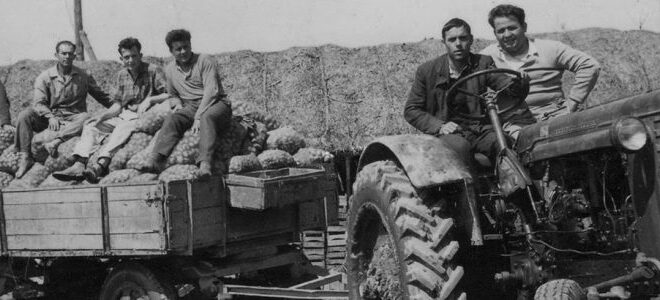
The socialist economic model was imposed on the Bulgarian countryside between 1948 and 1958. The process is known as collectivization. Labor Cooperative Agricultural Farms (TCAF) were created through violence, into which land, livestock, and equipment were taken. Over the years, they were enlarged, restructured, renamed, etc., but their essence did not change.
In this publication, we will focus primarily on everyday rural manifestations of socialism. Through archival materials from the 1960s, we will reveal how two TKZSs functioned in the villages of Burya and Gostilitsa, located in Central Northern Bulgaria. Their microhistory is the basis for two hypotheses that concern enduring characteristics of Bulgarian economic culture.
A little about the big picture
Until the end of the 1940s, Bulgarian agriculture was small, fragmented and low-productive. Even before the communists came to power, options were being sought for the consolidation of land ownership. It was believed that this would increase the income of rural households. This was also one of the main arguments for socialist collectivization. The founding statutes of the established TKZS stated that their goal was to eliminate poverty and ignorance, to overcome the great backwardness of individual agriculture and to achieve higher labor productivity.
Behind the good intentions lies a different reality. Many villagers instinctively sense this and are reluctant to voluntarily enter the TCZS. Their resistance is broken by a combination of violence, economic coercion, and social isolation.
The economic macro picture reveals from another angle the discrepancy between desires and reality. The mechanism that builds the socialist regime essentially robs the rural population. The production of collective farms is bought up almost entirely by state organizations. As a de facto monopolist, the state determines the purchase prices, which are extremely low. In this way, the income of the collective farms, and hence the income of the cooperators, remains low. Resources are seized from the village for purposes that the ruling elite has determined to be a priority. For example, industrialization with an emphasis on investments in heavy industry.
Ordinary socialism
The villages of Burya and Gostilitsa are neighboring, one is part of the Sevlievo municipality, and the other is in the Dryanovo municipality. There, the TKZS were formed towards the end of collectivization. In the village of Burya, the TKZS was founded on March 29, 1956, and began its actual activity on January 1, 1957. In Gostilitsa, the TKZS was established on October 27, 1957. It began its activity on January 1, 1958. Thus, the people of Burya and Gostilitsa were brought into the socialist economic model, where everything was subject to central planning and "strict control".
In the first half of the 1960s, the main characteristics of the TKZS economy in Burya and Gostilitsa became visible. A financial audit of the farm in the village of Burya established that the sowing plan for 1960 adopted by the General Assembly of the TKZS had not been implemented. Of the planned 2,000 decares of corn, 1,000 decares were sown, of the planned 576 decares of barley, 422 decares were sown, etc. That same year, the planned agrotechnical measures were not carried out on time and in full. Sowing was carried out on unprepared soil, and the sowing itself took place late. Fertilization was insufficient. Similar findings were made by auditors for Gostilitsa in 1962 and 1963. There, sowing was not carried out on time, some of the seeds remained on the surface, and many plants froze in the winter. Vineyards and orchards were not cultivated well. In Gostilitsa, untimely fertilization and improper cutting of the vineyards, etc., were found in 1961. Everything led to the failure to meet the planned average yields per decare and total yields from the blocks of the Agricultural Crops and Crops Management System for wheat, barley, corn, oats, sunflower, etc.
The state of livestock breeding in Burya and Gostilitsa is similar. In 1960, 3,000 chickens were delivered to the TKZS village of Burya, of which 1,812 died, 192 of 513 hens died, etc. The chief zootechnician of the TKZS village of Gostilitsa reported on the insufficient nutrition of the farm's sheep and the poor conditions in which the pigs were raised, the sows were placed in damp and dark rooms. Similar information about the state of livestock breeding was also given by the zootechnician in the village of Burya. The results are not surprising: the production plans in livestock breeding were systematically not implemented. In 1962, in the village of Burya, with a plan of 40,000 liters of sheep's milk, 25,806 liters were obtained, with a plan of 165,000 liters of cow's milk, 112,381 liters were obtained.
Several other typical features are evident in the functioning of the two TKZS. Vegetable production is not transported from the gardens on time and a large part of it is allowed to spoil and be thrown away. The person responsible for the vegetable garden in the village of Gostilitsa in 1963 said that in 1962 alone, about 4-5 tons of tomatoes were wasted there. The available equipment is not used to its full potential: tractors are left for repairs for too long, the repairs of equipment carried out by state enterprises are expensive and of poor quality, there is a lack of qualified personnel to work with the equipment, which leads to long downtimes and losses. In both TKZS, overexpenditure of labor is established, i.e. little work is done by many people.
The listed problems explain the poor financial results of both farms. For 1960, the TKZS in the village of Burya planned revenues of just over 3.7 million leva, and received about 2.2 million. For 1963, the TKZS in the village of Gostilitsa managed to exceed its production plans by about 133%, but the planned expenses were also “overfulfilled” by over 200%.
Is there rationalism in the countryside?
The socialist economic model, seen through the collective farms of the villages of Burya and Gostilitsa, seems absurd. But the people who are forced to live and work within its framework find ways to rationalize it.
One of the reactions was the beginning of permanent migration processes, with the younger generation moving to nearby cities. Archival documents reveal two more responses of the cooperators to state-imposed collectivism.
The first is judged rather by indirect evidence. Almost all audit reports from the 1960s speak of the lack of proper primary accounting for the consumption of construction materials, fuel and lubricants and spare parts, for the use of trucks for which there are no properly completed waybills, etc. Individual employees of the TKZS are forced to reimburse large amounts for fuel and other materials for which they do not have accounting documents. Apparently, the common property - equipment, materials, etc. - is used for private needs. Without being theoretically prepared, the cooperators from Burya and Gostilitsa privatize the profits from the common whenever possible, and socialize expenses and other losses. The norms on the basis of which the labor of the members of the TKZS is paid are underestimated by the management. Thus, they are easily fulfilled and overfulfilled, and incomes increase without increasing productivity. Such actions are understandable given the low state purchase prices for the production of TKZS.
The second rational answer in the two TKZS is related to the attitude of their managements to the small market that exists in socialist Bulgaria. The majority of their production under pre-concluded contracts is purchased by state organizations. The output above the contractual deliveries can be placed on the so-called cooperative markets in the cities at prices that are higher than the state ones and therefore more profitable for the producers. It is important to mention that the socialist market is highly deficient. Due to the lack of sufficient consumer goods, it takes almost everything. In this situation, the TKZS Gostilitsa deliberately avoids fulfilling its contracts with the state, and sends its production to the cooperative markets. For example, in 1963, out of the agreed 25,000 kg. of green pepper, 12,000 kg. were delivered to the state purchasing organization. etc. There were quantities to fulfill the contracts, but the production was diverted to the “free market”.
Well, and?
In 1965, the two TKZS were liquidated and transformed into State Agricultural Enterprises. Even the minimal resemblance to a cooperative was destroyed, and the land was nationalized.
TKZS have long been part of the nostalgically forgotten socialist past. The story of the two villages shows how people locally react to the models and structures imposed on them from above. The reaction is rational, but the rationality is not the one that the creators of the model expected. In conditions of blurred responsibility for profits and losses, peasant cooperators stop working hard and find ways to prevent this from leading to a decrease in their income.
In the form of a hypothesis, two more long-term consequences of socialism in the village are outlined. First: it strengthens the love for the common, but not out of a conviction that collective property is better or more efficient, but because everyone can steal from it. And second: it strengthens the belief existing among Bulgarians that contractual obligations may not be respected. These are diseases that permanently damage the economic organism and it is not known whether they are subject to successful treatment.
P. Penchev