EKIP– Expert Club for Economics and Politics A Different Opinion
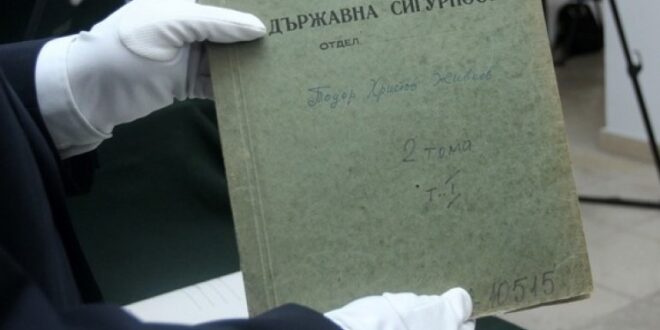
The dog in the title is the State Security (DS) – the secret services of Bulgaria during the communist regime (1944-1989). Their numerous functions also included monitoring various aspects of the country's economy.
The preserved authentic documents with which the representatives of the State Security informed the political leadership about the economy of Bulgaria are important and interesting. They contain a superficial layer of ideological distortions: the obvious mistakes, material losses and even the spread of contagious diseases in livestock are at first glance explained by foreign espionage or sabotage. With a deeper insight by the State Security into the essence of the economic plagues, the chronic shortcomings of the socialist economic model, some of the lasting characteristics of the Bulgarian economic culture and the germs of diseases that soured the transition to a market economy are discovered. This publication focuses on these specifics of the State Security's activities.
The DS dog – breed characteristics
One of the most important characteristics of the DS breed is loyalty to the masters from the ruling communist oligarchy and malice towards their alleged or real enemies. The services try to carefully monitor the pulse of society, to "sniff out" and promptly suppress potential socio-economic threats to the regime. Loyalty to the masters is not entirely selfless. Sometimes the interests of the DS employees are so obvious that they cause discontent among the big bosses. In a top-secret report from the 1960s, dedicated to the style and methods of work of the communists in the secret services, it was noted with irritation that some "comrades use their official position to settle personal matters". The DS is not expected to be a particularly smart dog, because it does not determine the directions of economic and social development. It must be concentrated on its security functions in relation to the authorities. The dog is not a local Bulgarian breed, because in its development and activities it follows the model of the "brotherly" Soviet security services.
During the communist period, with many conditions, Bulgaria can be defined as one giant company. It was run by the oligarchy of the Bulgarian Communist Party. Within the company, the State Security Service specialized in corporate security: thefts, accidents, fires, economic troubles, espionage and counter-espionage of foreign companies from the capitalist world, theft of industrial licenses and technical documentation, collection and provision of information to foreign trade organizations on prices and intentions of foreign partners, etc. The regime's dog has very sensitive information that rarely becomes available to the general public. With its help, the rulers control people's moods, try to correct the increasingly deepening defects of the economic and political model they follow.
The economics of socialism, seen by the DS
The State Security documents contain a number of interesting facts about the state of specific enterprises and business associations. Some of them are perceived as representative of the communist economy and fuel a lasting nostalgia for its "successes". However, the secret services show not just the other side of the coin, but what is the situation behind the shiny facade.
In the 1970s, it was established that the management of the national airline BGA Balkan had been receiving bribes from foreigners for a long time and had concluded deals that were disadvantageous for the country in exchange for personal gain. In 1984, the Second Main Directorate of the State Security prepared information on the difficulties in overseas economic and engineering activities. It was noted that the manufacturer of electric forklifts and forklifts Balkancar was experiencing difficulties with its foreign exchange return, i.e. it was operating at a loss. The reasons for the troubles were synthesized in one sentence: “The market in Iraq, Spain and many other countries in Europe, Asia and South America was lost due to the poor quality of the forklifts, unsecured service and failure to meet delivery deadlines”. In the late 1980s, enterprises from the military-industrial complex began to become a source of anxiety, budget costs and social tension. A top-secret report from 1989. characterizes the economic situation of VMZ - Sopot as particularly unfavorable. Due to the reduction of military production, there is a backlog of production worth over 167 million leva, "2,112 workers and employees have been laid off and excess stocks of explosives have accumulated in the amount of 5,343 tons". The same document states that the mining sites on the territory of the municipalities of Madan and Rudozem, which pollute the environment with heavy metals, lead dust and chemicals.
Very often, from the specific shortcomings in the reports of the services, findings about general characteristics of the Bulgarian communist economy are reached. From the first years of the regime, the State Security Service reported on the existence of commodity deficits and insufficient supply of basic consumer goods. Reports and information for the entire period under review contain information about numerous unfinished construction projects, which froze significant capital investments. Thus, in 1952, the existence of 606 unfinished projects was established, the construction of which had begun as early as 1946. Another constant motive is the enormous mismanagement and waste of raw materials and materials. In the warehouses of enterprises and commercial organizations, large quantities of stale and poor-quality goods accumulate, which cannot be sold even on the unpretentious and deficient domestic market. Enterprises' reports on their production are often falsified in order to obtain high salaries and bonuses. Production and technological discipline and organization in many enterprises is at a low level, workers do not compact their working hours.
Contacts with Western European and American companies are strictly controlled, because they ruthlessly expose all the local shortcomings that the authorities stubbornly hide from the broad masses of the people. The lack of experience, knowledge and, above all, state ownership of the means of production are the cause of errors in deliveries, non-compliance with contractual obligations, etc. Exports consist of low-quality products, often incur losses and are subsidized by the state budget, while imports from Western Europe often purchase old machinery and technologies.
The specter of corruption
The State Security Service's careful look at the specifics of Bulgarian economic life during communism shows that corruption is increasingly present in it. It is especially visible in foreign trade, which was completely monopolized by the state. Corruption causes damage to the state budget when negotiating and concluding contracts for the supply of equipment to the factories of industrializing Bulgaria. Their total size is difficult to establish. There are specific examples that give a general idea of the burden on the budget from corruption. In 1985, it was established that the director of Technoimport had received illegal benefits worth 29,000 leva, in exchange for which obsolete and poor-quality equipment for the chemical industry was imported into the country for more than 35,000,000 foreign currency leva.
Initially, the State Security authorities believed that representatives of foreign companies with which Bulgaria trades were trying to bribe Bulgarian specialists and officials. Too often, the State Security suspected espionage, but careful monitoring of specific cases proved the presence of corruption. In 1984, however, the Deputy Head of the Second Main Directorate of the State Security, Gen. K. Velichkov, noted that very often the initiative to request bribes "passes to our degraded specialists, who most brutally begin to bargain with foreign representatives for the size of the commissions, for the provision of expensive objects and belongings". Increasingly, members of the Bulgarian Communist Party, sometimes in senior administrative and managerial positions, as well as people of working-class and rural origin, have been accused of such actions. Obviously, corruption has an upper-class nature and affects people of all backgrounds.
Another characteristic conclusion reached by the representatives of the secret services is that corruption is extremely persistent. Under the regime, there are those convicted of corruption, but “The educational power and the impact of effective sentences do not give the desired result.” With the presence of huge state property, everyone strives to benefit from the common. Even the strictest control does not eliminate the temptations of easy enrichment.
At the very end of the regime, representatives of the State Security Service came to the conclusion that the shortcomings of the communist economy stimulated the growth of corruption, smuggling, and illegal currency transfers. And the crimes uncovered in these areas already "bear the hallmarks of organized crime."
Who is the dog barking for?
The secret services are better known as an important tool for political repression. The observations and findings they make about the economy are also an important aspect of their activities. From them, the main sores of the regime and the reasons for a number of failures in the years of transition to a market economy are visible. They show the severe and lasting deformations that have been inflicted on the mass economic culture. And last but not least, organized crime was ready for "flight" before November 10, 1989, corruption has seeped into the economically active strata and seems to be an indispensable component of entrepreneurship, contracts with foreign and local partners are executed conditionally and by eye.
After the end of the communist regime, we did not dare to send the dog DS to the yard. From a guard dog of the oligarchy, DS turned into a master dog. It remained in our homes, on television and in newspapers, entered political parties, formatted the way of thinking and contributed to the construction of capitalism in accordance with its own limited and perverse views of a market economy. And today it seems that the evil and not very smart dog gives birth to a generation that is no different from its parent ...
That's why the dog barks for us.
You can learn more about corruption and the role of the State Security Service in it in this video.