EKIP– Expert Club for Economics and Politics A Different Opinion

Authors: Stoyan Panchev, Arkadi Sharkov
- We predict over 2,300 undiagnosed cases of malignant neoplasms for 2020 and 2021.
- We report a 20% and 23% decrease in the number of hospitalizations for 2020 and 2021, respectively, or a total of 1.1 million fewer for both years combined.
- We report missed activities in hospital medical care in the amount of BGN 337 million for the period 2020 and 2021.
The coronavirus pandemic has brought unprecedented challenges to healthcare systems around the world, including the provision of services to patients with illnesses other than COVID-19. When a significant portion of hospital capacity is diverted to managing a newly emerging deadly and contagious disease, other parts of healthcare begin to suffer from shortages – of staff, of workspace, of supplies, and even of patients (fearful or limited in access to treatment).
The health effects of Covid-19 can be divided into four categories. First, there are the direct health effects of Covid-19, which are associated with increased mortality and the effects of the so-called "long Covid" on the organisms of those who have passed the acute phase of the disease. The second effect is the consequences of delayed access to health care, which we will examine in this material, and is related to the refusal and postponement of thousands of important medical procedures as a result of the pandemic situation. The third effect is the direct consequences of the lockdowns - a study in Italy shows 93% of respondents with feelings of anxiety, 42% with a serious drop in mood and 28% with sleep problems after just one week of lockdown [1]. In other words, effects related mainly to mental health. And finally, fourth, effects arising from the long-term economic consequences of the pandemic, which at this stage are most clearly distinguished through the prism of record consumer inflation, occurring including in health services.
The main studies that tracked delayed access to health care during the two years of greatest pandemic activity (2020 and 2021) were sociological. A popular study by the Harvard School of Health Policy showed that 20% of adults in the United States had a household member who failed to receive medical care or received it with delay (for a serious condition) in the first months of 2020. [2] Other studies have put the rate of missed care at half the adult population (52%) [3] or 31% to 42% [4], depending on how delay is defined and what type of health care respondents are asked about.
According to a comprehensive study by the World Health Organization (WHO) [5], 60% of countries in Europe reported suspension or disruption of their established screening programs for noncommunicable diseases during the pandemic. 53% of the countries in the study reported complete or partial interruptions in activities related to hypertension management, as well as those related to diabetes and diabetic complications (49%). Among high-income countries, 17% reported partial or complete interruptions in activities related to the treatment of urgent cardiovascular diseases, and 26% in activities related to the treatment of oncological diseases. 79% of countries in Europe reported partial or complete interruptions in their rehabilitation procedures.
The study also gives us indications as to why interruptions in screening, prevention and treatment activities occur in the various health systems reviewed by the WHO:
- 65% due to a reduction in the volume of the inpatient unit due to cancellation of planned activities;
- 46% due to the suspension of national screening programs;
- 43% due to national or transportation lockdowns and inability to access medical facilities;
- 39% due to relocation of medical human resources to units fighting Covid-19;
- 25% due to reduced volume of outpatient care due to patient non-appearance;
In Bulgaria, a sociological study on the effects of the Covid-19 pandemic on access to healthcare was conducted by the Trend Research Center in July 2021 [6]. It shows that nearly 40% of patients suffering from chronic diseases had problems with access to diagnostics and treatment as a result of the pandemic - delay or interruption of treatment, delay in diagnosis. Of the respondents, 22% canceled a medical examination, 16% a hospital visit, 12% canceled or delayed therapy, 20% had problems with access to a general practitioner. 32% of Bulgarians described their access to healthcare services as "problematic".
Graphic 1:
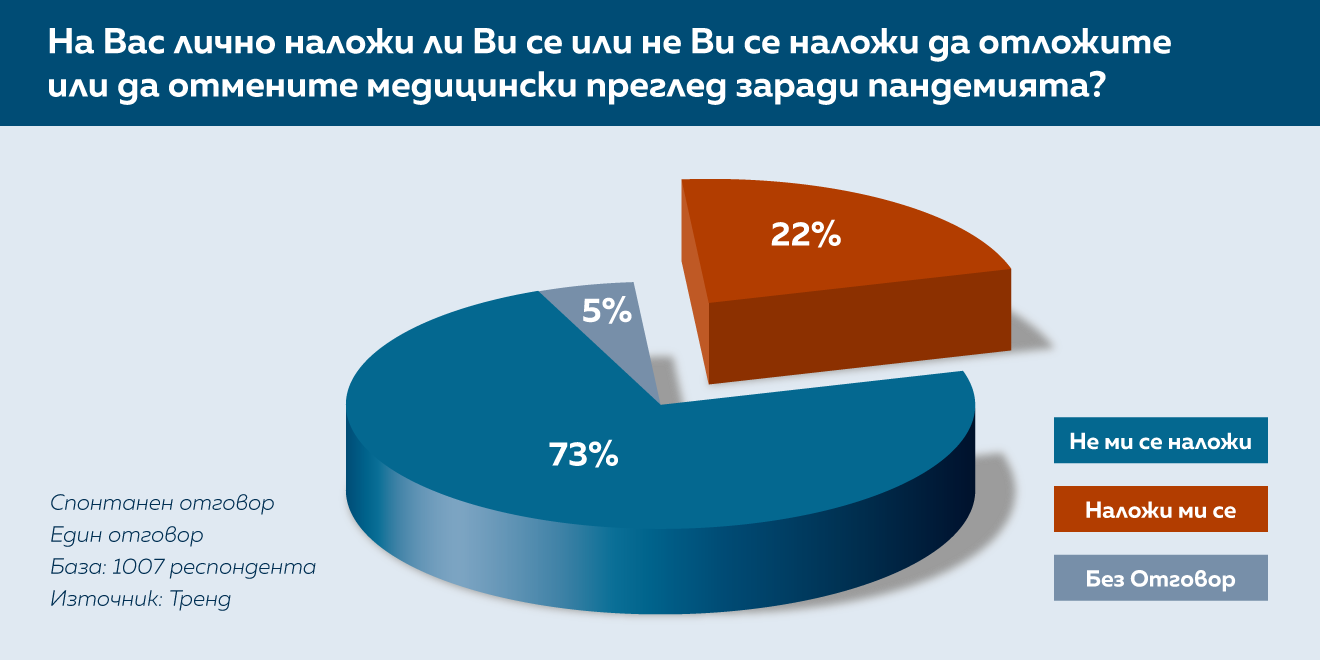
As shown in Chart 1, similar to the data from the US, in Bulgaria, just over 20% of the population has postponed a visit to a medical professional due to pandemic restrictions. Which is further worsening, considering the low percentage of Bulgarians who visit the doctor for preventive examinations – as many as 71% have not had such an examination during the pandemic, according to Trend data.
Sociological surveys are useful for presenting the picture while observing the development of the studied phenomenon. That is, by collecting sociological data, we can obtain confirmation that a certain situation has arisen beyond anecdotal observations and we can gain a generalized idea of the scale of what is happening. For a post-factum analysis of the effects of delayed access to healthcare, we can judge from the health statistics already available for 2020 and 2021.
In this study, we will examine three health indicators from the period of the Covid-19 pandemic in Bulgaria – (i) registered newly diagnosed diseases of malignant neoplasms, (ii) number of hospitalizations for the entire health system, and (iii) the difference between approved and paid values of health insurance payments for hospital medical care (HMC) and for medical devices used in HMC.
1. Newly discovered diseases from malignant neoplasms
Statistics on newly diagnosed malignant tumors are collected by the National Center for Public Health and Analysis (NCPHA) on an annual basis. At the time of writing, the latest available data is for 2020, with those for 2021 not yet published.
To assess the delayed diagnosis of malignant neoplasms, we first use historical data before the onset of the Covid-19 pandemic to derive, through a forecast based on linear regression, the expected path of development of diagnosed cases in an equilibrium environment, without the presence of lockdowns and other restrictions on access to treatment. In this way, we have a basis for comparison with the real situation that has occurred in the country since the start of the Covid-19 pandemic.
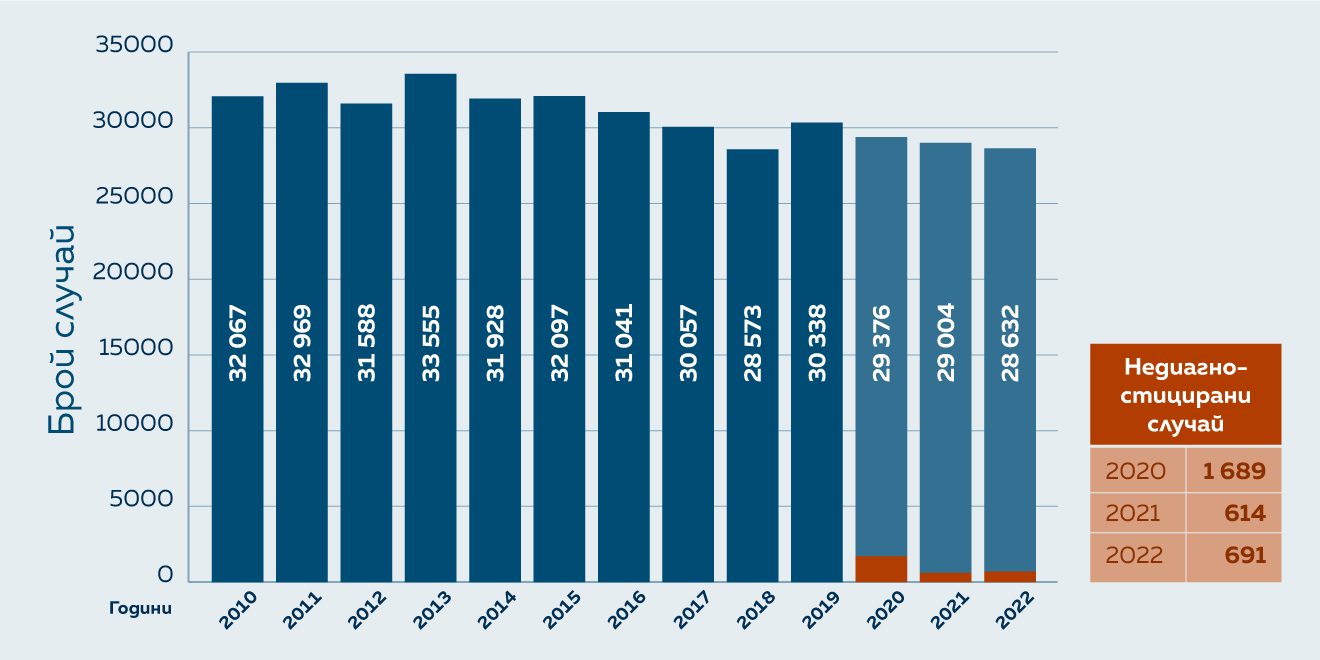
In Chart 2, these predicted values in an "equilibrium environment" are marked in orange and represent a continuation of the trend from 2010-2019 and are 29,376, 29,004 and 28,632 for 2020, 2021 and 2022, respectively. Since we have the actual reported cases for 2020 in the amount of 27,687 from the annual data of the National Center for Health and Family Planning, we can calculate that the undiagnosed cases for 2020 are 1,689.
Having the reported data for the “pandemic” 2020, we can derive a new forecast using the same linear regression method, taking into account the change in the trend and obtain the new trend “after the impact of Covid-19” for the years 2021 and 2022. Accordingly, our model shows that the undiagnosed cases for these years will be 614 and 691, respectively. It is important to note that since in 2022, the restrictions related to the Covid-19 pandemic are not in place, we can actually expect another reversal of the trend towards a higher number of diagnosed cases. In effect, to catch up with the undiagnosed cases reported in the previous two years, which our model shows to be 2303 for the two years of limited access to diagnostics. Additional pressure for diagnosing these cases will likely be the deteriorating condition of the patients themselves, who have been left without the necessary medical attention in some cases for a period of two years.
Chart 2: Reported and projected rates of undiagnosed malignant neoplasms 2010 – 2022
Source: NCPHA, own calculations
2. Hospitalized cases in inpatient units of medical facilities
The number of hospitalized patients in medical facilities is another indicator of health statistics that can illustrate the problem of limited access to care during the Covid-19 pandemic. As with undiagnosed cancers, a large number of delayed hospitalizations also means a large number of unresolved health problems that will sooner or later manifest themselves, possibly in a more acute form, creating a need for delayed consumption of health services.
The reporting of hospitalized cases in the inpatient units of medical institutions is also carried out by the National Center for Health and Family Planning. Before commenting on the data and our model, we would like to specifically note that this material does not enter into the popular debate in healthcare circles about whether the Bulgarian healthcare system creates an excessively high number of hospitalizations. We use the situation before the onset of the Covid-19 pandemic, as it is. It serves as a basis for our subsequent comparisons. In the study of delayed access, the key is the relative change in the indicators, not their absolute values.
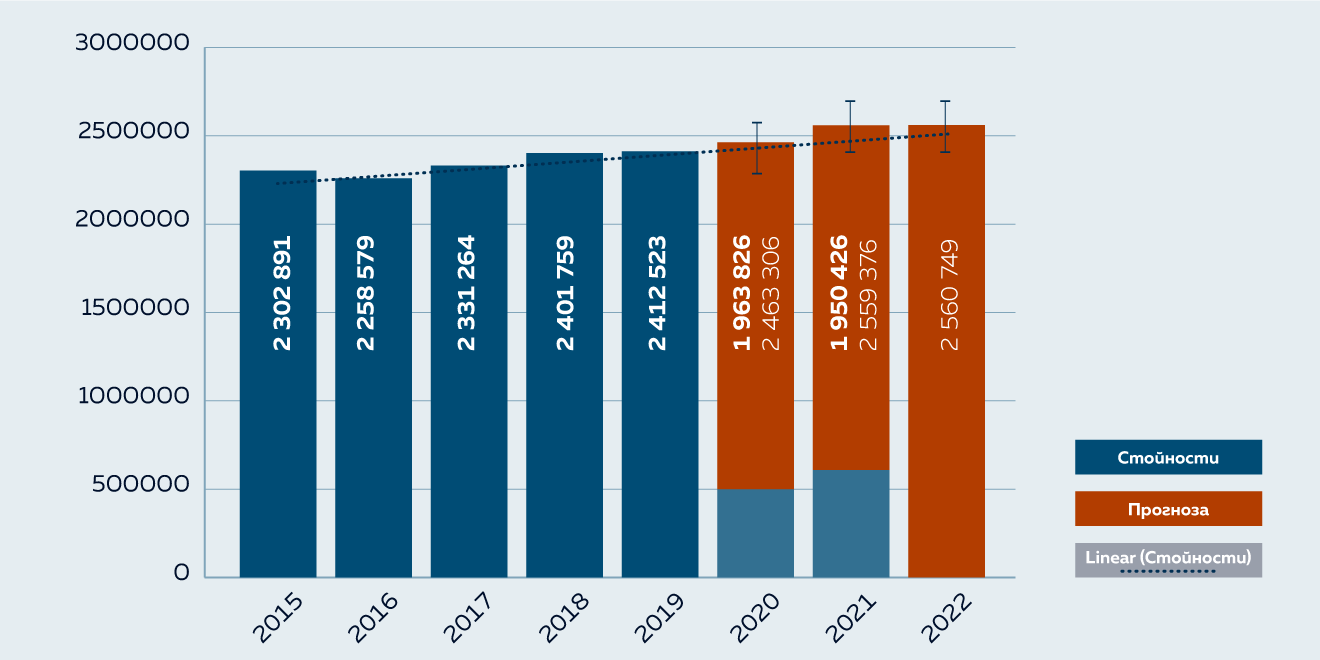
Figure 3 illustrates the reported hospitalization data and the results of our linear regression model. In 2020, the National Center for Public Health and Social Care reported a sharp decline in the number of hospitalized cases compared to the previous five years. We use the pre-COVID-19 pandemic trend to calculate the expected number of hospitalizations in the absence of a pandemic situation, or as we called it earlier in an “equilibrium environment” – 2.46 million cases. We compare this with the actual reported hospitalizations – 1.96 million cases – the delta between the two represents the effect of the COVID-19 pandemic for 2020 or 499 thousand cases (20%).
Due to the lack of data on the reported number of hospitalizations for 2021, we use the same methodology to model the expected number after the onset of the pandemic situation. Out of the expected 2.55 million hospitalization cases, our forecast shows 1.95 million for 2021, or a difference of 608 thousand cases (23%). These results are also consistent with the results of sociological surveys in Bulgaria and around the world.
Chart 3: Reported and projected hospitalization rates in inpatient units of medical institutions 2015-2022.
Source: NCPHA, own calculations
3. Cash flows from the National Health Insurance Fund (NHIF)
The third indicator for assessing the effects of the Covid-19 pandemic, which we will examine, is the planned and realized payments of the National Health Insurance Fund (NHIF) under two items - hospital medical care (HMC) and medical devices used in HMC. We use data obtained through a request for access to public information under the APIA.
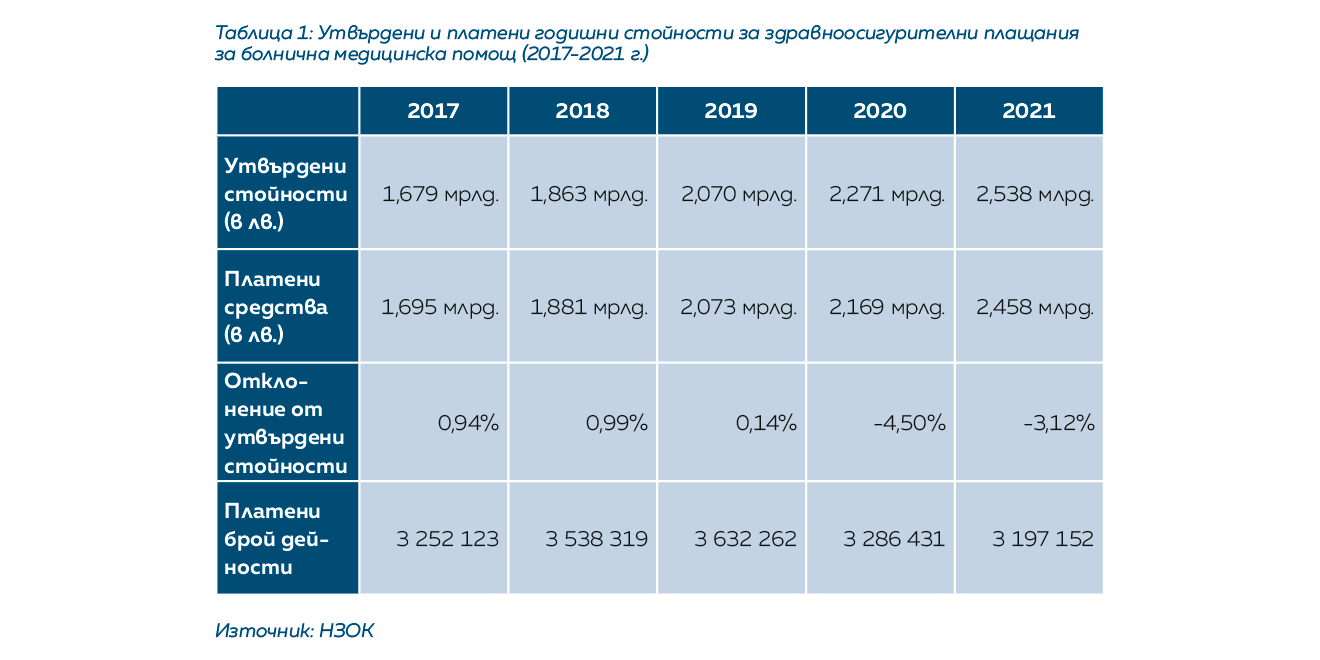
In Table 1, we track the annual values of approved and paid health insurance payments for hospital medical care for a period of time before and during the Covid-19 pandemic. For the years preceding the event (2017-2019), the reported deviation is less than 1% in a positive direction – overpayment above approved activities. In the pandemic period (2020-2021), we observe a significantly larger deviation in a negative direction – 4.5% and 3.12% for 2020 and 2021, respectively.
Table 1: Approved and paid annual values for health insurance payments for hospital medical care (2017-2021)
Source: NHIF
This is consistent with the data on a sharp decline in the number of paid activities, which decreased by 9.5% in 2020 compared to the previous year and an additional 2.7% in 2021 [7]. That is, we observe a decline in both the number of paid activities and the amount of funds paid by the NHIF. Both imply a significant amount of deferred consumption of health services, which we can try to quantify.
We calculate that the average number of paid activities in the period before the Covid-19 pandemic (2017-2019) is 3.474 million, in other words the decrease for 2020 is 187,804, and for 2021 – 277,083 or a total of 464,886 missed activities. Using the average price per activity performed in the specific years, namely – 660 BGN for 2020 and 769 BGN for 2021, we calculate that the value of missed activities is 123.9 million BGN for 2020 and 213.1 million BGN for 2021 or a total of 337 million BGN for the entire period defined as a “pandemic”.
It is difficult to determine how much of the foregone consumption of health services in the period 2020-2021 will be carried over directly to subsequent reporting periods. Unlike services such as restaurant visits, tourist trips, concerts, etc., health care is not about satisfying regular, elective needs. A visit to a medical facility is associated with problems that cannot simply “go away”, except when the patient dies. Moreover, the delay in diagnosing and treating such problems increases the complexity of dealing with them. In the absence of academic research that can quantify the two countervailing effects, we assume that they are zeroed out and the deferred consumption is carried over in full to subsequent periods. This valuation may be the next step in building on this analysis in other publications.
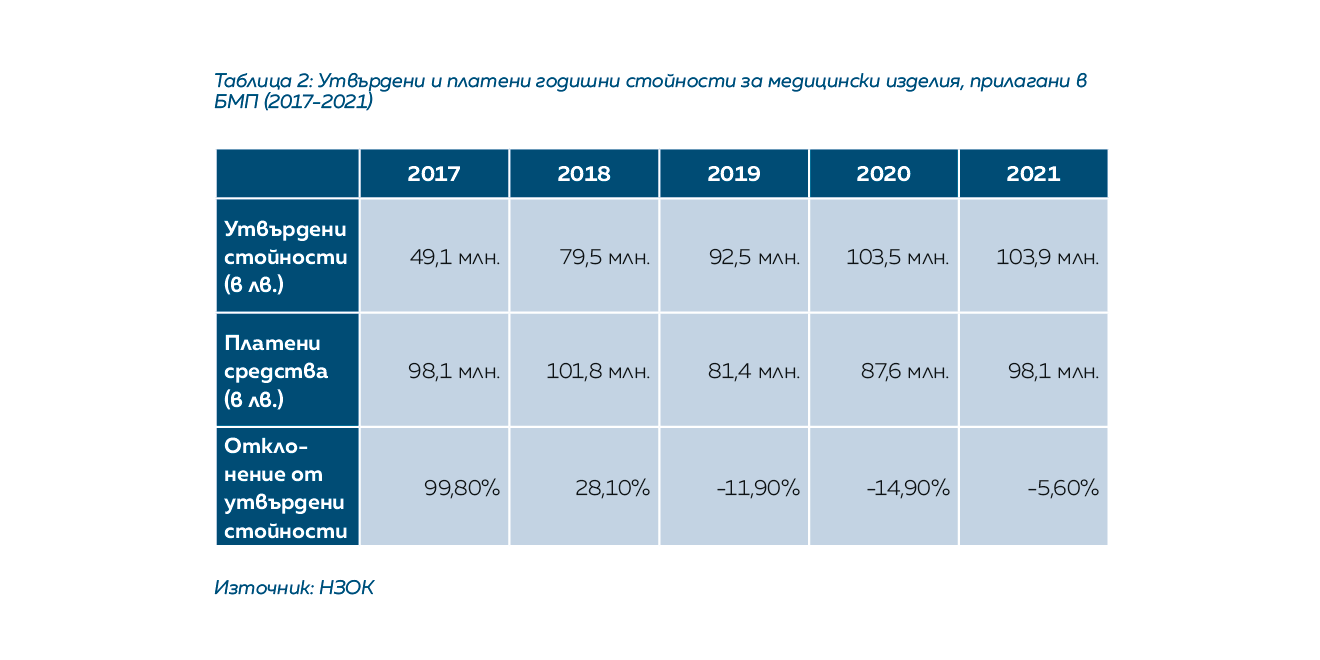
In Table 2 we have listed the values of the approved and paid medical devices that are used in hospital medical care and the corresponding deviations between planned and implemented. It is noticeable that the period under consideration begins with a huge, almost 100% deviation in 2017, part of it was compensated in 2018 and already in 2019 (before the onset of the Covid-19 pandemic) we see the opposite, non-implementation of the approved funds by 11.9%. Non-implementation in the first “pandemic” year 2020 worsens further and reaches almost 15%, and in 2021 it drops to 5.6%.
Table 2: Approved and paid annual values for medical devices applied in BMP (2017-2021)
Source: NHIF
It is important to note that between 2017 and 2020, approved funds more than doubled, with the data demonstrating an equilibrium consumption over the entire period of about 100 million leva per year. Obviously, from the available data, we can hardly draw conclusions that are relevant to the effects of the Covid-19 pandemic. For example, despite the pandemic restrictions, the funds spent on medical devices in hospital care in 2020 and 2021 are more than those in 2019. The explanation of this effect requires an explanation beyond the phenomena examined in this study.
4. Conclusion and results of health statistics
Our review of health statistics data confirms the results of international and Bulgarian sociological surveys on delayed access to medical care during the active phase of the Covid-19 pandemic in 2020 and 2021 and builds on them with a certain level of specificity.
- We predict over 2,300 undiagnosed cases of malignant neoplasms for 2020 and 2021.
- We report a 20% and 23% decrease in the number of hospitalizations for 2020 and 2021, respectively, or a total of 1.1 million fewer for both years combined.
- We report missed activities in hospital medical care in the amount of BGN 337 million for the period 2020 and 2021.
All other things being equal and in view of the above data, we can conclude that as a result of the delayed seeking of medical care during the Covid-19 pandemic, as well as the delayed return of patients to prevention, prophylaxis and treatment activities, a gradual increase in the incidence of untreated non-communicable diseases of social significance is expected in the coming years. Taking this information into account, the focus of health authorities should be on screening and financing of activities and medicines in order to overcome the negative trend of increasing incidence.
[1] Henley J, “Lockdown living: how Europeans are avoiding going stir crazy,” Guardian, March 28, 2020, theguardian.com.
[2] https://jamanetwork.com/journals/jama-health-forum/fullarticle/2774358
[3] https://www.kff.org/report-section/kff-health-tracking-poll-june-2020-social-distancing-delayed-health-care-and-a-look-ahead-to-the-2020-election/#:~:text=Notably%2C%20the%20March%202019%20KFF,counterparts%20to%20say%20they%20had
[4] https://www.cdc.gov/nchs/covid19/pulse/reduced-access-to-care.htm
[5] The impact of the COVID-19 pandemic on noncommunicable disease resources and services: results of a rapid assessment. Geneva: World Health Organization; 2020. Licence: CC BY-NC-SA 3.0 IGO.
[6] https://rctrend.bg/project/209684/
[7] Data on the paid number of activities for the months of September, October, November and December 2021 were obtained using the extrapolation method due to lack of available data.