EKIP– Expert Club for Economics and Politics A Different Opinion
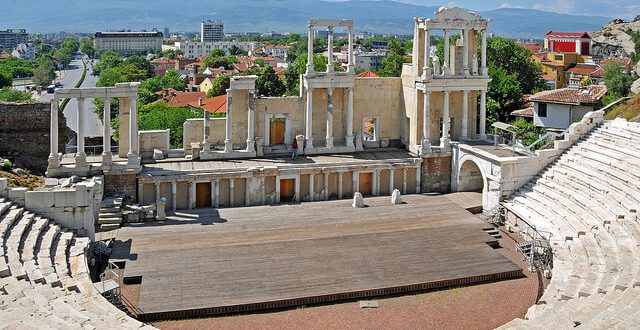
Or how foundations or other non-governmental organizations take care of cultural heritage around the world without government subsidies.
Capitalism and the free market are often criticized for issues related to products or activities that would not generate a profit on their own, i.e. they cannot exist limited to their own budgets with their own profit. For this reason, there are all the policies related to lobbying to increase funds for certain sectors - health, education, social services and the like.
The misconception about capitalism and culture
One of these areas is the preservation of cultural heritage. The thesis that funds should be allocated from the state and municipal budgets for cultural heritage is argued mostly in this way: no one will voluntarily give money for the preservation of cultural heritage, therefore the state should do it with tax money. The state should restore, maintain personnel, a bureaucratic apparatus, control bodies and educate experts, since no one else would undertake to do it.
However, this is refuted in many places around the world, where the entrepreneurial spirit is widespread, and economic development is sufficiently advanced. The confusion comes from the idea of the “free market” – that is, that everyone will necessarily seek maximum financial benefit and increase their profit under all circumstances. Practice shows otherwise – in the free market, without any coercion, donations, charitable actions and other financial investments are constantly happening, from which no profit is expected. In fact, donations are capitalism, as long as they happen voluntarily.
Anything that does not happen voluntarily between private owners is not a free market. Such non-market institutions have been created in most (but not all) countries to finance or work for the preservation of cultural heritage. They work with varying success – both local structures (for example, in Bulgaria the National Institute for Immovable Cultural Heritage) and global ones – UNESCO and its substructures related to cultural heritage.
There are many private organizations that preserve cultural heritage.
However, there are dozens of organizations on the free market – most of them operating as non-governmental organizations (foundations, associations, and others, according to the legislation of the respective country) – that also work to preserve cultural heritage.
Probably the largest and most prestigious such organization is the World Monuments Fund. It is financed entirely by private funds– donations and management of own capital – and its goal is to provide expertise, attract public interest and, above all, to finance restorations of sites all over the world. UNESCO also has a similar activity, which, however, through the so-called UNESCO Fund finances much less actual preservation of cultural heritage.
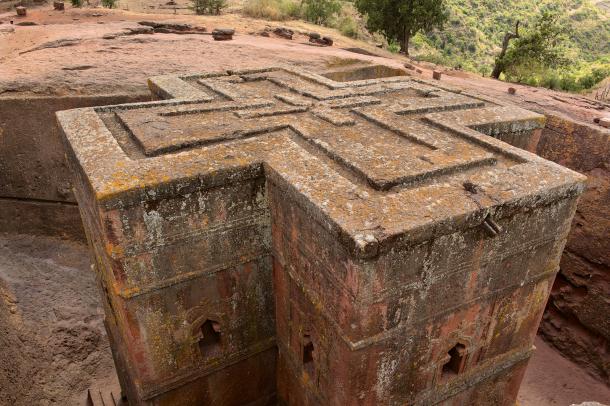
The Monolithic Church in Lalibela, Ethiopia, Restored with WMF Funding
The private WMF is run by a team of about 40 people, while the tax-funded UNESCO employs over 700. Since 1996, the WMF has worked on 790 sites, investing over $240 million in protection and conservation – or an average of $12 million per year. By comparison, the UNESCO World Heritage Fund invests $4 million per year.
These private organizations are doing better than state-owned ones
Both organizations publish detailed financial statements every year – UNESCO has long been at an increasing loss, while WMF usually grows. The private organization experienced some financial problems in 2016, when a huge donation from a major philanthropist was cut, but this only led to staff reductions and streamlining of work. Something almost impossible for any state or supranational institution.
An important difference between the two organizations is the approach to heritage itself. While at UNESCO everything happens rather clumsily and policies from 50 years ago are still used, at WMF they have a very up-to-date view – in the sites affected by UNESCO you will not find some of the sites that WMF deals with – for example, buildings with modern or postmodern architecture.
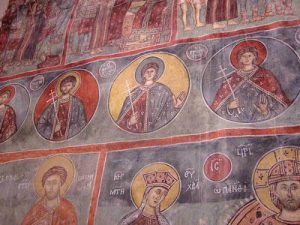
Frescoes in the church of St. Dimitar near Boboshevo, over which a protective covering has been built and the frescoes have been restored, also funded by WMF
The German Deutsche Stiftung Denkmalschutz has received donations and invested over 500 million euros over the past 30 years (since its establishment in 1985). During this period, thousands of cultural assets have been carefully restored, and the organization also works actively to educate young and older audiences and to promote this cultural heritage.
A similar foundation – much more narrowly specialized and with a smaller scope – is, for example, the Chicago Architecture Foundation. Created in the 1960s with the specific idea of saving the valuable Glessner House from demolition, it has developed into a fairly large organization that today researches and promotes the entire diverse architectural heritage of Chicago. CAF is not specifically involved in financing restorations. However, the foundation works actively to promote the architectural heritage among both locals and tourists – organizing various interesting initiatives. Until 1994, CAF also managed the Glessner House, which was saved from demolition, as a private museum.
State intervention in the preservation of cultural heritage is completely unnecessary
What unites all these organizations (and these are just a few examples – in fact, there are hundreds of them in every capitalist country) is that they are made up of enthusiastic people who do what they love the most. They are not bureaucrats who have to monitor whether a certain point or paragraph of the regulation is complied with, they are not dictators who determine what is legal and what is not. They are free people who love cultural heritage and make sure that it is preserved in the best possible way – and not in the way described in a given, usually outdated regulation. And so the preservation happens both faster (freed from bureaucracy) and better.
The good news is that even in Bulgaria - a country that is quite backward, both economically and in terms of entrepreneurial spirit - similar organizations are also emerging. One such is the Daskal Brunzalov Foundation of architect Kristiana Brunzalova. Instead of waiting for cumbersome bureaucracy, the Foundation will provide financial and expert assistance for the restoration of old houses in the Rhodope Mountains - forgotten by any authority or institution.