EKIP– Expert Club for Economics and Politics A Different Opinion
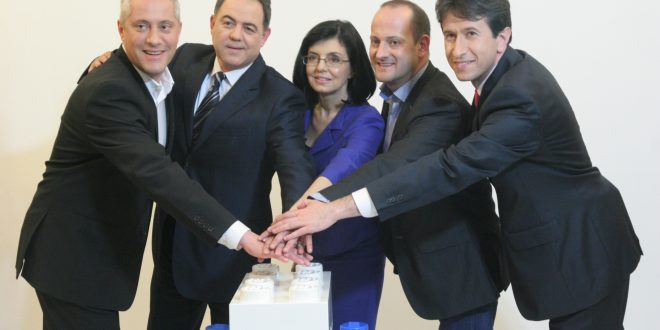
I recently read this article, written by a member of the UDF. The author reflects on the question of who the “right” can unite with, in particular the UDF. The article reads like a manifesto of impotence. The currently fragmented “right” is not a significant enough factor, even if it manages to unite itself without losing half of its membership and sympathizers as a result of “historical compromises” for the purpose of unification, to expect anyone to take it seriously enough to want to unite with it.
The "right" cannot afford the luxury of ruling out potential unification partners, which the author does in the first 3 paragraphs. The "right" must first put its own house in order before expecting anyone to take it seriously and want it as a partner.
The "right" has already compromised itself
The author correctly notes that the choice between GERB and BSP is a false dichotomy. “Vote for us so that the others do not win, we are their only alternative,” both parties claim. This model must be broken, the weight of both parties in Bulgarian politics must decrease. This can only happen if alternatives emerge that can gather enough support and not cling to one or the other when the parties in question win a majority. The problem is that the “right” has already participated as a coalition partner of GERB in one cabinet, and it will not happen soon that the UDF, or the “right” in general, will govern independently.
As for the patriots, it turns out that the easiest way to deradicalize someone is to throw them into the jazz of governance. The same thing happened with Trump and the patriots, who once found themselves in a governing coalition with a larger partner, became significantly more moderate, thus losing the support of those of their supporters who supported them precisely because of the radical rhetoric. The practice of governance turns out to be more moderate than the rhetoric. In the last sentences, I roughly quoted reasoning from the pilot episode of the EKIP podcast “60 Minutes for Freedom”.
The voter has already created the feeling that the "right" is capable of abandoning any principle and entering into any agreements and arrangements with any partners in the name of the coveted 4% and possible participation in power. Strange times bring strange loyalties and strange fellowships, I say more and more often. Even the UDF has already toyed with the possibility of joining the United Patriots.
The UDF's unrealistic expectations
The author predictably believes that the unification of the UDF should be with other “right-wing” parties, and that the UDF should be at the core of the future unification. That is, a new attempt is underway to build a new brothel with old blood (forgive my French), or to sew a new Frankenstein monster with white threads from blue corpses. I particularly like these analogies about the unification on the “right”, and they fit him quite well. There is talk of a humility, in the form of the return of the prodigal parties under the wing of the mother party, the UDF, under its banner, and even under its name.
The author speaks of setting aside differences and making new “historical compromises”. The remaining “right” parties are invited to set aside their feelings for Bozhidar Lukarski, whom no one except his close associates likes, and has rather become ridiculous to the voter with his claims that the UDF should retain the office that is due to parties and coalitions that have overcome a certain threshold in parliamentary elections. Not to mention that he is far from inspiring either trust or loyalty, much less showing humility and a tendency to compromise, as he expects from others.
The UDF is not a significant enough factor to dictate things on the “right”. Even as part of the Reformist Bloc and in a coalition with Glas Naroden, they barely managed to surpass 3%. Before demanding compromises from the other right-wing parties, they must be ready to make them first, and understand that Lukarski simply is not liked by anyone, and that they will not be able to dictate the terms in a new attempt to unite the “right”. Hristo Ivanov is called the leader of an Indian, but this definition also applies to Lukarski. If the UDF is not a leading party, as the author claims, then why is it so difficult for them to give up Lukarski in the name of unification with other “right-wing” parties?
None of the "right" parties is ready for unification
It is also about reaching out to "Yes, Bulgaria", which should first be defined ideologically, as the possibility of their acceptance into the coalition exists regardless of where in the political spectrum they will stick, on the left or on the right, and this is the only place in the article where I do not put the word "right" in quotation marks. As if such a "right" coalition is created with a left "Yes, Bulgaria" in its composition, we will witness a neither left nor right turlyguyvech, which will again alienate a significant part of the members and sympathizers that the parties participating in it would have separately, due to the differences between them, and the impossibility of smoothing them out and overcoming them.
Because all potential participants in this future coalition know one thing, they are tired of one thing. And the UDF in this future coalition, together with the entire RB and "People's Voice", does not represent a much bigger factor than "Yes, Bulgaria", together with the "Greens" and DEOS, to set conditions for them. In any case, somehow I do not see either "People's Voice", nor DEOS, nor the "Greens" in such a coalition. They are not even mentioned by the author, although their total election result is about 2%, of which a future "right" project hardly has the luxury of depriving itself. Any future broad unity on the "right" will have to find a way to either include these parties in its composition, without alienating a large part of their and significant parts of their own sympathizers, or taking away from their voters for its own benefit.
The next unification on the "right", if it ever takes place, will again be stillborn. Otherwise, the five principles outlined in the program with which this future unification would emerge (included in the cited article) are all things I would support. Language.