EKIP– Expert Club for Economics and Politics A Different Opinion
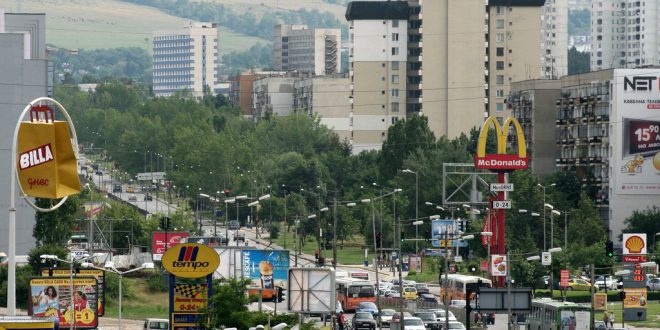
The Sofia neighborhood of Mladost has become a center of what American political scientists call grassroots activism. Starting with the election of the controversial and currently indicted Desislava Ivancheva as district mayor in October 2016 – through the support of local committees and gravitating activists of small urban parties in opposition to the political status quo.
Continuing to this day, when weekly protests are held in the neighborhood with mandatory closure of main roads, new political forces are gaining momentum and organizing successful external meetings in Mladost 2, and dissatisfaction with the overall work of the Sofia Municipality is accumulating.
At the forefront of active youth discontent are the former “greens” and currently loyal praetorians of Ivancheva from the association “For Green Youth”. At the beginning of the month they published an open letter to Mayor Fandakova and Chief Architect Zdravkov, setting out specific demands. As a resident of the neighborhood and an economist, I want to comment on them because of the greater ideological load they carry, unlike slogans [1] such as “Freedom for Desi and Bilyana”, used at various protest rallies.
Let's go through the requests in the letter:
- "Carrying out inspections by the Sofia Municipality of all procedures under which properties within the boundaries of the Mladost District have been restored or sold over the last 20 years;"
First of all, the activists either used the word “property” incorrectly, or they decided to conduct a complete audit of the Transition at the level of a single residential complex. The usual definition of property does not include only plots of land. The requested audit will cover all kinds of transactions with apartments, commercial and office space. In other words, we are literally talking about an audit of thousands of purchase and sale transactions. For example, an elderly relative is retiring, his family is selling the studio apartment in Mladost 4 – whoops, the Ivanchevites are conducting an audit.
Even if the authors had something narrower in meaning in mind, conducting "inspections" and "revising" wholesale some already historical market and political processes is a high form of populism. And as with the proposals for reviewing privatization, which we heard from the government some time ago, they can be used mainly as a political club, not as an instrument of justice. If, after all, "For Green Youth" has serious data on abuse in specific deals, let them focus on them. It is always easier to say - we will beat the bad kulaks [2].
- "In parallel with the inspections, we ask you to issue an Order for the admission of a development procedure to update the current comprehensive detailed development plans of Mladost 1, Mladost 1A, Mladost 2, Mladost 3, Mladost 4, Gorublyane and Polygona, defining and reflecting the living spaces that citizens use. These living spaces must also include an adequate buffer zone that does not allow construction in the immediate vicinity of playgrounds and recreational facilities. Existing parking lots and border areas of parks should not be built on, parks should have free access from residential complexes, and not be densely built around them. Private properties that fall into people's living spaces should be regulated for wide public use, so that they are subject to expropriation;"
Through several long leaps in logic, the activists develop their theory to justify the violent seizure of someone else's property. If we translate what is written in the paragraph, it sounds like this: if someone parks their car, takes their dog out, or hatches seeds on a piece of land, that piece of land is their living space and is subject to nationalization by the authorities.
If the socialist state has allocated a grandmother and grandfather to live in a panelka, on part of the land of the people of Gorublyan, I have the right to use the other, undeveloped but restituted, land as my living space – i.e. to have no neighbors to bother me. I personally witnessed the ultimate application of this absurd logic when the residents of a newly built block of flats in Mladost 4 protested against the construction of a twin block of flats to theirs, by the same company, next door.
There is no right to a view or a right to free parking. The sooner we understand that we cannot and should not receive something forcibly seized from others through political means, the sooner we can focus on arranging and negotiating public space so that it works for everyone.
- "Immediate suspension of construction activities in the park next to the Lidl store in Mladost 3. The investor should be offered equivalent municipal land in a conflict-free location. Cancellation of the planned 8-story building and two retail outlets in the park next to Lidl. Preservation of the park in its current form and its inclusion in the Green System of the Sofia Municipality;"
The area next to the Lidl store in Mladost 3 is not a park, neither in terms of regulation nor in appearance. It is a large space between two boulevards, covered with grass, which was gradually built up over the years - first with car repair shops and tire shops and then with a large new supermarket. In the area next to the supermarket (according to information from residents there), Lidl built a playground with benches, which are currently popular among mothers with children.
The enclosed space for new construction does not affect the site, but it is understandable that people would like to keep it after the full implementation of investment intentions (which according to plans also include more shops). However, this can hardly be achieved by demanding that someone's land be forcibly taken and put into the Green System. The position: "You made me a children's playground, I liked it very much, so the land is no longer yours" - is not moral or heroic, but impudent and unproductive.
- "Construction should not be allowed in the inter-block spaces behind block 320, near block 20, near block 70 and in all conflict areas where civil discontent arose"
Civil discontent is a very poor criterion for stopping construction. We can hardly expect satisfaction when some people had free access to a (foreign) resource and this access is terminated. Until yesterday I parked in the clearing next to us, from tomorrow I can no longer do so, and I have new neighbors coming. In general, making a decision on such a ban will only create more incentives for conflicts and for politicizing the issue.
Here we should not remain uncritical of the owners and builders themselves. Quite a few landowners neglect their land and leave it in a deplorable state, which in itself can create problems for neighbors. Builders in recent years have also repeatedly shown that they are able to be extremely sloppy and destroy public space (especially those who work for the Sofia Municipality). And yet, confiscation of property due to dissatisfaction should not be among the political tools of the 21st century.
Citizens have a legitimate interest in any change near them, even in many places around the world there are associations specially created for this purpose, defending a common vision for the development of cities and neighborhoods. In the case of Mladost (and other parts of the city), there are decades-old problems such as traffic, parking, and neglected inter-block spaces, but their solution will not be found through over-politicization or green nationalization. And there is no need, because of incompetent management, to cross out a basic civilizational value such as private property.
[1] "Bilyana" refers to the deputy mayor of the Mladost District, Bilyana Petrova, who was arrested along with Desislava Ivancheva for accepting a bribe.
[2] Ironically, many residents of Gorublyane had their lands nationalized by the communist government precisely to dispossess them. To this day, the municipality plans to build a park on the same land – by force, while large office buildings are planned for the municipal land. This is the drama of the so-called “Iztok” park in a nutshell.