EKIP– Expert Club for Economics and Politics A Different Opinion
October was another month in which the TEAM actively participated in the public debate in Bulgaria. Our experts were sought after by the media on a variety of political and economic topics, and our report calling for the abolition of the corporate tax enjoyed particular interest.
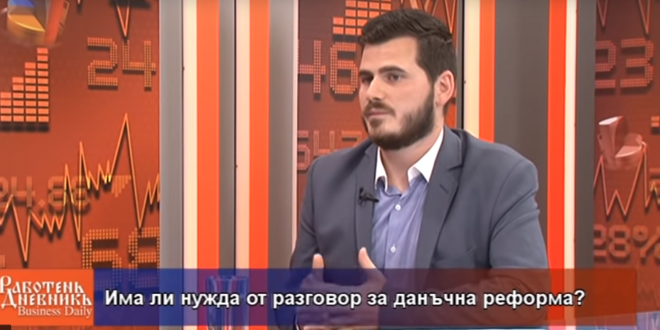
In the first week of October, our proposal to abolish the corporate tax on retained earnings, prepared by Stefan Stoyanov, was presented. On the very day of the press conference presenting the report on BTA, Stoyanov appeared on the air of the Bulgarian National Radio and TV Europe. He explained to viewers and listeners that the corporate tax is not only harmful to the economic environment in Bulgaria, but also unfair.
In the same week, EKIP health expert Arkadi Sharkov took part in “Referendum” on BNT. In the popular publicistic show, Sharkov listed the shortcomings of the state-launched models for healthcare reform. He advocated for a third approach to reform, which includes reducing the contribution in order to establish a free insurance market and demonopolizing the NHIF.
The week ended with the participation of the editor-in-chief of EKIP Georgi Vuldjev in the show “Q&A with Klara Marinova”. On the air of BG On Air, together with political scientist Dimitar Ganev, they discussed the inability and unwillingness of the government to solve the problems of Bulgarian citizens, the financial and political commitments of the state budget and the problems with the lack of adequate opposition to the status quo.
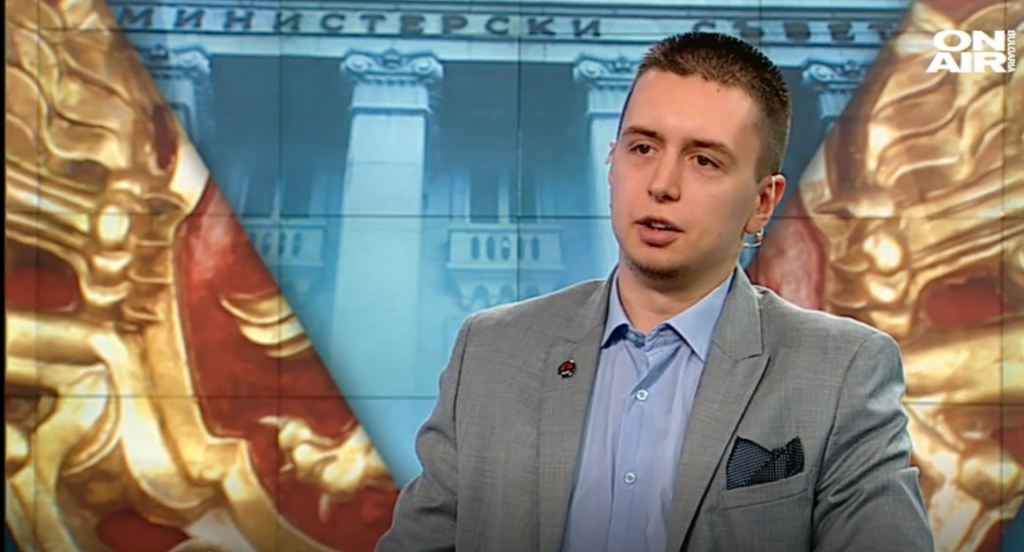
Media interest in the EKIP proposals to abolish the corporate tax remained high over the next two weeks. Our economist and author of the report proposing tax reform Stefan Stoyanov presented his arguments in the pages of the newspaper Trud and the newspaper Sega . In addition, Stoyanov was invited to the TV Europe studio to discuss taxes, the tax burden and public spending together with Georgi Harizanov from the Institute for Right-Wing Politics, the editor-in-chief of money.bg Georgi Minev and the financier Preslav Raykov. During the discussion, our economist emphasized that although we have economic growth, Bulgaria lags significantly behind other similar post-socialist economies.
In the last weeks of October, the expertise of the editor-in-chief of EKIP Georgi Vuldjev was sought on a variety of economic topics. On the air of Channel 3, he commented on the incomes of Bulgarians, the problems of the pension system and the necessary reforms in the field of public finances together with the chairman of the Association of Industrial Capital in Bulgaria Vasil Velev. Vuldjev pointed out that the government's fiscal policy is being pursued piecemeal, with the main focus seeming to be to mitigate the pressure from various interest groups - unions, pensioner organizations and others. In front of the audiences of TV Europe and Bulgaria On Air, he criticized the draft budget proposed by the government, indicating that it de facto maintains the current fiscal irresponsibility by only raising the salaries of civil servants without carrying out the necessary structural reforms and without creating fiscal buffers for a future financial and economic crisis.
In October, our experts were also consulted on European issues. In the program “Crossroads” on VTK , Georgi Vuldjev commented on the conflict between the European Commission and the Italian government. He warned that we are in uncharted waters, as this is the first case in which the EC refuses to accept the budget plan of a national government. And on Channel 3, EKIP political analyst Kaloyan Pravov discussed the future of the EU together with Kristijan Škvarek from the Youth Conservative Club. The two agreed that the accelerating federalization of the EU is an extremely negative phenomenon and argued whether the rising nationalist wave in Europe is a positive reaction to it. According to Pravov, some of the dimensions of this phenomenon carry great political risk, since extreme nationalists would hardly be able to offer a workable alternative vision for the EU.
The organization’s chairman, Stoyan Panchev, also took an active part in the public debate during the month. The newspaper 24 Chasa took advantage of his economic expertise by publishing his analysis of the size of the middle class in Bulgaria. According to Panchev, our middle class is thinning and is not well represented politically, as politicians prefer to satisfy the interests of other groups at its expense.
Urban planning was another area in which Panchev’s opinion was sought. Readers of the Trud newspaper got to know his views on the problems of the Mladost neighborhood. In the article, he criticized the administration of Desislava Ivancheva and her activists, pointing out that their demands would only worsen the situation in the neighborhood. And in the BTV news, journalist Rumyana Stoilova discussed with him the expansion of the green parking zone in Sofia and the serious traffic problem in the capital. Panchev pointed out that the solution to this problem is to apply market principles and for prices to begin to correspond to the demand and supply of parking spaces.