EKIP– Expert Club for Economics and Politics A Different Opinion
Author: Murray Rothbard, Mises.org
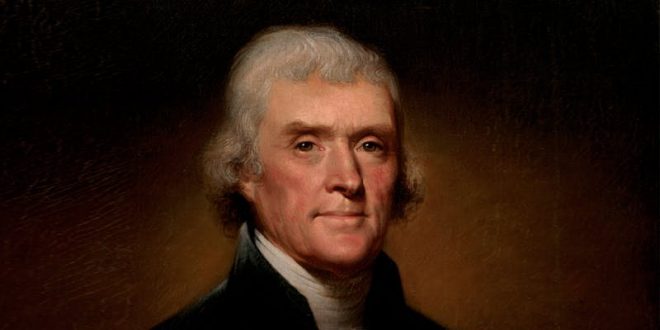
Jeffersonian or Alexander Hamiltonian? Every student, indeed every literate person in the United States, is expected to take sides and join one of two camps in the Great Debate. Most people today consider themselves Jeffersonian. Groups as diverse as the States Rights movement (the so-called “Dixicrats”) to even communists see themselves as the intellectual heirs of Thomas Jefferson. Conservative Southerners call themselves “Jeffersonian Democrats,” while the nation’s leading revolutionary Marxist school is called the Thomas Jefferson School of Social Science. Amid this maelstrom of confusion, it is particularly difficult to pin down a true portrait of Jefferson as a person and political philosopher.
A puzzling mosaic
The analysis of Jefferson's views is further complicated by the complexity of his personality and career. A man of brilliant intellect, deeply interested in all spheres of human thought and knowledge, from economics to architecture to scientific agriculture; active, dynamic, and devoted to multiple callings; and of course, a political leader for most of his life—there is no way that unraveling the personality and thought of a man who was all of these and more would not present an extremely complex mosaic for historians. Politics itself is a daily occupation that, by its very nature, requires the one who practices it to make a number of compromises. Thomas Jefferson combines the characteristics of a great intellectual spirit in search of eternal political principles, of a constantly busy and pragmatic man, and of a political leader. When we also remember that Jefferson dominated the scene during the most important years of the Republic (the Revolution, the creation of the Constitution, the growth of the Republic, the War, etc.), it becomes clearer why so many groups with contrasting views and goals like and choose one or another part of his life and intellectual legacy to cite in support of their own goals.
A simple scratcher?
But to the unbiased historian, the principles of Thomas Jefferson are self-evident and crystal clear. His political philosophy is deeply embedded in the very soul of America, and his personality and thought have left their mark on the minds of countless Americans of the generations that followed him. His achievements are mocked and ignored by Hamilton's followers both during his lifetime and today. Hamilton, they argue, was a constructive and pragmatic man. A man of action. He financed the national debt, reformed the administration, founded the national bank, and so on. Jefferson was simply a scribbler and the author of good-sounding phrases. These "pragmatic men" do not realize that the forces that generate human action and, accordingly, the movements of the historical process are, for better or for worse, ideas. It is ideas - in the spheres of politics, economics, ethics, aesthetics, religion - that are of decisive importance for human action in the present and in the past. It is foolish to claim that Hamilton's financial measures were of greater or even comparable importance to the Declaration of Independence or the Kentucky Resolution.
The battle between Jefferson and Hamilton is of great importance, however, precisely because it represents a clash between two fundamentally opposed sets of political principles. Jefferson’s political philosophy can be summed up in the phrase: “That government is best which governs least.” It finds its clearest expression in his Declaration of Independence: God has endowed man with certain natural rights; “to secure these rights, governments are instituted among men, deriving their just powers from the consent of those governed.” And when government ceases to serve this end (the securing of natural rights), citizens have the right to change the form of government to a more suitable one. Accordingly, Jefferson, as John Locke had done a century before him, dramatically shifted the moral focus from the state to the individual. During the absolutist and earlier feudal eras from which the world was then emerging, divine right had focused exclusively on kings and the aristocracy. In short, the state and those who govern it. For Jefferson, God grants natural rights to every individual, not just to those in power.
Jefferson's Great Lesson
What are these natural rights? The fundamental right from which all others follow is the right to life. Every individual has the right to live without violent interference from others. To live, one must have the freedom to work and own property, to “pursue one’s happiness.” In a political sense, the most important natural right is that of self-defense—of one’s life, liberty, and property—from attempted encroachment. In this context, the function of the state and its executive organs, represented by the government, is to use its power to prevent and combat attempts at such encroachments on society. If the state expands its power beyond this human rights-protecting function, then it becomes a tyrant and the greatest threat to those same rights. Because the state has a virtual monopoly on violence, its potential for inflicting harm on its citizens is far greater than that of any other institution or individual. People must constantly watch that the power of their governments is small and confined to the local level, and even then they must keep a close watch on it. This is Jefferson's great lesson. A lesson that all Americans today should remember.
The rest of Jefferson's political philosophy is easily deduced from this basic cornerstone. It explains his passionate defense of States' Rights throughout his life, his determined opposition to John Marshall in the latter's successful campaign for a "more elastic" Constitution to allow for greater expansion of federal power, his skepticism of the Constitution itself, and his insistence on including a Bill of Rights.
Jefferson's position on foreign policy has the same root. He does not believe that our government, or any government, is capable of remaking the whole world to our liking. Of course, he was a thorough patriot, whose natural love for the land of his birth was heightened by the fact that America represented the Great Experiment in Liberty. His foreign policy may be summed up in his classic phrase: "Peace, Commerce, and Honest Friendship with all Nations, without any Binding Alliances." His well-founded distrust of the covert imperialism of Great Britain is especially pronounced.
The fundamental division
In the economic sphere, Jefferson was not an anti-capitalist, as his opponents claimed. He believed in true entrepreneurial freedom, unencumbered by government regulation or the granting of government monopoly privileges. His opposition to paper money and central banking was based on his astute understanding of the then-emerging science of economics. Jefferson's almost unknown writings on banking, money, and economic depressions demonstrate that his intellectual level was a head above that of his "pragmatic" opponents. What was later interpreted as anti-capitalist rhetoric was simply an expression of Jefferson's personal preference for agrarian life and antipathy to urban life.
The significance of the Jefferson-Hamilton clash is unfortunately obscured. It is a clash that, in one way or another, has forever scarred our country and has continued to influence its history since its founding. Hamilton and the Federalists believed in the ever-expanding power of the federal government, multiple state regulations, forms of control and special privileges in the economic sphere, the crushing of the independence of individual states, and the limitation of individual rights. Their ideal was Great Britain - a strong monarch who ruled the country in the name of the "common good"; in the absence of such a monarch, a strong president could act as a benevolent despot.
In foreign policy, the Federalists viewed the British Empire as a friend and ally. Hamiltonian federalism was, in one fundamental sense, anti-American; it represented a conscious return to the British imperial model, preserving typically European forms of strong central government and a semi-socialist "planned economy." Our Constitution was created as a compromise between the followers of Jefferson and Hamilton, with James Madison playing the role of the eternal mediator between the two camps. The rhetoric and the specifics may differ, but the fundamental conflict remains unresolved on the American stage.